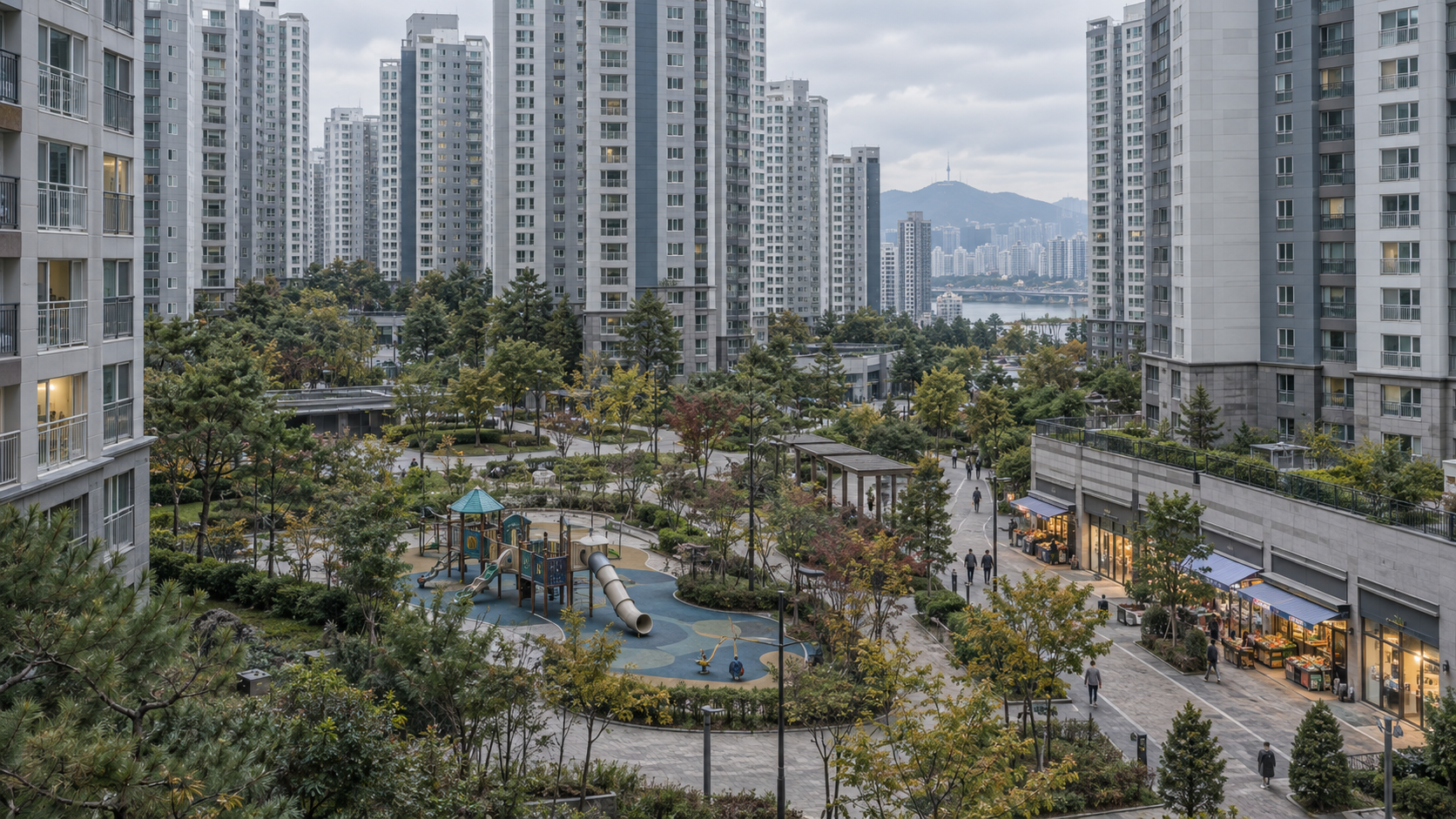
Apartments are popular in South Korea because they combine efficient high-density housing with predictable management, transport access, school districts and strong resale markets. Decades of apartment-led urban development also turned them into a major store of household wealth.
| Factor | Why it matters |
|---|---|
| Rapid urbanization | Large complexes supplied housing quickly |
| Standardized management | Security, repairs and shared facilities are bundled |
| Transport and schools | Infrastructure often develops around major complexes |
| Financial systems | Presales, mortgages and jeonse connect housing to family finance |
| Resale liquidity | Standardized units are easier to compare and trade |
How common are apartments in South Korea?
The 2024 Population and Housing Census counted 12.97 million apartments, equal to 65.3 percent of all housing units. It also found that 53.9 percent of general households lived in apartments. The two percentages measure different things: housing stock and resident households.
Why did Korea build so many apartment complexes?
Industrialization and migration into cities created urgent demand for housing. Large, standardized complexes allowed public agencies and private developers to supply many units while coordinating roads, utilities and services.
Apartments also suit Korea’s dense cities and mountainous terrain. High-rise development places many households near transit and jobs, although it can produce repetitive landscapes and concentrate redevelopment pressure.
What makes a Korean apartment complex distinctive?
Many complexes function as managed neighborhoods. Residents may share security, parking, playgrounds, landscaping and community facilities. Unit sizes and layouts are standardized enough that buyers can compare prices across buildings.
This predictability matters in resale markets. A detached house may have unique land, maintenance and construction conditions. An apartment unit in a known complex is easier for buyers, banks and brokers to evaluate.
Why are apartments linked to education and status?
Addresses can determine access to local schools, and families often connect particular districts with educational opportunity. A complex name can therefore signal location, price and school access at once.
The strength of that signal varies by city and household. It should not be treated as proof that every resident chooses housing primarily for status.
How do jeonse, presales and reconstruction shape demand?
Jeonse is a rental arrangement based on a large refundable deposit rather than ordinary monthly rent. It has historically allowed landlords and tenants to use housing as part of their financing strategies, although deposit risks have become more visible.
Presale subscription systems give eligible households a route to buy new apartments before completion. Reconstruction can add expectations of future value to older complexes. Together, these systems make an apartment both a place to live and a financial decision.
The OECD’s 2026 review of well-being in Korea notes that high purchase costs and jeonse deposits contribute to household borrowing pressure.
Does every Korean prefer apartments?
No. Preferences differ by age, household size and region. One-person households frequently live in low-rise multi-unit buildings or studios, while rural households may prefer detached homes. Apartments dominate the national stock, but they do not describe every Korean housing experience.
FAQ
Why do Korean apartments look similar?
Standardization reduced construction costs, accelerated supply and made maintenance and resale comparison easier.
Are Korean apartments mainly homes or investments?
They are both. Most are lived in, but housing is also a major household asset and price expectations influence purchasing decisions.
What is jeonse?
It is a Korean rental system in which the tenant provides a large refundable deposit, usually with little or no monthly rent. Contract terms and risks vary.
Why do school districts affect apartment prices?
Families may pay more for access to sought-after local schools and private-education districts, adding educational demand to ordinary housing demand.
A preference built by a system
Korean apartments are popular because the country placed housing, services, education and finance around them. Describing the result as an obsession hides the institutional reasons the choice often makes sense.