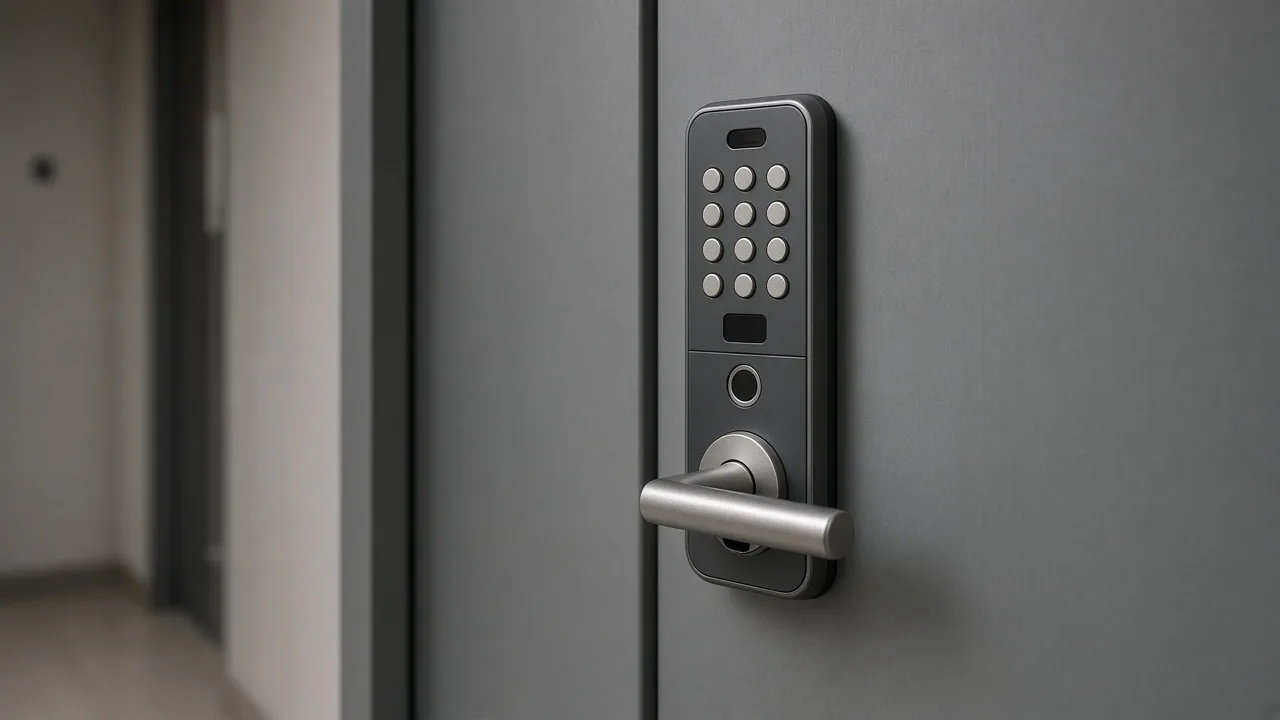
Korean apartments use keypad door locks because three things lined up: most people live in standardised apartment complexes, tenants move often, and a code is easier to reset than a key is to replace. According to a report by the Korea Trade-Investment Promotion Agency (Kotra) cited by the Korea JoongAng Daily in October 2026, about 80% of Korean households use a digital door lock, compared with about 40% in Japan, 35% in Europe and the Americas, and 14% in China. Ask a Korean when they last used a house key and many will have to think about it. This guide explains where the keypad door locks came from, why apartments made them standard, how families and delivery drivers use the shared codes, and what the safety questions are.
Where the Korean keypad door lock came from
The origin story is a theft. The JoongAng Daily reports that a software engineer at Daewoo Electronics’ research lab, Ha Jae-hong, read a news story about a woman who stole around 500 million won from upscale saunas in Gangnam using copied keys. He imagined a lock whose code changes every time it opens, so a copied key would be worthless. He founded a company in 1997, which was renamed iRevo in 2001 and makes the Gateman lock. Korea’s lock industry says the country was the first to commercialise the technology, the article adds.
The first adopters were not ordinary homes. A January 2003 JoongAng Daily report on the door lock market described a boom linked to luxury apartments. Hyundai Engineering and Construction had fitted digital locks in 20% of the apartments it built that year and planned to fit a digital or fingerprint lock in apartments from the following year, while Samsung Corporation planned fingerprint locks for medium and large apartments. The same report said the lock market, then about 20 billion won, could reach 400 billion won in a year as the technology progressed. That was a projection, not a result, but it shows what builders and manufacturers were betting on.
In 2004, the industry estimated that about 18% of Korean homes had a digital lock and projected 51.4% by 2006. Most newly built apartments were already installing them. Older rental housing took longer. Lee Eun-hyung of the Korea Research Institute for Construction Policy told the JoongAng Daily that many studio apartments near universities still had keys until around 2004 to 2006, and that digital locks spread widely, “even to ordinary houses”, from the 2010s. Prices fell, too: he said the cheap models cost under 100,000 won, and some only tens of thousands.
Why apartments made keypad locks standard
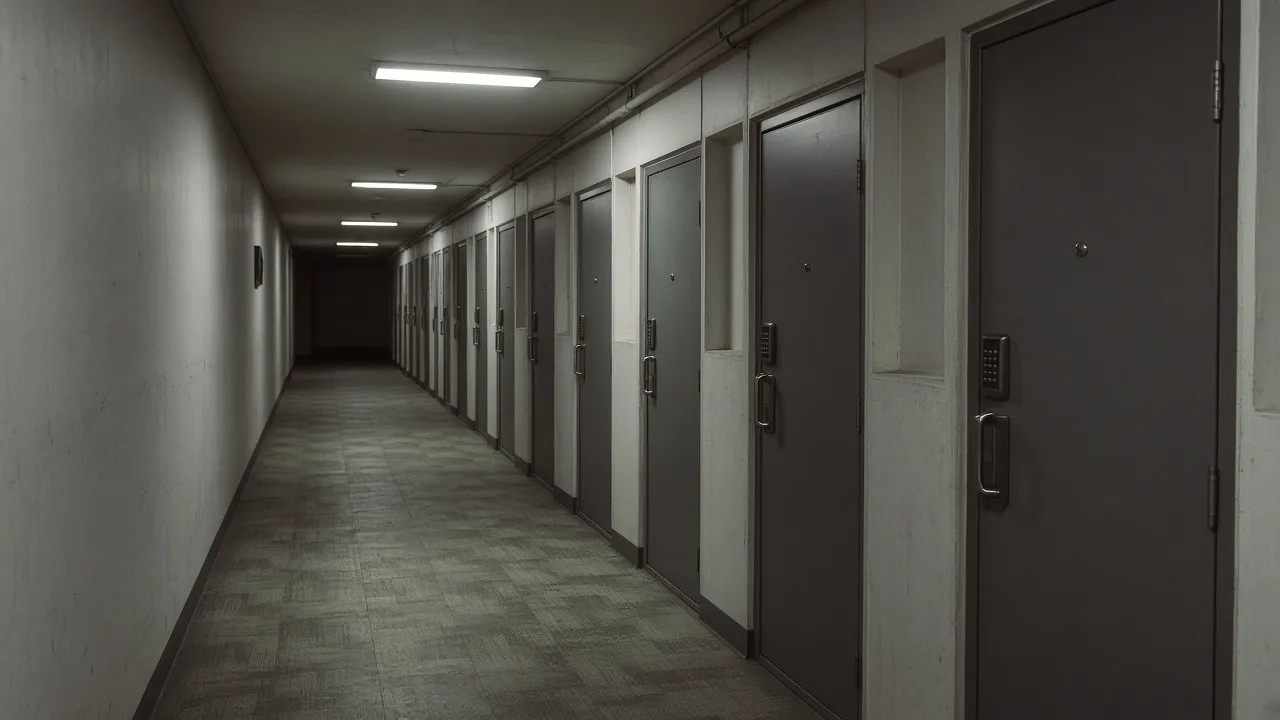
Housing explains most of the story. Apartments were 65.8% of Korea’s 20.18 million homes in 2025, according to the Ministry of Data and Statistics (as cited by the JoongAng Daily). Jung Heon-mok, an anthropology professor at the Academy of Korean Studies who has studied Korean apartment complexes, told the paper that apartments are a highly standardised form of housing, supplied by the hundreds or thousands of units at once with set specifications, so “once a particular fixture is adopted, it can quickly settle in as a kind of standard feature.”
That standardisation shows up in small details. Korean digital locks use standard hole positions and sizes on the door, so a replacement fits without new drilling. The Korea Consumer Agency noted this when it tested ten digital locks bought from AliExpress in 2025: all ten had drilling specifications that differed from the Korean standard, which meant extra installation costs and a door that had to be restored to its original state when the tenant moved out.
For the wider story of why Koreans prefer apartments in the first place, see why apartments are so popular in South Korea and the comparison in Korean vs European apartments.
The keypad as a sign of a new building
The keypad is also a status marker. In July 2026, buyers visiting a model home for a new Hoban Construction complex in Gimpo, due for move-in in 2030, found standard key locks on the front doors. Complaints spread online, and one post asked whether it made sense to use keys in an apartment people would move into in 2030. According to the JoongAng Daily, the recruitment notice said a mechanical lock would be installed by default so that the fire doors stay fire-resistant as the law requires, and Hoban said buyers could switch to a digital lock at no extra cost.
Jung told the paper that the complaints were less about practicality than about what a key lock signals. In new apartments, he said, various fixtures become markers of the apartment’s newness and value as a product, so the backlash came from a “symbolic sense of incongruity” more than from the inconvenience of a key.
How keypad door locks work for renters
Korea’s rental market made digital locks easier to accept. Many tenants rent on a jeonse basis, paying a large lump-sum deposit, or pay monthly rent, and they move out when the contract ends (see how jeonse works in South Korea). With a key, a landlord may have to change the lock when a previous tenant does not return the key or says it was lost. With a keypad, the landlord or tenant sets a new code. Lee told the JoongAng Daily that this is convenient for renting, and Jung called the ability to change the password without making new keys “very practical”.
Safety was also part of it. Lee said that in the past women who rented a new place were told to change the lock, and that since digital locks came out that advice has largely disappeared. Jung added a more structural view: Korean apartment security works as a system of main gate, guard booth, CCTV, shared lobby door and each unit’s front door, and a visible security system becomes part of the standing of the complex.
The code is shared on purpose

A keypad lock changes who can enter without the owner being home.
- Lobby codes and deliveries. Many buildings have a shared lobby door with its own code. Residents often give that code to couriers so parcels reach the front door. The JoongAng Daily notes that Coupang lets customers save the lobby code in their delivery address book. This is part of the system described in why food delivery is so convenient in South Korea.
- Family access. The people who know the code are often family. The article describes parents dropping off banchan at their adult children’s homes and grandparents coming over to look after grandchildren while both parents work.
- Family friction. The same sharing can cause trouble. The JoongAng Daily recounts a case aired on a radio legal advice programme in September 2026 in which a woman changed her code to stop her mother-in-law from dropping in unannounced and her husband then gave his mother the new one.
Are keypad locks safe?
There are two separate questions: break-ins and fire.
Hacking. A traditional lock can be copied, and a digital one can be hacked. In 2021, a security specialist hacked the central servers and wall pads at 638 apartment complexes covering 404,847 households and secretly filmed inside homes through the panels’ cameras, the JoongAng Daily reports. He had tried to sell the footage online and was arrested in 2022. Wall pads are the in-home panels that can also control door locks, so the case is a reminder that smart home systems are a different risk from a simple code lock.
Fire. A digital lock must still open when a building is burning. The Korea Consumer Agency said that digital locks should have a manual lever that residents can use at high temperatures to escape. In its February 2025 test of ten Chinese-made locks sold on AliExpress, three models could not be opened in a fire because the manual lever melted. All five models with lithium-ion batteries ignited or exploded at temperatures between 170 and 260 degrees Celsius, below the 270-degree test standard. One lock could not be opened from outside when its internal battery ran flat because it lacked an external emergency power terminal. AliExpress blocked six of the products and agreed to refund buyers.
The agency recommended that buyers choose products that have passed KC Safety Confirmation. It also noted that domestic digital locks were not allowed to use rechargeable (secondary) batteries before 7 May 2025, when their use was due to be permitted.
What visitors and renters should know
If you rent or stay in Korea, a few habits make a keypad door lock easier.
- Learn the emergency options. A digital lock is supposed to have an external emergency power terminal for when the internal battery runs flat. Ask your landlord or host where it is.
- Change the code on move-in. A new code costs nothing. Prefer a number that is not a birthday or an address.
- Understand the lobby code. It is a separate code. Delivery drivers and visitors may be given it, so treat it as shared.
- Do not buy the cheapest imported lock for a Korean door. The Consumer Agency’s tests show why drilling specifications and fire safety matter.
- Expect fewer keys. Many Koreans carry no house key at all, though the keyring itself survived as a bag accessory.
The bigger picture
Keypad door locks in Korea are not a gadget fashion. They are the result of standardised housing, a rental culture of frequent moves, a design idea that began with a copied-key theft, and a status signal that now makes a mechanical lock in a new apartment feel out of date. They also show a pattern that appears throughout Korean daily life: once a convenience is built into a standard apartment, it becomes the default for everyone. The costs are different now. A lost key has become a forgotten code, a copied key has become a shared password, and the questions are about batteries, fire doors and who else knows your code.
FAQ
Why do Korean apartments use keypad locks?
Because most Koreans live in standardised apartment complexes where a fixture quickly becomes standard, tenants move often and can reset a code instead of changing a lock, and keypads are convenient and avoid copied keys. About 80% of Korean households use a digital lock, according to a Kotra report cited in October 2026.
How common are digital door locks in Korea?
About 80% of households, compared with about 40% in Japan, 35% in Europe and the Americas, and 14% in China, per Kotra. In 2004 the industry estimated about 18% of Korean homes had one.
Who invented the Korean keypad lock?
A Daewoo Electronics engineer, Ha Jae-hong, began developing it after reading about a theft with copied keys. His company, founded in 1997 and renamed iRevo in 2001, makes the Gateman lock.
Can a keypad door lock be opened during a power failure or fire?
It should be. Locks must have a manual lever for escape in a fire and an external emergency power terminal if the internal battery runs out. The Korea Consumer Agency found cheap imported models that failed these checks.
Do new Korean apartments always come with a digital lock?
Almost always, but a mechanical lock can be the default on fire doors. A Gimpo complex due for move-in in 2030 listed a key lock by default, and the builder said buyers could switch to a digital lock at no extra cost.
Sources and further reading
- Korea JoongAng Daily, “Why don’t Koreans carry house keys anymore?” (10 October 2026), citing Kotra, the Ministry of Data and Statistics and interviews with Lee Eun-hyung and Jung Heon-mok: koreajoongangdaily.com
- Korea JoongAng Daily, “Competition in Door Lock Market Heats Up” (4 January 2003): koreajoongangdaily.com
- Korea Consumer Agency, test of overseas direct-purchase digital door locks (February 2025), as reported by The Asia Business Daily (18 February 2025): asiae.co.kr
- Korea Consumer Agency consumer information page on the same test (Korean): consumer.go.kr