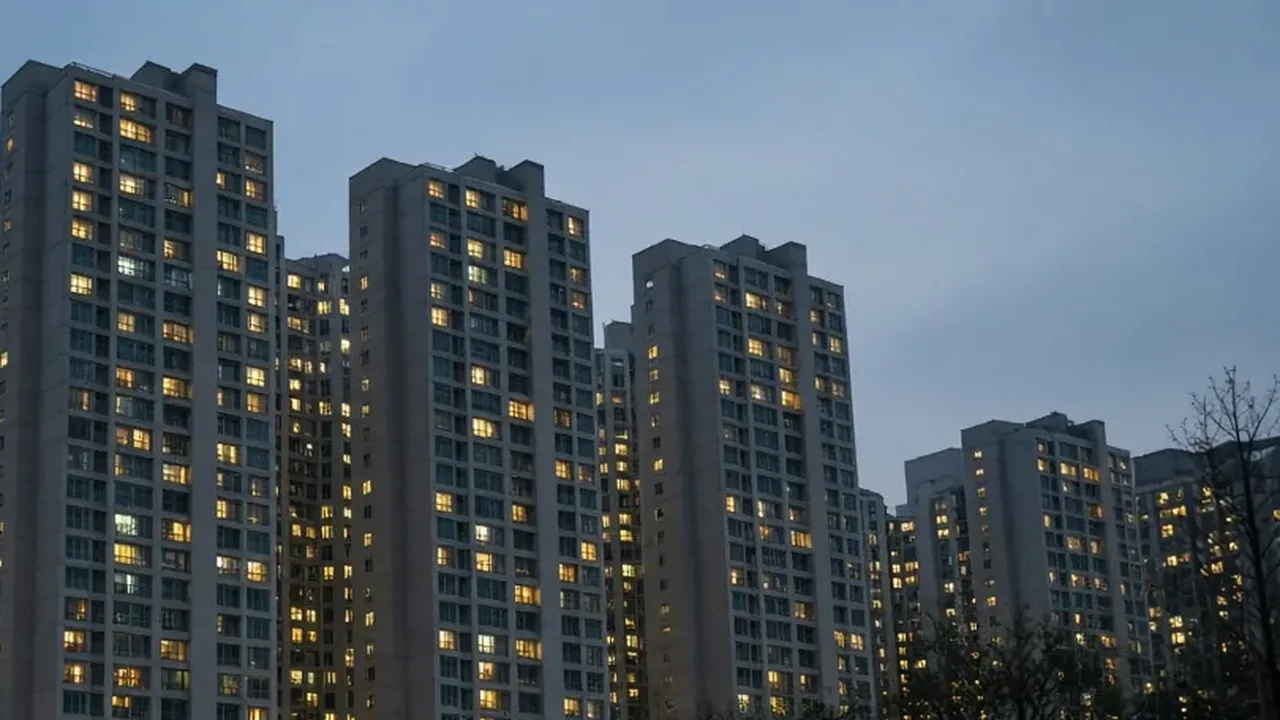
Korean household debt is high because Korean families borrow heavily to buy or rent a home, and for decades banks found mortgages safer than business loans. Measured against income it is still among the highest in the OECD: 171.1% of disposable income in 2025, about twice Germany’s 84.9%. Measured against the economy, though, it fell to 81.1% of GDP in mid-2026, the lowest in a decade, mostly because GDP grew faster than borrowing.
Last updated: October 31, 2026
Key takeaways
- Korean household debt was 171.1% of disposable income in 2025 (Bank of Korea data), down from a peak of 193.4% in 2021. The OECD’s own series shows 174.3% for 2024.
- As a share of GDP it dropped to 81.1% at the end of June 2026, from 85.3% in March. The Bank of Korea says nominal GDP rose 6.2% in the quarter while household debt rose 1.1%.
- Most Korean household debt is housing debt: mortgages, plus the loans tenants take out to pay jeonse deposits.
- Since 2025, borrowers face a stressed DSR (1.5 percentage points added in the limit calculation), a 600 million won cap on Seoul-area purchase mortgages and a 30-year maximum maturity.
- A falling ratio does not mean families repay less each month. It mostly means incomes and GDP grew faster.
How high is Korean household debt compared with other countries?

It depends on which of three numbers you use. Korean news mixes them, and so do many English articles.
| Measure | What it compares | Korea | Source and date |
|---|---|---|---|
| Debt to disposable income | Household debt divided by after-tax income | 171.1% (2025) | Bank of Korea data presented to the National Assembly audit, reported by Hankyoreh |
| Same measure, OECD basis | OECD National Accounts | 174.3% (2024) | OECD via the National Indicator System, July 2026 |
| Debt to GDP | Household debt divided by nominal GDP | 81.1% (end of June 2026) | Bank of Korea flow of funds, 7 Oct 2026 |
The first row is the one to use for comparisons. If a household can spend 100 won a year after tax, it owes about 171 won. For 2025 the same Bank of Korea data put Germany at 84.9%, and for 2024 Japan at 122.4%, the United States at 98.9%, the United Kingdom at 130.8% and France at 115.2%. A think tank, the Nara Salim Institute, calculated that Korea ranked seventh highest among the 38 OECD countries for 2024, behind the Netherlands, Australia, Denmark, Canada, Sweden and Luxembourg. Rankings shift with the definition and the year, so “among the highest” is safer than “the highest.”
Why did the debt-to-GDP ratio fall in 2026?
Because a ratio has a top and a bottom. According to the Bank of Korea’s flow-of-funds release of 7 October 2026, as reported by Seoul Economic Daily, the ratio stood at 81.1% at the end of June, down 4.2 percentage points from 85.3% in March and the lowest since 80.2% in the second quarter of 2016. A Bank of Korea official said nominal GDP rose 6.2% in the quarter on the back of semiconductor exports, while household debt grew only 1.1%, helped by lending restrictions. The government’s target is about 80% by 2030, and the official quoted said the ratio could drop below 80% this year.
That is good news for the headline number on Korean household debt. It says less about a family’s budget. The same release showed households’ net surplus funds shrinking from 79.2 trillion won to 60.7 trillion won, which the Bank attributed to lower income and more net home purchases. A research institute noted that the earlier decline in the income-based ratio was also driven mainly by rising incomes, and debt itself was still growing (3.11% in 2025 versus 2.34% in 2024). In short, Korea is not yet deleveraging in earnest.
Why do Koreans borrow so much? The housing channel behind Korean household debt
The Bank of Korea’s 2023 study of the question (Issue Note 2023-22) points to three things: mortgages were more profitable and safer for banks than business loans, limits on how much one person could borrow arrived late, and a long spell of low interest rates raised demand for assets. A home is also the central family asset in Korea, which is why so many people want an apartment (see why apartments are so popular in South Korea).
Does jeonse count as household debt?
The deposit itself does not, but the loans used to pay it do. Under jeonse a tenant pays a very large deposit instead of monthly rent (see how jeonse works and why rental deposits are so large). Many tenants borrow part of it from a bank, and landlords may use the deposit to fund their own purchase. A 2020 IMF report described deposits as averaging roughly 50 to 70 percent of the house price and said jeonse loans had doubled to 72.2 trillion won since 2014. The system works while prices hold, which is why the IMF flagged the risk if deposits fall and landlords must find cash to repay tenants. Those are 2020 numbers, so treat them as background, not a current count.
Why are Korean mortgages riskier for the borrower?
An IMF review in 2007 described the typical Korean mortgage as a three-year floating-rate “bullet” loan, with interest paid monthly and principal settled at sale or refinancing. That left rate and refinancing risk with households. The mix has improved, and regulators now push toward fixed-rate and amortising loans: the 2025 stressed DSR rule applies a smaller stress add-on to loans whose rate is fixed for longer.
What rules limit borrowing in Korea now?

These are the rules in force as of the Financial Services Commission (FSC) releases of May and June 2025. Check the FSC site for later changes.
| Rule | What it does | Source |
|---|---|---|
| DSR (debt service ratio) | Caps total yearly loan repayments at 40% of income for banks and 50% for non-banks, for borrowers whose total loans exceed 100 million won | FSC notice 2022-29 and FSC release 77936 |
| Stressed DSR, stage 3 (from 1 Jul 2025) | Adds 1.50 percentage points to the rate used to calculate your limit, not to your actual rate; non-capital-area mortgages stayed at 0.75 until end-2025; credit loans only stressed above 100 million won | FSC release, 20 May 2025 |
| Mortgage cap | Purchase mortgages in the Seoul metropolitan area and regulated zones limited to 600 million won | FSC release, 27 Jun 2025 |
| Maturity limit | Mortgages in those areas limited to 30 years | FSC release, 27 Jun 2025 |
| Owners | No new purchase mortgage for existing homeowners in those areas (LTV 0%) unless they sell within six months; “livelihood” mortgages capped at 100 million won | FSC release, 27 Jun 2025 |
| Move-in rule | Buyers in those areas must move into the new home within six months | FSC release, 27 Jun 2025 |
| Jeonse guarantee | Guarantee ratio on jeonse loans cut from 90% to 80% | FSC release, 27 Jun 2025 |
A worked example, as an illustration only. Suppose you earn 60 million won a year (about US$43,000 at roughly 1,400 won per dollar). A 40% DSR limit means all your loan repayments together, principal and interest, cannot exceed 24 million won a year, or 2 million won a month. Because stress DSR adds 1.5 points to the interest rate used in that calculation, the bank sizes your loan as if rates were higher than they are, so your maximum loan is smaller than the monthly payment alone would suggest.
What does this mean for you?
If you are visiting: nothing changes for you. Card and cash habits are unaffected, and household debt shows up only indirectly, in why young Koreans put off marriage and children.
If you are an expat renting: your deposit is effectively a loan to the landlord, and a jeonse loan from a Korean bank is subject to the same DSR rules. Ask the lender what guarantee covers your deposit before you sign.
If you are a worker or buyer: a bank looks at total repayments across all loans, so a new arrival without Korean income history may get a lower limit than the headline numbers imply. Fixed-rate loans have a lower stress add-on, and in the capital area the 600 million won cap applies regardless of how much you earn.
Common mistakes: comparing Korea’s 81% debt-to-GDP with another country’s debt-to-income figure; assuming that a falling ratio means lower repayments; forgetting that the stress rate affects your limit, not your actual interest rate.
Is Korean household debt a danger to the banks?
The Bank of Korea’s 2023 view was that the risk of a financial crisis was limited, because loan-to-value ratios are low and many borrowers have high incomes and good repayment ability. Its larger worry was that heavy repayments drag on consumption and long-term growth and widen asset inequality. That is an assessment from 2023 and could change with the housing cycle. For how Koreans manage cash flow day to day, see why Koreans split their salary across bank accounts.
FAQ
Is Korean household debt the highest in the world?
No. It is among the highest in the OECD relative to income (171.1% in 2025 on Bank of Korea data, 174.3% for 2024 on the OECD’s series), but countries such as the Netherlands, Australia, Denmark and Canada are higher on that measure.
Why did Korea’s household debt ratio fall in 2026?
Because nominal GDP grew faster than household debt. The Bank of Korea said GDP rose 6.2% in the second quarter on semiconductor exports while household debt rose 1.1%.
What is DSR in Korea?
The debt service ratio limits the share of your annual income that goes to repaying principal and interest on all loans: 40% for banks and 50% for non-banks once your total loans exceed 100 million won.
What is stressed DSR?
It adds a margin, 1.5 percentage points since July 2025, to the interest rate used when a bank calculates how much you can borrow. It does not raise the rate you actually pay.
Does jeonse count as household debt?
The deposit is not debt, but loans used to pay it are, and landlords often use deposits to fund purchases. That links tenants’ loans and landlords’ mortgages to the same market.
How much can you borrow for a home in Seoul?
As of June 2025 rules, purchase mortgages in the Seoul metropolitan area and regulated zones are capped at 600 million won with a maximum maturity of 30 years. Check the FSC for current limits.
Sources and further reading
Figures are as of the dates shown; checked on October 31, 2026.
- Bank of Korea: Flow of Funds during the 2nd quarter of 2026 (preliminary), 7 Oct 2026
- Financial Services Commission: measures to strengthen household debt management, 27 Jun 2025
- Financial Services Commission: third-stage stressed DSR, 20 May 2025
- Financial Services Commission: individual DSR, release no. 77936
- OECD: household debt indicator definition
- National Indicator System: OECD household debt to disposable income, updated July 2026 (Korean)
- Seoul Economic Daily: household debt ratio falls to 10-year low, 7 Oct 2026
- Yonhap Infomax: household debt ratio posts record drop, Oct 2026
- Hankyoreh: household debt to disposable income 171.1% (Korean)
- Yonhap: Korea seventh among OECD for household debt to income, Nara Salim Institute (Korean, 18 Jun 2026)
- Bank of Korea Issue Note 2023-22 on household debt (Korean)
- IMF Country Report 20/279: jeonse and financial stability
- IMF 2007 Selected Issues: Korean mortgage market