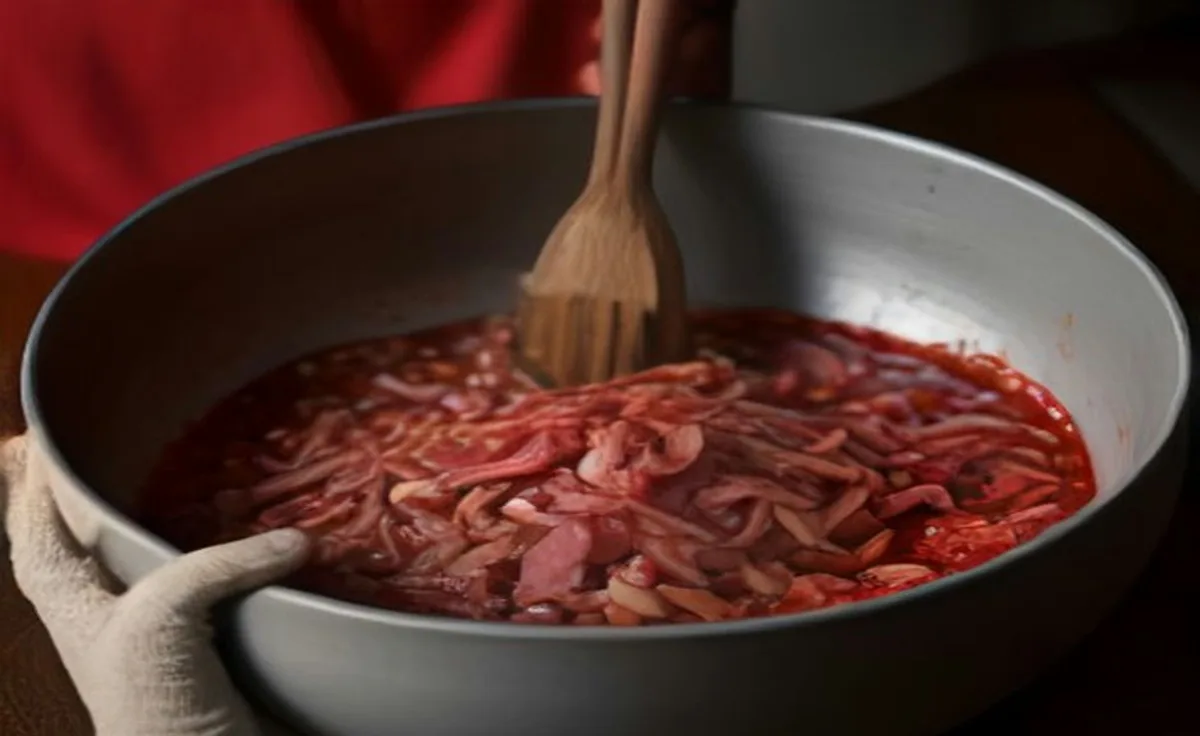
김장 (kimjang) is the late-autumn making and sharing of large batches of kimchi, and Koreans traditionally do it at the start of winter because that is when napa cabbage and radish are harvested, when outdoor cold could store fermented food for months without refrigeration, and when a household had to secure vegetables before winter closed in. The timing was not festive decoration. It was a supply decision, made together by families and neighbours, and UNESCO listed “Kimjang, making and sharing kimchi in the Republic of Korea” as Intangible Cultural Heritage in 2013 for that communal practice, not simply for kimchi itself.
| Term | What it means |
|---|---|
| 김치 kimchi | Salted, seasoned, fermented vegetables, most commonly napa cabbage |
| 김장 kimjang | Making a large batch of kimchi in late autumn for winter, and sharing it |
| 배추 baechu | Napa cabbage, the main kimjang vegetable |
| 절임배추 jeorim-baechu | Pre-salted cabbage sold ready for seasoning |
| 김치냉장고 kimchi-naengjanggo | A kimchi refrigerator, a separate appliance tuned for kimchi storage |
| 항아리 / 장독 hangari / jangdok | Earthenware crocks once buried or kept outdoors for fermentation |
Why winter, and not spring or summer?

Because three conditions used to meet only in late autumn.
First, the ingredients peaked then. Napa cabbage and radish grown through autumn are firm and sweet after cool nights, and red pepper, garlic, ginger and salted seafood for the seasoning had been prepared across the year. UNESCO’s description of the yearly cycle puts the sequence plainly: seafood is salted in spring, sea salt is bought in summer, chillies are dried and ground in late summer, and late autumn is when communities collectively make and share kimchi “to ensure that every household has enough to sustain it through the long, harsh winter.”
Second, the weather did the preserving. Kimjang kimchi has to ferment, then almost stop. Buried earthenware crocks and cold storehouses held temperatures close to freezing for months, slowing fermentation so a November batch was still edible, souring gradually, in March. Make the same batch in June and it over-ferments in weeks. In a climate with a hard winter and almost no fresh vegetables in it, a fermented, salted vegetable that kept in the cold was not a side dish. It was how vitamins and vegetables survived the season at all.
Third, winter was coming whether a household was ready or not. Kimjang was closer to filling a pantry than to cooking a meal. That is why the quantities still surprise foreign readers: a family did not make a jar, it made dozens of cabbage heads at once.
If cold storage was the point, why did people do it together?
Because the work is heavy, the timing window is narrow, and sharing was part of the product.
Salting, rinsing, draining and seasoning scores of cabbages is a full day of physical labour for several adults, and the batch has to be made when the cabbage and the weather are right, not when one household feels like it. So extended families and neighbours pooled labour, worked through one household’s batch and then another’s, and divided the result. UNESCO’s listing stresses this point: kimjang “reaffirms Korean identity and is an excellent opportunity for strengthening family cooperation,” and methods were typically transmitted inside families, classically from a mother-in-law to a daughter-in-law.
The sharing was also practical insurance. A household that received kimchi from relatives in a year when it could not make its own, and gave in a year when it could, was smoothing risk across a network. Modern readers often describe kimjang as a tradition. From the inside it was also a small, recurring distribution system for winter food.
That history explains a detail foreigners notice in November: supermarkets, farms and online shops advertise 절임배추, pre-salted cabbage, reservation dates and seasoning by the kilogram. The communal form has shrunk, but the seasonal market built around it has not disappeared.
Does anyone still need to do this?
No, and the survey numbers show a practice becoming a choice rather than a necessity.
The Korea Rural Economic Institute (KREI) surveyed 1,000 consumers aged 20 and over across 17 provinces for the 2025 season. It found 62.3 percent planned to make kimchi themselves, down from 64.5 percent the year before and the lowest in that series since 2022, while 32.5 percent planned to buy packaged kimchi, up from 29.5 percent. Most kimjang still happens in a tight window: 73.1 percent planned to do it between mid-November and early December. The stated reasons for doing less are instructive, led by lower household kimchi consumption (49.0 percent) and the convenience of bought kimchi (18.4 percent).
A separate industry survey cited by the Ministry of Agriculture and aT (Korea Agro-Fisheries & Food Trade Corporation) tells the same story from the eating side: households buying kimchi rose from 30.6 percent in 2022 to 35.1 percent in 2023, while households making it themselves fell from 24.7 percent to 21.1 percent, and only 9.6 percent of single-person households made their own.
Cabbage numbers make the shrinkage visible per household. KREI’s household panel put intended kimjang cabbage purchases at 21.9 heads per household in 2020 and 18.5 heads in 2024. People still kimjang. They make less of it.
What replaced the buried crock?

The 김치냉장고, the kimchi refrigerator, and it is the clearest example of a storage problem becoming an appliance category.
Traditional storage used the ground: crocks buried up to their necks stayed near freezing all winter. Apartment living removed the yard, and a normal refrigerator is both too warm in its cycling and too small for a winter batch. Kimchi refrigerators, popularised in the mid-1990s, hold a steady low temperature and separate compartments for different batches and degrees of fermentation. Gallup Korea’s 2025 appliance survey (5,251 respondents aged 13 and over, surveyed March to July 2025) found 85 percent of households owned one, down from 90 percent in 2021, with ownership notably lower among single-person households.
Read those two figures together. An appliance owned by 85 percent of households exists because a November batch still matters to most Korean homes. Its decline tracks the same forces as kimjang itself: smaller households, less kimchi eaten, and good packaged kimchi available all year.
Why some households still make their own kimchi
What making it yourself still gives you. Taste control, first of all: salt level, seafood, spice and fermentation can be set to a household’s preference in a way no national brand can match, and many families are loyal to a specific hand. There is also a cost logic at volume, and the social fact that a day of kimjang still gathers a family that otherwise meets at formal occasions.
What it costs. A full day or more of hard labour, storage space in small apartments, and ingredient prices that swing with the autumn cabbage crop. For a one- or two-person household eating less kimchi, the arithmetic often fails, which is exactly what the surveys record. There is a generational cost too: the knowledge transfer UNESCO describes depends on someone younger being present and willing, and smaller, busier families make that harder to arrange.
The honest middle. Much of modern kimjang is already hybrid. KREI found 58.9 percent of 2025 kimjang cabbage was bought pre-salted, with 55.8 percent of those buyers citing the burden of the salting process. A family that buys salted cabbage and seasoning, then mixes and packs together, has kept the shared part and outsourced the heaviest part. That is not the tradition failing. It is the tradition shedding the steps that were only ever about labour.
What is changing now?
Three things, all visible in the numbers above.
Packaged kimchi is becoming the default for smaller households, and premium brands, including hotel brands, compete on taste rather than only price. Kimjang quantities keep shrinking even among households that still do it. And the calendar is flattening: with kimchi refrigerators and year-round supply, the penalty for making or buying kimchi outside November has largely gone, so kimjang survives less as winter provisioning and more as a chosen family event.
That last shift is the structural answer in miniature. A practice built by scarcity can persist after the scarcity ends if it also does social work. Kimjang does, which is why it is shrinking rather than vanishing.
Quick answers
What is the difference between kimchi and kimjang?
Kimchi is the food. Kimjang is the act and season of making a large batch of it in late autumn, traditionally together, to last through winter and to share.
When is kimjang season in Korea?
Mainly mid-November to early December. KREI’s 2025 consumer survey found 73.1 percent of households planning kimjang in that window, with the season largely finished by mid-December.
Why do Korean homes have a separate kimchi refrigerator?
To hold large batches at a steady, near-freezing temperature that controls fermentation, replacing buried earthenware crocks that apartment living made impractical. Gallup Korea put household ownership at 85 percent in 2025.
Do most Koreans still make their own kimchi?
A majority still planned to in 2025 (62.3 percent in KREI’s survey), but the share buying packaged kimchi is rising (32.5 percent), and the amount made per household keeps falling.
Why is kimjang on the UNESCO list?
UNESCO inscribed the making and sharing practice in 2013, citing family cooperation, transmission of methods within families, and the communal sharing of kimchi, rather than the dish alone.
Winter solved the problem, so why does kimjang remain?
Koreans make kimchi in winter because winter was the problem the food solved. Late-autumn cabbage, cold that could preserve fermentation for months, and a season with almost no fresh vegetables made one large, shared batch the rational way to eat through winter, and doing it together spread both the labour and the risk. Refrigeration, apartments, packaged kimchi and smaller households removed each of those reasons one by one. What remains, at 62.3 percent participation and 18.5 cabbages at a time, is the part the cold never explained: a family still marking the start of winter by making food for each other.
Related reading: Why Are Apartments So Popular in South Korea? Why Are Apartments So Popular in South Korea? Why Are Some Young South Koreans Delaying or Opting Out of Marriage?
Sources and background
- UNESCO: Kimjang, making and sharing kimchi in the Republic of Korea (inscribed 2013)
- Korea Rural Economic Institute: 2025 consumer kimjang intentions and cabbage supply outlook (survey of 1,000 consumers)
- Korea Rural Economic Institute: clarification on 2024 kimjang intentions, household cabbage purchases 21.9 heads (2020) to 18.5 (2024)
- Gallup Korea 2025 household appliance ownership survey: kimchi refrigerator ownership 85 percent, via ICH Courier and press reporting
- UNESCO ICH Courier: the kimchi refrigerator as successor to the buried crock