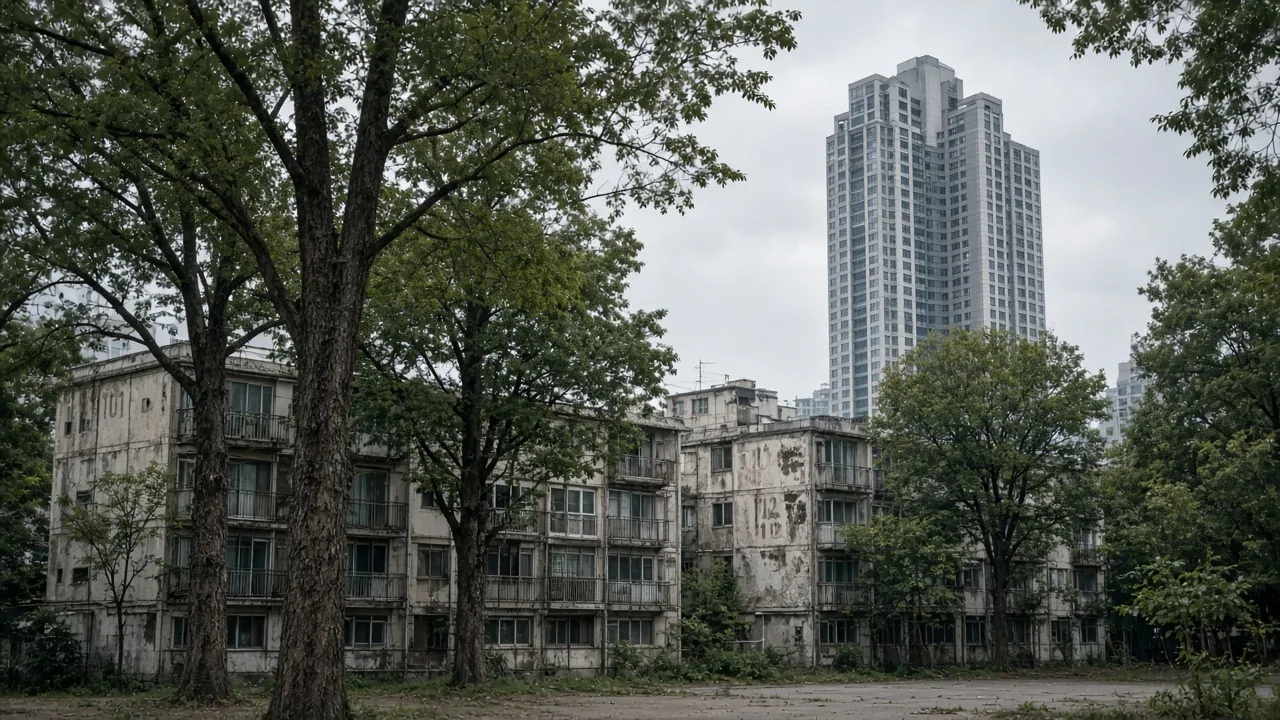
Apartment reconstruction in Korea means owners of an old complex vote to tear it down and build a new one on the same land, and the usual driver is money rather than safety. Roughly 30 years after completion, many complexes become eligible to start the process, and since 2025 the old “safety inspection” has been replaced by a “reconstruction diagnosis” that gives more weight to residents’ everyday problems such as parking and lifts. Owners come out ahead only if the new complex can include more apartments than the old one, because the extra units are sold to pay for construction.
Last updated: October 31, 2026
Key takeaways
- Korean owners decide collectively; reconstruction is called jaegeonchuk (재건축).
- The economics work when the old site was low-density: extra apartments sold on the general market reduce what owners pay.
- In 2025 the Ministry of Land, Infrastructure and Transport (MOLIT) renamed the “safety inspection” the “reconstruction diagnosis” and raised the weight of residents’ living conditions from 30% to 40%.
- High-density 1990s complexes in Seoul are the next problem, because there is little room to build extra units.
What is reconstruction in Korea?
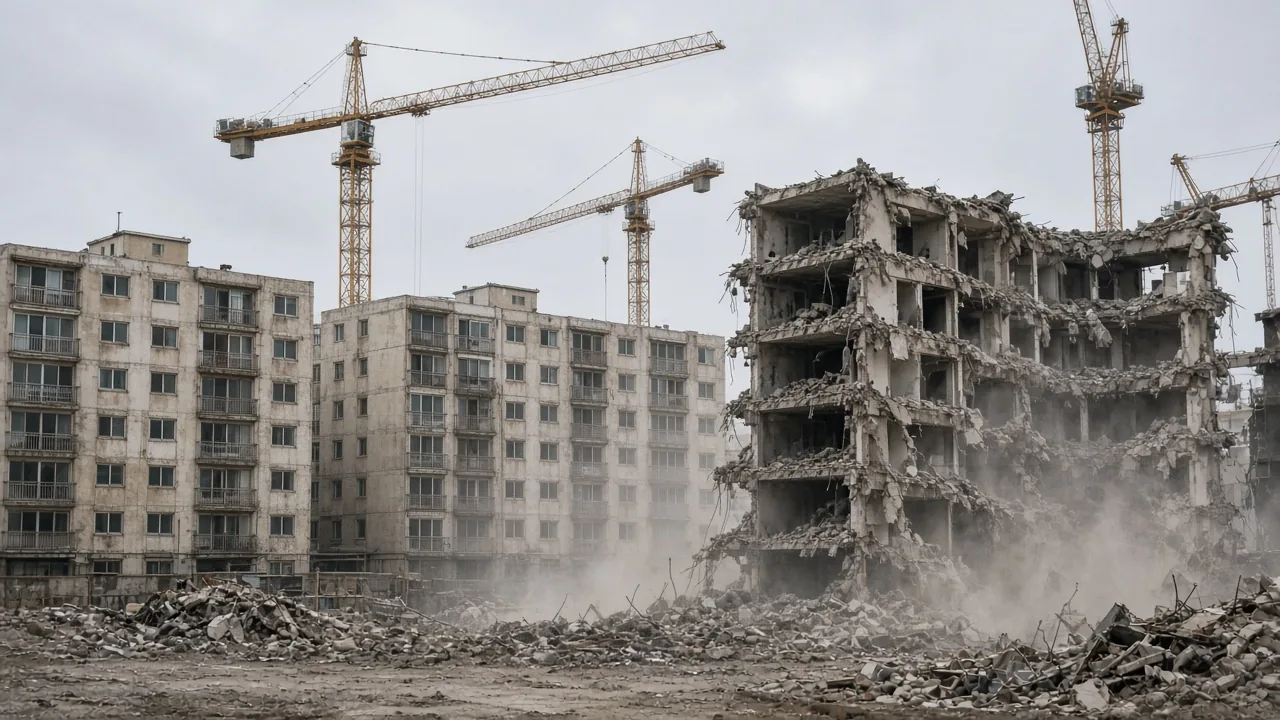
Jaegeonchuk means demolishing an old apartment complex and building a new one. It differs from remodelling, which keeps the structure and renews the interior and facilities. Because an apartment owner in a Korean complex holds a share of land and building (see why apartments are so popular in South Korea), rebuilding is a collective decision made by an owners’ association at several stages of voting.
Age is a legal milestone. According to Asia Business Daily (June 2026), Seoul’s ordinance lets buildings of five or more floors built after 1986 be reconstructed after 30 years if the site is at least 10,000 square metres or the complex has at least 200 units. Other cities have their own rules.
Why does money drive apartment reconstruction in Korea?
The basic bargain, as described by Asia Business Daily and its experts:
- Owners hold a share of the land and the building.
- The new complex is allowed a certain floor area ratio (FAR): total floor area permitted as a percentage of the site area.
- If the old complex was low-density (such as five-storey blocks with open space), the new one can hold many more apartments.
- The extra apartments are sold to the public (the general sale), and the proceeds pay for construction. The more extra units, the less existing owners pay.
Complexes with low FARs can secure many units for general sale, reducing owners’ costs. High-density complexes cannot, which is why an old, run-down complex with a high FAR may not be a candidate.
Because a unit in an old complex includes the prospect of a new apartment, buyers pay for the option as well as the building. This article makes no claims about prices. For related basics, see what cheongyak is, which explains how new apartments are sold.
What changed with the reconstruction diagnosis?
Under the old system an old complex had to pass a “safety inspection” before it could move forward, so the test was whether it was structurally unsafe. The Urban Maintenance Act was amended, and in April 2025 MOLIT published rule changes to match, as reported on its policy site:
- The “safety inspection” was renamed the reconstruction diagnosis, and a complex must pass it before the project implementation plan is approved, not before starting the process.
- Housing-environment criteria grew from 9 to 15 items. New items include community facilities, underground parking and green space. A complex with no underground parking, too little landscaping, or narrow lifts that are hard to widen can reflect residents’ inconvenience in its result.
- The housing-environment part now carries 40% of the score, up from 30%.
- Cost analysis can be left out, though residents can ask for the old weighting that includes it.
- A diagnosis report written within the last three years can be reused if a complex has to repeat it before plan approval.
The reconstruction diagnosis rules took effect on 4 June 2025, when the amended enforcement decree renamed the safety inspection the reconstruction diagnosis (jaegeonchuk jindan). In effect, a complex that is old enough can start without proving it is unsafe, and the test of residents’ living conditions carries more weight.
What is the first-generation new towns law?
Korea also has a Special Act on Support for Old Planned Cities, in force since April 27, 2024. It applies to areas of at least 1,000,000 square metres that were developed through housing site projects and similar projects at least 20 years ago, such as Bundang. According to Asia Business Daily (July 2024), it eases inspection requirements and allows higher floor area ratios, up to 450%, in return for “integrated” reconstruction of several complexes together.
What is the problem with high-density complexes?
The 1990s apartments built in Seoul were large, dense and fast. According to Asia Business Daily’s June 2026 analysis of ministry building ledger data, Seoul has 530 complexes (234,178 units) with an FAR of 300% or more. Of these, 28 complexes (11,277 units) reach 30 years this year and 251 (126,105 units) will by 2030.
For them the basic bargain works badly: a consultant quoted in the article said that above an FAR of about 270%, rebuilding the same number of units is usually impossible apart from those given to the public. The article also cites a fire in February 2026 at an apartment complex in Gangnam that killed one person, and a researcher who said Korea’s long-term repair reserves are smaller than Japan’s, so complexes that are neither rebuilt nor repaired could decline.
What does apartment reconstruction in Korea mean for you?
Renters and buyers: the age and density of a complex are part of its value. A 28-year-old complex with a low FAR is treated very differently from a newer one. Check the FAR, the diagnosis status and the stage of the association before buying.
Visitors and observers: large cranes and banners (“reconstruction promotion association”) on old complexes are signs of the process. Complexes often change names around redevelopment (see why Korean apartment complexes change their names).
Expats: the process takes much longer than most expect, with votes, diagnosis, plan approval and relocation. Use the pyeong unit (about 3.3 square metres) when comparing sizes. Compare with other countries in Korean vs European apartments.
Common mistakes: assuming old means unsafe, assuming every 30-year-old complex can be rebuilt, and ignoring density. This is not financial advice.
How does apartment reconstruction in Korea work, step by step?
Seoul’s redevelopment information site sets out the stages for reconstruction under the Urban Maintenance Act. Its table pre-dates the 2025 renaming described above, so it still says “safety inspection” where the new rule says “reconstruction diagnosis”. The sequence is:
- Basic plan. The city sets its basic maintenance plan, with public viewing and consultation.
- Diagnosis. For apartment reconstruction only, owners (with one-tenth consent, per the Seoul table) can apply once the complex is old enough.
- Zone designation. The city designates the maintenance zone after a plan, public viewing and review.
- Promotion committee. The district office approves a committee on the consent of at least half of owners, with five or more members. It selects a management company and prepares for the association.
- Association approval. Owners consent to forming the association, with an estimated share of costs provided first. The district office approves.
- Project implementation approval. The association drafts the plan and holds a residents’ meeting with majority consent, then applies.
- Management and disposal plan. Owners apply for the unit they want over a 30 to 60 day period, the plan is viewed for 30 days or more, and a general meeting approves it by majority.
- Relocation, demolition and construction. Owners move out, buildings are demolished and building begins.
- Completion and transfer. After completion approval and registration, the association settles accounts and dissolves.
The point of this list is that the project depends on repeated owner votes, so it is slow and can stall at any stage.
How many owners must agree? A worked example
Under Article 35(3) of the Urban and Residential Environment Improvement Act, as in force in October 2026, forming a reconstruction association needs the consent of at least 70% of all owners and owners of at least 70% of the land area in the housing complex, plus a majority of owners in each building (buildings with five or fewer owners are exempt). The owner threshold was cut from three quarters to 70% on 1 May 2025, after the Act was amended on 31 January 2025. For commercial units in a complex, the per-building majority can fall to one third in cases set by decree. Older material, including the Seoul procedure table used in the steps above, still shows three quarters, so check the date of any figure you see. Redevelopment (jaegaebal) is a different type of project with its own thresholds.
For a complex of 1,000 owners, you need at least 700 owners to consent, and owners holding at least 70% of the land area, plus a majority in each building. Under the former three-quarters rule, the same complex needed 750.
Easy Law also describes how consent works in practice:
- Consent is given on a written form (or an electronic signature form) with your name, a fingerprint stamp and a copy of an ID card such as a national ID or passport.
- The form must carry the stamp or confirmation of the local government. A form without it has no effect.
- Consent to form an association can be withdrawn only within 30 days of first giving it, and not after the inaugural general meeting. Other withdrawals can be made until the related permit is applied for.
A worked example of the bargain in apartment reconstruction in Korea
Here is a made-up illustration with no prices, to show why density matters. Suppose a complex has 1,000 apartments.
- Low-density case. The new complex is permitted to hold 1,400 apartments. The 1,000 existing owners each receive a new apartment, and 400 are sold on the general market. Those sales help pay construction, so owners pay less.
- High-density case. The permitted floor area only fits 1,000 apartments. There is nothing to sell, so owners must pay the full cost between them.
That is the logic in Asia Business Daily’s description, where above a floor area ratio of about 270% the same number of units usually cannot be rebuilt apart from those given to the public. The numbers 1,000 and 1,400 are invented for illustration.
What should a buyer or owner check in apartment reconstruction in Korea? A checklist
- The age of the complex and whether it meets the local age rule.
- The floor area ratio compared with the permitted ratio.
- The diagnosis status under the new rule, and which version of the rule applies.
- The stage of the project from the nine steps above.
- Consent figures and forms. Do you hold a copy of what you signed, and when does the 30-day withdrawal window end?
- The estimated share of costs. The Seoul table says the committee must give owners an estimated share and certain information before collecting consent.
- Whom to ask. The Seoul redevelopment site gives a call centre at 02-2126-4672 to 4674.
More common mistakes in apartment reconstruction in Korea
- Treating a banner or an association’s name as proof that a project is approved.
- Signing a consent form without keeping a copy.
- Assuming the old 75% figure still applies. Since 1 May 2025 the owner threshold is 70%.
- Mixing up the stages. A diagnosis result is not an approval to demolish.
- Assuming the process takes a few years. The nine steps include repeated votes and reviews.
Common questions
Why are Korean apartments torn down after 30 years?
Mostly because of the financial logic: if the new complex can have more apartments, selling the extra units pays for the project. About 30 years is when many complexes become eligible, but they do not need to be unsafe.
What is jaegeonchuk?
The Korean word for reconstruction, demolishing an old apartment complex and building a new one on the same land.
What is the reconstruction diagnosis?
The test that replaced the “safety inspection”. It looks at structure, housing environment and equipment, and since 2025 gives 40% weight to housing environment.
Who pays for apartment reconstruction in Korea?
Owners through their association, with sales of extra apartments covering a large part of the cost. The lower the existing density, the greater the share.
What is the old planned cities law?
A special act, in force since April 2024, that supports integrated reconstruction in large planned cities developed at least 20 years earlier, such as Bundang.
How many owners must agree to reconstruction in Korea?
Association approval needs at least 70% of all owners and 70% of the land area, plus a majority in each building, under Article 35(3) of the Urban and Residential Environment Improvement Act (in force since 1 May 2025). Older material still shows three quarters.
Can I withdraw my consent?
Easy Law says consent to form the association can be withdrawn within 30 days of first giving it, but not after the inaugural general meeting.
References and further reading
Checked October 31, 2026.
- Korea Policy Briefing: MOLIT rule changes on the reconstruction diagnosis, April 17, 2025 (Korean)
- Ministry of Government Legislation: Special Act on Support for Old Planned Cities (Korean, law.go.kr)
- Korea Policy Briefing: Old planned cities special act now in force (Korean)
- Ministry of Land, Infrastructure and Transport (English)
- Asia Business Daily, July 2024 and June 17, 2026 (Korean press analyses of reconstruction and density; secondary sources)
- Seoul Metropolitan Government: reconstruction project procedure (Korean, Cleanup information site)
- Easy Law (Ministry of Government Legislation): owners’ consent for reconstruction by an association (Korean)
- Ministry of Government Legislation press release: easing of reconstruction association requirements, 30 Apr 2025 (Korean)
- Yonhap: Ministry of Government Legislation, reconstruction association consent rate eased from 75% to 70%, 30 Apr 2025 (Korean)