
Korean restaurants serve free side dishes because banchan (반찬) are priced into the main dish, not sold separately. The kimchi, pickled radish and seasoned vegetables that appear before your stew are part of what the menu price pays for, and in most casual restaurants a refill of the basics is a normal request, not a favour. That arrangement has held for generations, but it is under strain: in early 2026, rising vegetable prices pushed a public argument among owners about charging for extra side dishes. This guide explains how the free side dishes system works, why leftovers cannot be reused, what changed in 2026, and what you can ask for at the table.
How free side dishes are paid for
The simplest way to think about banchan is as a bundled price. A bowl of soup with rice costs a set amount, and that amount covers the soup, the rice and a handful of small plates. Nobody tallies the kimchi on the bill because nobody expects to.
Korean consumers hold that expectation firmly. In a February 2026 report on the debate, Maeil Business Newspaper quoted a typical objection from the public: the main menu price already includes the cost of the side dishes and the service. Choi Chul, a consumer economics professor at Sookmyung Women’s University, told the paper that Korean customers habitually assume the side-dish cost is inside the menu price, so a restaurant that begins charging for something that used to be free is likely to see customers stay away.
The word “service” belongs here too. Koreans use the English word to mean a free extra, such as a plate of dumplings or a drink the owner brings unprompted. Banchan are the baseline; “service” is the surprise on top, and it is never owed.
Why the dishes you do not finish are thrown away
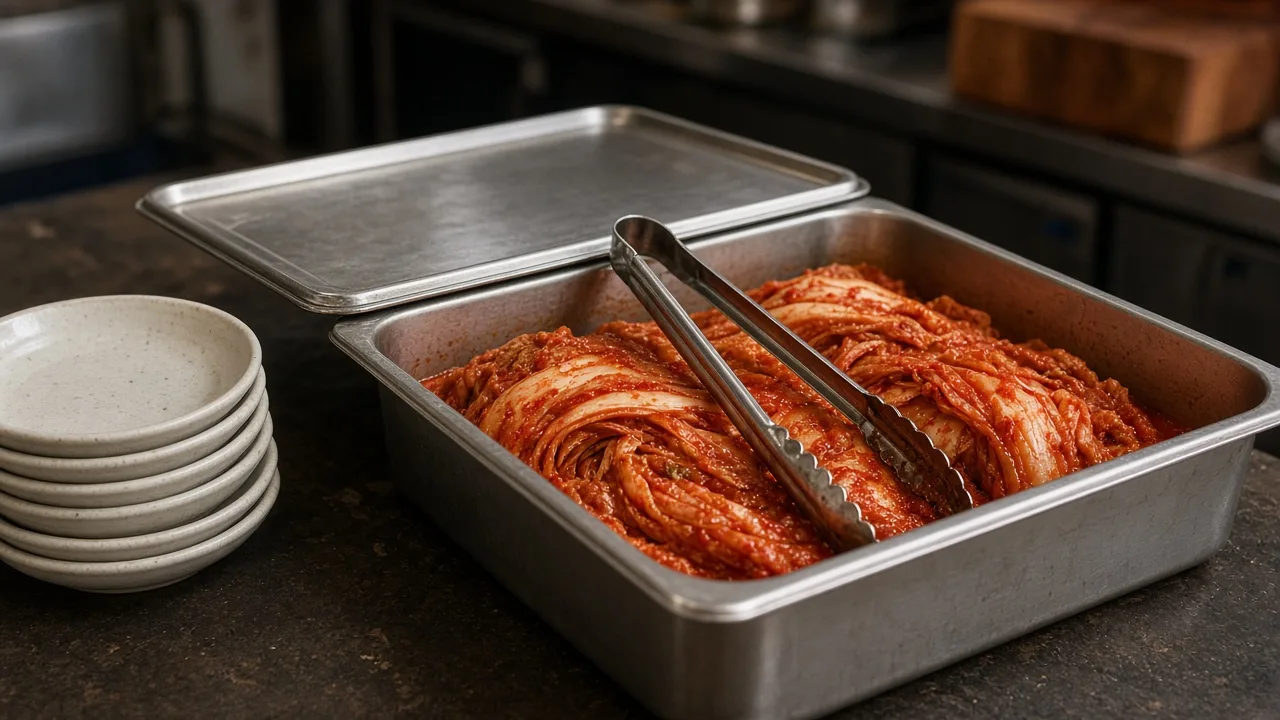
There is a hygiene rule behind how refills work, and it explains why a restaurant hands you fresh plates instead of putting yesterday’s dishes back in the kitchen.
Under Korea’s Food Sanitation Act, a restaurant operator may not reuse, re-cook or keep food that has been served to customers or displayed for them to eat. District offices publish the penalties: a first violation brings a 15-day business suspension, a second two months and a third three months, and the offence carries up to three years in prison or a fine of up to 30 million won. The rule applies to restaurants, cafés, bars and other food-service businesses.
There are narrow exceptions for items that can be handled hygienically. According to the Yeongdo District Office’s public notice, they include:
- Unprocessed vegetables and fruits that can simply be washed, such as lettuce, perilla leaves, whole chili peppers, whole garlic and cherry tomatoes.
- Fruits and nuts in a shell or skin that is kept whole, such as bananas, mandarins and peanuts.
- Dry packaged snacks served so that customers take only what they eat.
- Seasonings, kimchi and rice served in a lidded container with tongs, so that customers serve themselves.
So the scope is limited. A plate of seasoned bean sprouts that has sat on your table is, in general, not going back into circulation. For the restaurant, an uneaten dish is a real cost, which is one reason owners dislike seeing refills left untouched.
What changed in 2026: the cost of the cheap plates

For years the system was stable because the ingredients were cheap enough. In early 2026 they were not. The Korea Agro-Fisheries and Food Trade Corporation (aT) reported that, on 23 January 2026, 100 grams of green lettuce cost 1,559 won, up 44.49% from a year earlier. Oyster mushrooms were 1,131 won per 100 grams, up 23.88%, and Cheongyang chili peppers were 1,727 won, up 11.42%. Owners also pointed to dried seaweed, anchovies and squid as components of common side dishes that had become more expensive.
In late January, the owners’ community “Apeuni-kka Sajangida” (“Because it hurts, I’m the boss”), which has more than 1.8 million members, ran a poll on charging for extra side-dish refills. As of 3 February 2026, 832 respondents (61.5%) were against and 520 (38.5%) in favour, Maeil Business Newspaper reported. The Asia Economy report on the same debate cited a poll with roughly the same split from about 1,300 votes. These are online polls of self-selected owners, not a representative survey, but they show how divided the people running the restaurants are.
The arguments on each side were concrete:
- In favour: supporters wrote that a solo customer who orders a bowl of gukbap and refills the kimchi and kkakdugi many times turns the table into a loss, and that a single card-sized sheet of seaweed costs more than 25 won. They also argued that charging for extra side dishes is already common on delivery, and that serving them by hand has a labour cost.
- Against: owners of Korean restaurants in office districts such as Yeouido and Jongno said they could not raise menu prices, and that charging for side dishes could drive customers away. One owner called banchan “both service and a promise to the customer” and said it was better to lose a little money than the customer’s trust.
Asia Economy also quoted the Korea Federation of Micro Enterprises as saying that charging for extra banchan touches the whole dining culture, not only cost, and needs public discussion.
Why customers resist paying
Professor Choi explained the reaction with the endowment effect from behavioural economics: people measure fairness from the starting point they were given, so losing a free item feels worse than an equivalent gain feels good. When something that was always included becomes an extra charge, customers experience it as a price rise and may prefer not to go back.
That helps explain what owners actually did. Asia Economy reported that some restaurants cut the amount of banchan they serve at the start or adjusted particular items, and that the expected near-term approach was a “buffer strategy”: put the cost into the menu price or change the mix of dishes, rather than start charging for refills. This is the same dynamic that drives many restaurant prices in Korea. Owners carry heavy fixed costs, from rent to key money (see what gwolligeum is), and many owners run on thin margins (see why retired Koreans open chicken shops and cafés).
Which free side dishes can you ask for?
We found no national rule listing what a restaurant must serve for free. The practice is set by each restaurant, so the following is a guide, not a guarantee.
| Item | Usually how it works |
|---|---|
| Kimchi, pickled radish, seasoned vegetables | Included in the meal, and refills of the basics are commonly free |
| Lettuce and wraps at a grill restaurant | Often included; check the menu if the set looks special |
| Rice, noodles, extra meat | Usually ordered and charged separately |
| “Service” items such as dumplings or a drink | A gift from the owner, never guaranteed |
| Self-service side dish bars | Take a small amount first, return for more |
If you are unsure, ask politely before you take anything that looks like a main ingredient. A short phrase works: “반찬 좀 더 주세요” (banchan jom deo juseyo), “Could I have a little more side dishes, please?” The word 좀 (jom, “a little”) softens the request.
Menu prices themselves are regulated: the posted price in an ordinary restaurant must include VAT and any service charge, and grilled meat has to be priced per 100 grams. The side dishes are an unwritten part of that final price, not a line item.
How Korean delivery differs
On delivery the logic reverses, because the customer chooses and pays for each item. Supporters of charging in dining rooms pointed to delivery apps as proof that extra side dishes can be sold. When you order in, a side dish becomes an option on the screen, whereas at the table it is part of the bundle. The comparison is covered in why food delivery is so convenient in South Korea.
The bigger picture
Free side dishes in Korean restaurants are a pricing convention, not generosity and not an accident. Because the customer assumes they are included, the restaurant sets the main dish price high enough to carry them, and because leftovers generally cannot be reused, every uneaten plate is a cost the owner absorbs. In a year when lettuce rose 44% and menu prices were hard to raise, that convention was tested openly. For now, most owners prefer smaller starting plates and careful menu pricing over breaking a promise that customers consider part of the meal. For a visitor, the practical rule is simple: eat what you ordered, ask for a small refill of what you like, and treat anything extra as a gift.
FAQ
Are side dishes free in Korean restaurants?
In most casual restaurants, yes. Banchan are included in the price of the main dish, and refills of basic items such as kimchi are commonly free. Rice, noodles, meat and special dishes usually cost extra, and each restaurant sets its own policy.
Why do Korean restaurants give free refills of banchan?
Because the price of the meal already includes them, and customers expect it. A Sookmyung Women’s University professor told Maeil Business Newspaper in 2026 that Korean consumers habitually assume the side-dish cost is in the menu price.
Can restaurants reuse leftover side dishes in Korea?
Generally no. The Food Sanitation Act bars restaurants from reusing food that was served to customers. Narrow exceptions include washable whole vegetables and fruit, and kimchi or rice served in a lidded container with tongs.
Are Korean restaurants starting to charge for extra side dishes?
Some owners have proposed it. In early 2026, a poll of more than 1,350 members of a large owners’ community found 61.5% against charging and 38.5% in favour. Most restaurants have kept refills free and adjusted portions or menu prices instead.
What does “service” mean in a Korean restaurant?
It is a free extra that the owner offers, such as dumplings or a drink. It is a gift, not something to ask for.
Sources and further reading
- Maeil Business Newspaper, “‘Boss, more side dishes please’ … free refills divide opinion” (3 February 2026, Korean): mk.co.kr
- Asia Economy, “‘More side dishes please’ is a thing of the past? Free refill culture wobbles amid high prices” (3 February 2026, Korean, summarising a Yonhap report): asiae.co.kr
- Yeongdo District Office, public notice on reuse of leftover food, penalties and exceptions (Korean): yeongdo.go.kr
- Korea Law Information Center, Food Sanitation Act Enforcement Rule, Annex 17 (rules for food service operators): law.go.kr
- EpicKor, “Free Side Dishes in Korea: Banchan, Service, and Refills” (updated July 2026), for a visitor-oriented overview: epickor.com