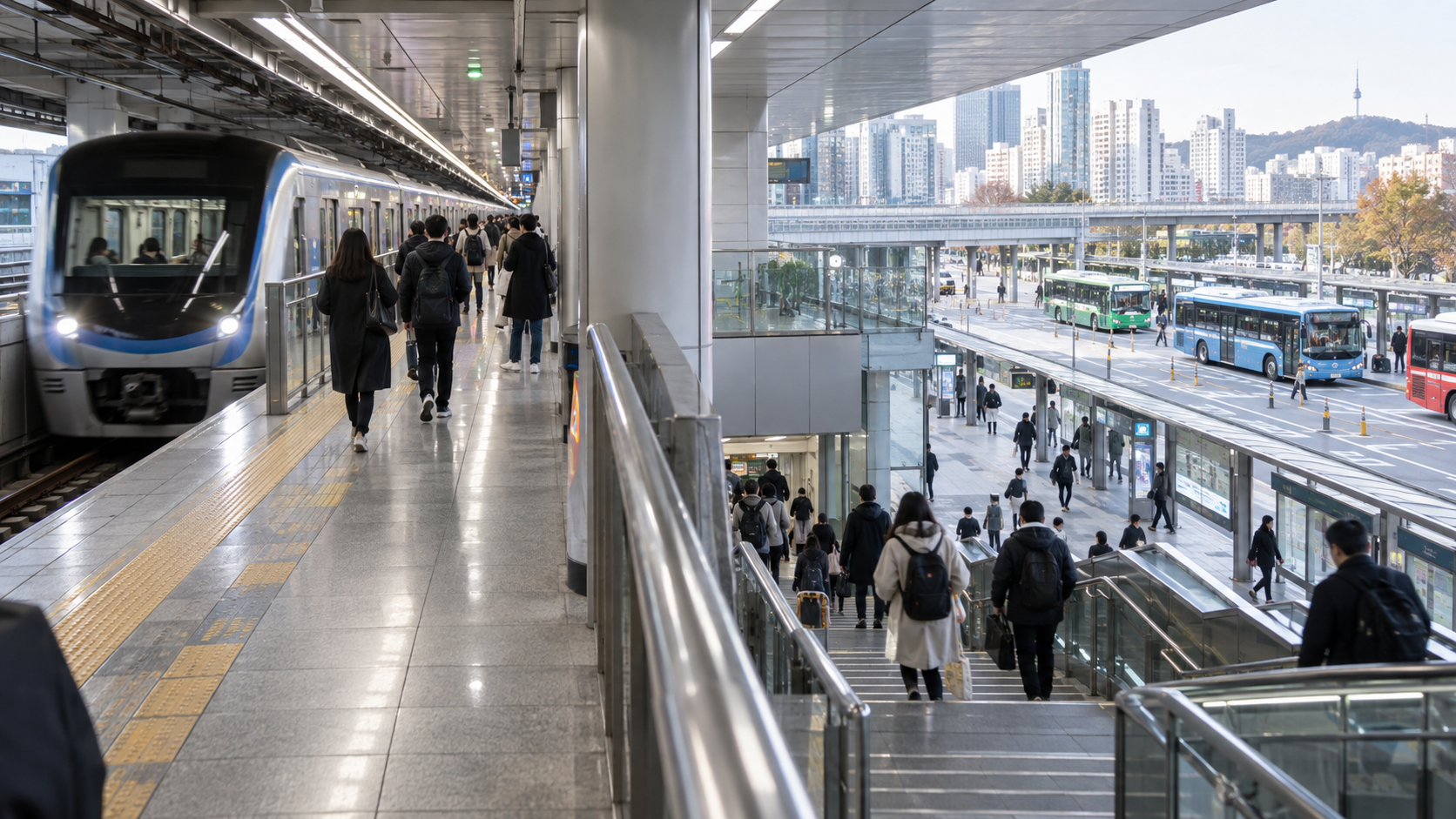
Public transportation works well in Seoul because high urban density is combined with sustained public investment, coordinated bus and rail networks, distance-based transfer fares, interoperable transit cards and reliable real-time information. Its main advantage is not any single technology: separate modes behave like one journey.
| Why it works | What passengers gain |
|---|---|
| High density | Frequent buses and trains |
| Integrated fares | Eligible transfers count as one distance-based journey |
| Transit cards | One payment layer across modes and operators |
| Real-time information | Less uncertainty and waiting |
| Public coordination | Coverage beyond only the most profitable routes |
Why does density matter?
Transit becomes more useful when homes, jobs and services are concentrated along a limited number of corridors. Seoul’s dense apartment districts and employment centers support frequent service; reliable transit in turn makes dense, car-light development practical. Density is the foundation, but policy determines whether individual services connect.
What changed in Seoul’s 2004 transportation reform?
Seoul launched a major reform on July 1, 2004. According to the Seoul Metropolitan Government, the city reorganized roughly 400 routes and about 8,000 buses, expanded median bus lanes and introduced an integrated card and fare structure.
The reform established a quasi-public bus model: private companies continued operating buses while the city took a stronger role in route planning, revenue management and service standards. The passenger-facing breakthrough was integration. Connected rides could be treated as stages of one journey rather than separate purchases.
How do T-money and transfer fares work?
T-money and comparable cards record linked stages when passengers tap on and, where required, tap off. Under Seoul’s published rules, a card user can make up to four transfers within the permitted time window. The system applies a base fare and adds distance charges rather than charging a new full fare for every eligible transfer.
As of June 28, 2025, Seoul’s adult subway base fare paid by transit card was ₩1,550. Fares change, so travelers should check the city’s current fare page.
Why is real-time information important?
Seoul’s TOPIS platform collects operational and vehicle-location data. Bus stops and mapping services can show estimated arrivals, locations and intervals. This lowers the mental cost of using the system: passengers do not need to memorize every timetable or understand which company operates each segment.
How do buses and subways function as one network?
Rail provides the high-capacity spine while buses extend coverage into neighborhoods. Seoul’s public data portal lists 2.744 billion subway passenger trips for 2025—an accumulated service-use count, not unique people. Multiple operators serve the metropolitan network, but integrated maps and fares make those institutional boundaries less visible.
Who pays for frequent service?
Fares do not cover every cost. Governments and public operators fund maintenance, labor, accessibility upgrades, infrastructure and socially necessary routes. The quasi-public bus model requires support when service obligations exceed fare revenue. This is a policy trade-off: a network designed only for profit would reduce less-lucrative routes and weaken the connectivity that makes the system useful.
Is transit equally good outside Seoul?
No. Korea’s strongest transit experience is concentrated in Seoul and other large cities. Statistics Korea’s 2026 SDG progress report documents regional differences and incomplete accessibility. The Korea Transport Institute has found that small cities and rural areas face weaker service, inconvenient transfers and discontinuities.
FAQ
Can one card be used on buses and subways?
Usually yes. T-money, Cashbee and other supported cards work across many systems, though coverage and transfer rules vary.
Why tap when getting off a bus?
The exit tap records where that stage ended, allowing the system to calculate distance and recognize an eligible transfer.
Is public transportation good everywhere in Korea?
No. Major cities have dense networks, while smaller cities and rural areas may have infrequent service and accessibility gaps.
A network is more than its vehicles
Seoul transit succeeds because passengers encounter a network rather than unrelated companies. Density supplies demand, public investment supplies capacity, cards connect fares and real-time information makes service predictable.