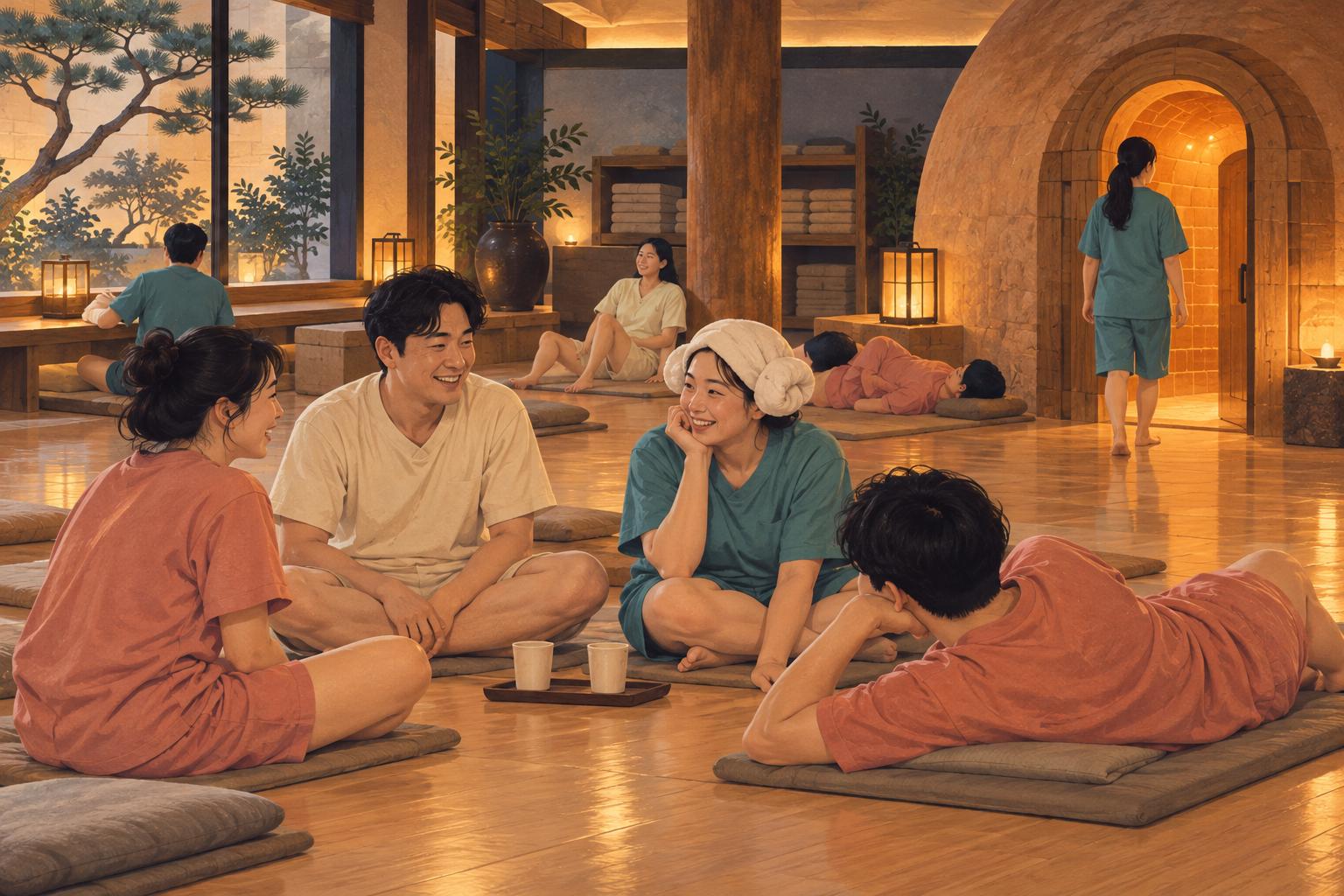
Some Korean jjimjilbangs stay open overnight because they are licensed as public bath businesses selling heat and shared floor space rather than private rooms, which makes one more guest at three in the morning very cheap to serve. Demand exists because many urban homes are small, the subway shuts down for nightly maintenance, and short stays are priced by the night. Overnight operation is legal and specifically regulated, but each operator decides, and bathhouse numbers have fallen for two decades.
| Factor | How it supports overnight operation |
|---|---|
| Licence | A public bath business, not lodging |
| Cost | Heat is fixed; an extra guest adds little |
| Space | Floor time, not private rooms |
| Housing | Small dwellings lack a bath and social space |
| Transit | Rail stops overnight until the first train |
What is a jjimjilbang, and how is it different from a 목욕탕?
A 목욕탕 (mokyoktang) is a public bath: gender-separated wet areas with pools at different temperatures, showers, and often a scrub attendant. You undress, wash, soak and leave.
A 찜질방 (jjimjilbang) keeps that wet area and adds a dry, clothed zone above it. After bathing you change into a cotton shirt and shorts issued at the front desk and move into mixed-gender common areas: heated floors, massage chairs, and 한증막 (hanjeungmak), the sweating chambers. The Korea Tourism Organization describes those rooms as built from materials such as mud, charcoal and salt, running from about 40C to 80C, with snack bars as the most popular additional facility. That snack counter, the 매점 (maejeom), earns real revenue: the standard order is roasted eggs and 식혜, a cold sweet rice drink.
Legally the two are identical. Each is a 목욕장업 (mokyokjangeop), which the official English translation of the Public Health Control Act calls a public bath business: one that lets customers bathe in water, or sweat using heat from loess, jade or far-infrared rays. A signboard reading 목욕탕, 사우나 or 찜질방 is marketing, not a promise.
Why do some jjimjilbangs stay open overnight?
The economics are unusual. Keeping water hot and rooms above 40C is expensive, and a regional bathhouse trade body estimates fuel at 40 to 50 percent of running costs. Once that heat is paid for, one more person on a shared floor costs almost nothing. A hotel sells rooms and runs out of them. A jjimjilbang sells floor time, which runs out only when the floor is full.
Demand comes from how Koreans live. The 2025 register-based census counted 23.25 million households, of which 8.24 million, or 36.6 percent, were single-person, and found 6.1 percent of ordinary households living in dwellings not classified as housing: officetels, 고시원 (gosiwon, very small single rooms rented by the month) and lodging facilities. A gosiwon room gives you somewhere to sleep but rarely a bath or space for guests, so functions a larger home would absorb get bought outside.
Transit supplies the last piece. Seoul’s city government states directly that the subway cannot run 24 hours because track and trains need the night for maintenance, which is why the city runs 14 dedicated night bus routes covering roughly 23:00 to 06:00. Miss the last train in an outer district and the options narrow to an unplanned taxi fare, a motel charged as a full night, or a building already open and warm.
That is a business logic, not a measured customer breakdown: no national statistic separates jjimjilbangs from other bath businesses or counts how many run all night.
Is overnight operation legal, and who regulates it?
Yes, and Korean regulation explicitly contemplates it. The Public Health Control Act delegates sanitation standards to the Ministry of Health and Welfare, and those standards include a clause for bath businesses operating 24 hours with jjimjil facilities: they must refuse entry to minors between 22:00 and 05:00 unless a guardian accompanies them, and must clean changing rooms, bathing rooms, sweating rooms and rest areas daily. That night restriction came from a 2005 amendment, reported at the time as a measure against unsupervised late-night stays.
Note what it does not do. The act defines a lodging business separately, as providing facilities and accommodations so as to make customers able to sleep and stay. A jjimjilbang is not registered as lodging, so there is no guest registration, no room standard and no accommodation licence.
Fire safety fills part of the gap. A bath business in jjimjilbang form counts as a multi-use business regardless of floor or size, which requires sprinklers, emergency exits, evacuation guide lines, gas leak alarms and flame-retardant interior finishes.
Can you actually sleep in a jjimjilbang?
Often yes, but confirm with the venue. Many have a 수면실 (sumyeonsil), a dim sleeping room with mats or reclining seats, usually separate for men and women plus a mixed common floor. The Korea Tourism Organization notes that sleeping rooms are available but blankets are not provided, and that extra fees may apply beyond 24 hours.
A single admission fee often covers a long stay rather than a fixed session, which is what makes an overnight visit cheap. It obliges no facility to let you stay. Hours, overnight availability, ticket windows and age rules are set by each operator within the law, and they change.
What should you expect on a first visit?
You pay at the front desk and receive a locker key, a towel and the issued shirt and shorts, leaving shoes in a shoe locker by the entrance. Then comes the gender-separated changing room and wet bathing area, where you are naked and wash thoroughly at a seated shower before any pool.
After bathing you dress and move into the common area, which behaves like an indoor park: hot rooms at different temperatures, heated floors where people lie down, the 매점, and paid extras charged against your locker key. Expect real heat, and drink water.
What are the etiquette rules inside a jjimjilbang?
- Wash before entering any pool or hot room. Entering unwashed is the serious breach.
- No swimwear and no clothes in the baths, and rinse off sweat before returning to a pool.
- Never take a phone or camera into the bathing area. This is a privacy matter, not a preference.
- Keep your voice low in the sleeping room, and do not step over someone lying on the floor.
- Do not reserve floor space with your belongings, and clear your own trays.
- Alcohol is restricted in these businesses.
What are the trade-offs, and what is contested?
The positive case is strong. A jjimjilbang is affordable, warm, staffed, legal and open to anyone who pays admission. It gives people in small dwellings a bath, a social space and hours of shelter, and it is one of the few public places where lying down near strangers is normal.
The costs are equally real. You get no door, no quiet, no control over light, and a hard floor. For anyone using it as a sleeping option rather than a leisure outing, the comparison is not with a hotel but with having nowhere else affordable to go, which is a housing and night-work question rather than a cultural quirk.
The sector is also shrinking. From Ministry of the Interior and Safety licensing records, the Hankook Ilbo reported 9,919 operating bathhouses nationwide at the 2003 peak and 6,012 by 2022, including 730 closures in the pandemic years. In Seoul, Sisa Journal counted 510 in 2025 against 1,764 in 1995, a 71 percent fall. Energy costs press directly: Statistics Korea’s index for jjimjilbang admission rose 12.2 percent year on year in June 2023, and the bathhouse fee index rose 14.2 percent, the steepest June increase since 1986.
FAQ
Are all Korean jjimjilbangs open 24 hours?
No. Overnight operation is common enough to be regulated but is not universal, and no official statistic reports how many run all night.
Is a jjimjilbang legally a hotel?
No. It is a public bath business under the Public Health Control Act, a category defined separately from lodging. People sleep there, but it is not licensed as accommodation.
Can minors stay in a jjimjilbang at night?
Not unaccompanied. A bath business operating 24 hours with jjimjil facilities must bar minors between 22:00 and 05:00 unless a guardian is present.
Do I have to be naked?
In the gender-separated wet area, yes. In the mixed common areas you wear the issued shirt and shorts, which is the larger part of the visit.
The structural answer
A jjimjilbang stays open overnight when the cost of keeping a building hot is already sunk and people still have a reason to be inside it. Korean law classifies the place as a bath rather than lodging, so it sells time on a shared floor instead of rooms, which is why an extra guest at three in the morning is nearly free to accept. Small dwellings, a rail network that closes for maintenance and short stays priced by the night supply the people. It is useful urban infrastructure, and a reminder of how much Korean life happens outside the home because the home is too small to hold it.
Related reading
- Why Does South Korea Have So Many Convenience Stores?
- Why Does Seoul Have So Many Underground Shopping Arcades?
Sources and further reading
- Korea Legislation Research Institute: Public Health Control Act, English text
- Geumcheon-gu Health Center: duties of public health business operators, including the 22:00 to 05:00 rule for 24-hour bath businesses
- Korea Tourism Organization: jjimjilbang facilities, sleeping rooms and fees
- Gijang Fire Station, Busan: multi-use business safety requirements for bath businesses
- Daily Pharm: 2005 amendment restricting minors from 24-hour jjimjilbangs at night
- 2025 register-based Population and Housing Census results
- Seoul Metropolitan Government: why the subway does not run 24 hours, and night bus coverage
- Seoul Metropolitan Government: night bus routes and operating hours
- Hankook Ilbo: bathhouse numbers from Ministry of the Interior and Safety licensing data
- Sisa Journal: Seoul bathhouse closures, 1995 to 2025
- Newsis: Statistics Korea price indices for bathhouse and jjimjilbang fees
- Gyeongnam Shinmun: fuel as a share of bathhouse operating costs