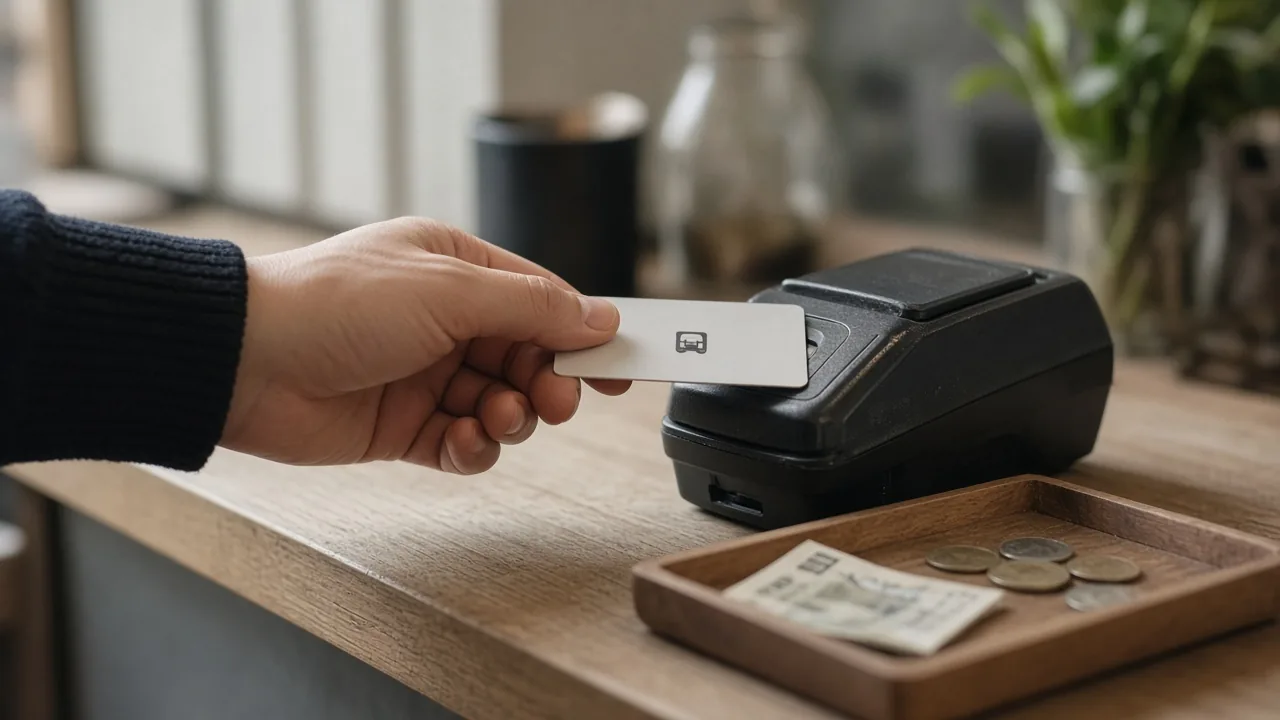
Is Korea a cashless society? Almost, but not entirely. Cash made up only 15.9% of payments in 2024, down from about 41% in 2013, according to the Bank of Korea’s payment survey as reported by Yonhap and Korea JoongAng Daily. Cashless Korea was not an accident of technology: a 1999 tax policy rewarded people for paying by card so that shops’ sales would be recorded, and convenience did the rest.
Last updated: October 31, 2026
Key takeaways
- By number of payments in 2024, credit cards made up 46.2%, debit cards 16.4%, cash 15.9% and mobile cards 12.9% (Bank of Korea survey of 19+ adults).
- Cash is far from gone for older people: those in their sixties and over used cash for about 30% of payments.
- The government created the card habit on purpose, in 1999, as a tax-collection tool, and it still shapes salaried workers’ year-end tax deduction.
- In cashless Korea, visitors can pay by card almost everywhere in cities, but some buses, kiosks and unmanned shops are card-only, and a few older businesses prefer cash.
How cashless is Korea really? The numbers behind cashless Korea

The Bank of Korea surveys adults about how they paid in a given year. The 2024 results, by number of transactions (not value):
| Payment method | Share of payments, 2024 |
|---|---|
| Credit card | 46.2% |
| Debit card | 16.4% |
| Cash | 15.9% |
| Mobile card (card stored on a phone) | 12.9% |
Together, cards and mobile cards covered about three quarters of payments. Age matters: among people in their sixties and older, cash was 30.2% of payments and credit cards 52.1%; among people in their twenties, credit cards were 38% and mobile cards 36.8%. Cash’s share was 21.6% in the previous survey three years earlier, according to press coverage of the release, and about 41% in 2013, so the direction is steady. These are self-reported survey results, so they show a trend rather than a count of every transaction.
Why did Korea go cashless? The 1999 tax decision
Cashless Korea started with tax policy. A 2013 paper from the Korea Institute of Public Finance explains it. After the 1997 financial crisis the government faced a deficit and a fairness problem: employees’ wages were reported to the tax office by employers, but many shop and restaurant owners were paid in cash, and unreported cash sales were common. Card payments leave a record held by a third party.
The tool was the credit card income deduction, introduced in September 1999 for salaried workers. Shoppers got a tax break for paying by card, and shops’ sales were recorded as a side effect. The paper lists the measures layered on top:
- Card acceptance rules: from 1998 the tax authority could designate businesses serving consumers as mandatory card participants (209 business types in 1999, 235 by 2009).
- Receipt lottery: from 2001 card slips entered a lottery (prizes up to 100 million won) to encourage lower earners; it ended in 2006.
- Cash receipts: from 2005, giving a phone number when paying cash reported the sale and earned the same deduction, because cash was still 57.4% of private consumption in 2002.
- Penalties: from July 2007, merchants who refused cards faced an extra tax penalty of 5% of the refused amount.
The paper says card payments rose from about 8.9% of private consumption in 1997 to 51.2% in 2009. This describes the rules as of 2013, not today’s law.
How does the card tax deduction work today?
Salaried workers can still deduct card use at year-end tax settlement. The National Tax Service (NTS) formula, citing Article 126-2 of the Restriction of Special Taxation Act:
Deduction = (card and similar spending − 25% of gross salary) × the rate
| Spending type | Deduction rate |
|---|---|
| Credit card | 15% |
| Debit card, prepaid card, cash receipts | 30% |
| Traditional markets and public transport | 40% |
The cap is 3 million won (2.5 million won for gross salary of 70 to 120 million won; 2 million won above that), per the NTS FAQ. Caps and extra allowances change by tax year, so check the current year.
Worked example (illustration): you earn 50 million won (about US$35,700), so your threshold is 12.5 million won. You spend 25 million won on a credit card: deduction = (25M − 12.5M) × 15% = 1.875 million won of taxable income. At a 15% income tax rate plus 10% local tax on it, that saves about 309,000 won (about US$220). Had the 25 million won been on a debit card, the formula gives 3.75 million won, but the 3 million won cap applies, so the deduction is 3 million won. That is why many Koreans use a debit card or ask for a cash receipt for everyday spending.
What do locals actually do in cashless Korea?

- Ask for a cash receipt. If you pay cash, give your phone number so the sale counts toward your deduction.
- Tap, don’t insert. Public transport, convenience stores and cafes work with tap cards and phones (see why Seoul’s public transport is so good).
- Skip the tip. There is no tipping to calculate (see do you tip in South Korea).
- Mix cards by purpose. Many use a credit card up to the 25% threshold and a debit card after it, since the debit rate is double (see how Koreans split their salary across accounts).
Who is left behind by cashless Korea?
Korea JoongAng Daily reported in October 2025 that 10 of 17 regions had introduced cashless buses, six of them fully (Gwangju, Daegu, Daejeon, Sejong, Incheon and Jeju), and that Seoul expanded cashless buses from 18 routes (436 buses) to 108 routes (1,876 buses) in March 2023. It also described a Japanese tourist with an empty card whom a driver let ride free. People most affected are older adults, foreigners without a Korean card, and rural residents: a study cited by the paper put ATM availability in some rural counties at only 24.3 to 33.5%. In a cashless Korea, a new resident may struggle to get a card at all (see why opening a bank account can be difficult for foreigners).
What does cashless Korea mean for you?
Visitors: bring a foreign card that works on Visa or Mastercard, a transit card (T-money or similar) and a small amount of cash, for example 20,000 to 50,000 won (about US$14 to $36), for markets, small shops and places that do not take your card.
Expats: ask for cash receipts and check your card spending against your threshold each year.
Workers: if you are a salaried employee, the deduction only applies to spending above 25% of salary, so tracking it matters most in the second half of the year.
Common mistakes: assuming every bus takes cash, forgetting to carry any cash for markets, and treating the deduction as a refund (it reduces taxable income, so the saving is a fraction).
Is cashless Korea really less cash-based than the US or the UK?
A look at official figures from other countries gives a more careful answer than “Korea is cashless”.
| Country | Cash share of payments | Source and basis |
|---|---|---|
| South Korea | 15.9% in 2024 | Bank of Korea survey of adults, by number of payments |
| United States | 14% in 2024 | Federal Reserve Diary of Consumer Payment Choice, by number of consumer payments |
| United Kingdom | Under 10% in 2024 (4.4 billion of 48.8 billion payments, about 9%) | UK Finance, Payment Markets Report, all payments |
On this evidence, Korea’s cash share by number of payments is close to the US figure and higher than the UK’s. That does not make Korea a cash society. It means “cashless” is better read as “card and phone dominate, and the tax system makes receipts matter” than as “no cash”. The three numbers come from different methods: a survey of adults, a three-day diary of consumer spending, and industry data that also include business and government payments. Treat the table as a rough comparison, not a ranking.
The US Federal Reserve also reports that nearly two thirds of cash payments in 2024 were made by consumers who prefer other payment methods, and that adults aged 18 to 24 used a mobile phone for 45% of payments. UK Finance reports that around 1.2 million people, just over 2% of adults, relied mainly on cash in 2024. Those are reminders that every country has some people who still rely on cash.
More worked examples: how much spending reaches the cap?
The earlier example used a credit card. Here are three further cases for the same 50 million won salary, with the threshold of 12.5 million won (25% of salary) and the 3 million won cap that the NTS FAQ gives for that salary band. They use the same formula and are illustrations.
- Lower credit card spending. Spend 18 million won on a credit card. The deduction is (18M − 12.5M) × 15% = 825,000 won of taxable income (about US$590). The deduction is far below the cap.
- How much credit card spending reaches the cap? The cap is reached when the excess times 15% equals 3 million won, which means an excess of 20 million won. Add the 12.5 million won threshold and you need about 32.5 million won of credit card spending (about US$23,200).
- How much debit card or cash receipt spending reaches the cap? At 30%, an excess of 10 million won reaches the cap, so you need about 22.5 million won of spending (about US$16,100).
The arithmetic shows why the earlier advice about using a debit card or asking for cash receipts is about reaching the cap with less spending, not about saving more than the cap. Once you pass the cap, extra spending adds no deduction under this formula.
How do you estimate your own deduction? A step list
- Find your gross salary for the tax year, from your payslips or tax statement.
- Multiply by 25% to get your threshold.
- Add up your spending by type: credit card, debit and prepaid cards and cash receipts, and traditional markets and public transport.
- Subtract the threshold from your card spending, and apply the rate for each type, as in the table above.
- Compare the result with your cap, which depends on your salary band.
- Remember that the deduction lowers taxable income. The tax saved is a fraction of it, as in the earlier example, and the rules change by tax year, so check the National Tax Service before you rely on the numbers.
More common mistakes in cashless Korea
- Treating the 15.9% as a ban on cash. Cash is still about one payment in six by number.
- Forgetting the threshold. The deduction starts only above 25% of salary.
- Spending far beyond the cap. Extra spending past the cap adds no deduction under the formula above.
- Assuming every bus or shop takes a foreign card. Cashless buses and unmanned shops exist, and a foreign card may not work everywhere.
- Using old numbers. Caps and rates change by tax year, as the NTS FAQ notes.
FAQ
Is Korea a cashless society?
Nearly. Cash was 15.9% of payments in 2024 by count, per the Bank of Korea survey, but it is still used, especially by older people.
Do I need cash in Korea?
Rarely in cities, but a small amount helps at markets, rural areas and older shops. Some buses, cafes and unmanned stores take cards or phones only.
What are cashless buses in cashless Korea?
Buses that accept only transit cards, bank cards or phone payments, not coins or bills. As of October 2025, ten of 17 regions had introduced them, according to Korea JoongAng Daily.
What is a cash receipt in Korea?
A record of a cash purchase linked to your phone number or card, reported to the tax office, so the spending counts toward the year-end deduction. It started in 2005.
Why do Koreans get a tax deduction for card spending?
The 1999 policy aimed to record the income of shops and restaurants. It remains part of year-end tax settlement, with a 25% of salary threshold and different rates by payment method.
Do foreign cards work in Korea?
Usually yes in cities, but some terminals and apps reject them. Carry a backup.
Is Korea more cashless than the United States?
By number of payments, the Bank of Korea reports cash at 15.9% for 2024 and the Federal Reserve reports 14% for the US in 2024. The surveys use different methods, so the figures are close but not directly comparable.
How much does the UK use cash compared with Korea?
UK Finance says cash was under 10% of all UK payments in 2024 (4.4 billion of 48.8 billion), lower than Korea’s 15.9%, but its data also include business and government payments.
Sources and further reading
Checked October 31, 2026.
- Bank of Korea: 2024 payment methods and mobile financial services survey (Korean)
- Hankyoreh: cash share falls to the 10% range (Korean)
- Yonhap: credit cards No. 1 payment tool in 2024, BOK poll
- National Tax Service: how to calculate the card and cash receipt deduction (Korean FAQ)
- Korea JoongAng Daily: Korea quickly going cashless but some get left behind, 28 Oct 2025
- Korea Institute of Public Finance (Jeon, 2013): credit card and cash receipt income deduction policy
- National Tax Service of Korea (English)
- Federal Reserve Financial Services: 2025 Diary of Consumer Payment Choice (May 13, 2025)
- UK Finance: Over half of UK adults now use mobile wallets (Payment Markets Report, October 1, 2025)