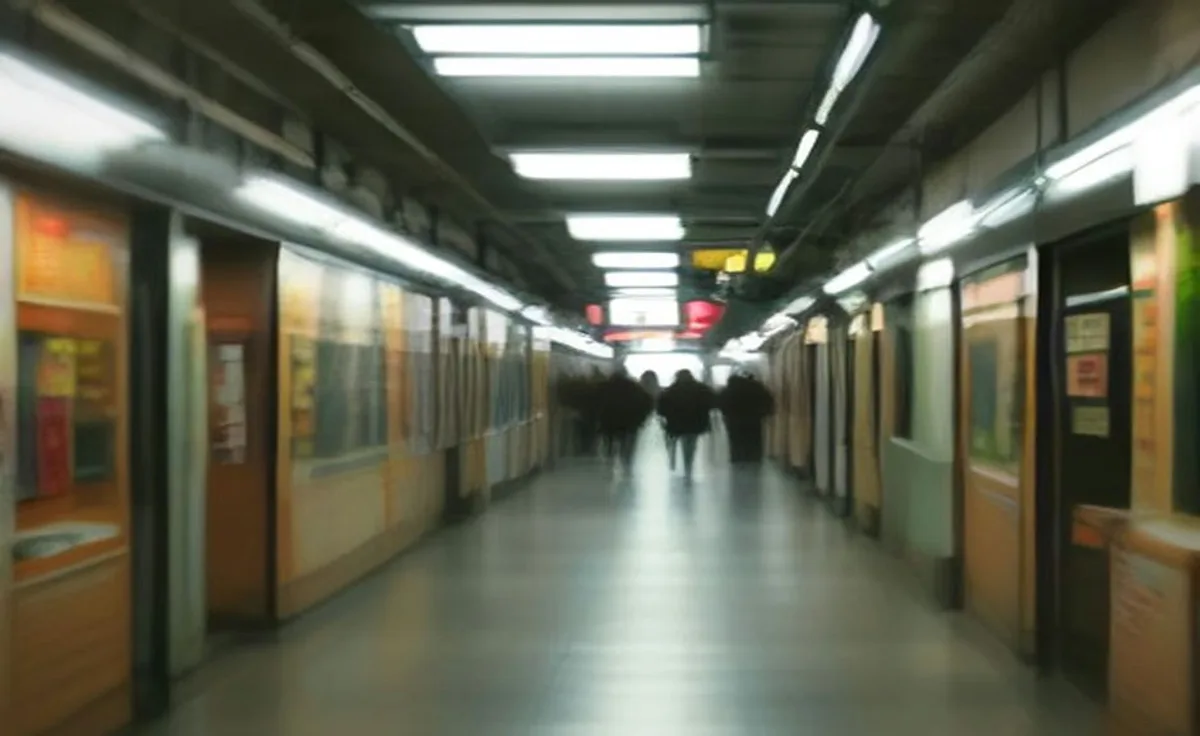
Seoul’s 지하상가 (jihasangga, underground shopping arcades) exist because the city needed three things at once in the 1960s and 70s and solved them with one hole in the ground: pedestrian crossings under traffic-choked roads, civil defence shelters, and infrastructure it could not afford. Seoul handed construction companies the right to operate shops in the tunnels for about twenty years in exchange for building them, so the retail was never an afterthought. It was the payment. The Seoul Facilities Corporation today manages 25 such arcades containing 2,788 shops.
| The arcade is | Because |
|---|---|
| A pedestrian tunnel | Wide roads and flyovers made surface crossing unsafe |
| A shelter | 1970s civil defence policy required underground refuge |
| A shopping street | Shop rent was how the city paid the builders |
| Publicly owned | It sits under a public road, so it is public property |
| Legally contested | Public ownership and private key money do not mix |
What is a jihasangga, exactly?
Walk down the stairs at Euljiro 1-ga or Myeongdong and you are not in a subway station. You are in a lit, tiled corridor that runs for hundreds of metres under a road, lined on both sides with small shops selling clothes, shoes, bags, watch repairs, phone accessories, tailoring and food. There are no cars, no weather and no daylight. Exits are numbered and marked to surface landmarks, and the corridor usually connects to a subway station at one or both ends.
Seoul distinguishes two kinds, and the difference is about who owns them:
- 지하도상가 (jihadosangga), underground passage arcades: built in the 1970s and 80s as civil defence shelters and pedestrian passages beneath public roads, and managed by the Seoul Facilities Corporation.
- 지하철상가 (jihacheolsangga), subway arcades: retail created inside station structures as lines opened, managed by Seoul Metro.
The corporation’s own inventory covers 25 arcades, 2,788 storefronts and roughly 177,000 square metres of floor area, grouped into the Euljiro, Jongno, Myeongdong, Gangnam, Terminal and Yeongdeungpo areas. Individual arcades are run partly by private operators and partly by the corporation directly.
Why did Seoul build shops underground instead of just tunnels?
Because the shops paid for the tunnels.
The arcades belong to a specific moment of Seoul’s growth. Under mayor Kim Hyon-ok in the late 1960s the city pursued what Korean urban historians call 도시 입체화, making the city three-dimensional: flyovers above the roads and passages below them, so that traffic could move without pedestrians in the way. Seoul’s first underground arcade, 새서울 지하상가 (New Seoul Underground Arcade), opened in 1967 as part of that programme. The Euljiro arcade followed in 1977 and connected to it, producing what was then the longest underground shopping stretch in the country. Korean historical scholarship on the development of Seoul’s underground space treats this as the founding period of the form.
The financing is the part that explains the retail. Rather than pay for construction from the municipal budget, Seoul granted the construction companies that dug the passages the right to operate the shops inside them for around twenty years, offsetting the build cost against future rent. The city got tunnels for almost no capital outlay. The builders got two decades of a captive retail corridor. Neither party had any reason to leave the walls blank.
Were Korean underground arcades really built as bomb shelters?
Yes, as one of their stated purposes, and this is not retrospective myth-making. Seoul’s own description of its arcade stock identifies the 1970s and 80s passages as developed for civil defence shelter alongside pedestrian movement.
The context was North Korea. Through the 1970s South Korea built civil defence into ordinary infrastructure, and a long reinforced-concrete corridor under a main road is a shelter whether or not anyone is selling socks in it. Many Seoul arcades are still signed as 민방위 대피소, civil defence shelters, and appear in the shelter registry. The dual use was deliberate: the shelter requirement justified the public expenditure, the pedestrian function justified the location, and the shops paid the bill.
This is also why they are concentrated where they are. Arcades cluster under the wide arterial roads of the old city centre, Euljiro, Jongno, Myeongdong, and around major interchanges, precisely where traffic was heaviest, pedestrian crossing was worst and the state most wanted shelter capacity.
Why are they useful for getting around Seoul?

Because an arcade is a weather-proof pedestrian network layered under the street grid, and Seoul’s climate makes that valuable twice a year. In a humid August or a sub-zero January, residents crossing the city centre route themselves underground without thinking about it. The corridors also link subway lines, department store basements and office building lower floors, so in parts of central Seoul you can walk a surprising distance without surfacing.
For a visitor this is why Seoul’s underground feels confusing: the layer is not one system. A subway station concourse, a city-owned road arcade and a private building’s basement can connect to each other while being owned, operated and signed by three different bodies. Follow exit numbers and surface landmarks rather than assuming a single map.
Why is the shopping so cheap, and why does it feel stuck in time?
The economics are unusual. A unit is small, has no street frontage, no window display visible from a road and no parking. What it has is footfall from people passing through for other reasons, and rent set against public property rather than a commercial market rate. That selects for high-turnover, low-margin goods and for long-tenured specialists: alterations, shoe repair, watch batteries, luggage, the single-line businesses that survive on regulars.
It also selects for stability bordering on stasis. Many arcades carry visible layers of the 1980s and 90s in their signage, tiling and merchandise mix, which is why some, such as the Hoehyeon arcade, have become destinations for vintage buyers rather than ordinary shoppers.
What is the fight over key money in Seoul’s arcades?
This is the live political problem, and it follows directly from how the arcades were built.
For about two decades Seoul’s ordinance let arcade tenants transfer their leasehold to an incoming merchant. In practice that meant 권리금 (gwolligeum, key money): a payment from the new tenant to the departing one for the right to the shop. Merchants treated it as the retrievable value of their business, often hundreds of millions of won.
In July 2018 Seoul amended the ordinance to ban leasehold transfer outright, affecting some 2,700 shops across the Euljiro, Myeongdong, Gangnam and Yeongdeungpo arcades. The city’s stated grounds were that the transfer clause generated illegal key money and offended social equity, and that an interpretation from the Ministry of the Interior and Safety held a municipal ordinance could not authorise the assignment of leasehold rights over public property under the Public Property and Commodity Management Act. Vacant shops would instead be let by competitive bidding, with key money no longer recognised.
Merchants protested that they had paid key money to enter in good faith and now had no way to recover it, framing the change as an expropriation of property rights. Myeongdong traders put the sums at stake in the hundreds of billions of won, and litigation seeking recognition of key money in the public arcades was dismissed. Illegal subletting in the arcades has continued to draw attention from city councillors.
The underlying contradiction is structural rather than anyone’s bad faith. The arcades are public property under public roads, which means they cannot be traded. They were built by a scheme that treated shop tenancies as a tradeable asset for twenty years, and merchants priced them accordingly. Both things are true, and the second one is now illegal.
What are the trade-offs?
The arcades are a genuinely good piece of city. They let people cross a hostile road network safely, work in all weather, carry shelter capacity the city would otherwise have to build separately, and support hundreds of small independent businesses at rents that no street-level location in central Seoul could offer. Few cities got this much infrastructure for so little public money.
The costs show their age. The financing model mortgaged the public asset to private operators for a generation and left a key money problem the city is still resolving against its own merchants. The spaces are windowless, often poorly ventilated, hard to make accessible, and physically dated in ways that are expensive to fix precisely because they are public. And as retail moved online and newer districts built air-conditioned malls above ground, the arcades’ captive footfall became less captive.
FAQ
How many underground shopping arcades does Seoul have?
The Seoul Facilities Corporation manages 25 road-passage arcades with 2,788 shops. Subway station retail is counted and managed separately by Seoul Metro, so totals you see elsewhere may differ depending on what is included.
Are Seoul’s underground arcades bomb shelters?
Many of the 1970s and 80s passages were developed for civil defence shelter as well as pedestrian movement, and are still designated as shelters. Subway-era arcades were built for different reasons.
Is shopping in a Korean underground arcade cheap?
Generally yes for clothing, shoes, bags and repairs, because units are small and overheads low. Prices are often negotiable and many shops prefer cash, though card payment is standard.
Which Seoul underground arcade should I visit first?
Euljiro and Myeongdong for scale and connection to the subway, Hoehyeon for vintage clothing and second-hand goods. Check current opening hours, since arcade shops keep shorter and more variable hours than malls.
Can I walk across central Seoul underground?
Partly. Connected stretches exist, especially around Euljiro, Jongno and Gangnam, but the network is not continuous and is formed from separately owned systems. Do not plan a long route on the assumption it joins up.
The structural answer
Seoul’s underground arcades are what a fast-growing, cash-poor, militarily anxious city built when it needed to move pedestrians, shelter them and avoid paying for either. Retail was the financing instrument, which is why the tunnels came out of the ground already full of shops. Sixty years later the city owns a useful pedestrian layer, a shelter network and a commercial district it cannot quite govern, because the asset is public but the businesses inside it were sold like private ones for twenty years. The arcades are not a quirk of Korean shopping culture. They are a 1960s public finance decision that people now buy socks in.
Related reading: Why Is Public Transportation So Good in Seoul? Why Is South Korea So Concentrated in Seoul? How Seoul Combines Nature and High-Tech Urban Life
Sources and further reading
- Seoul Facilities Corporation: underground arcade inventory, shop counts and management structure
- Korean History Research Association: the development of underground space in modern Seoul
- Opinion News: the Euljiro underground arcade, Seoul’s lower street
- News Post: the Hoehyeon underground arcade and its vintage trade
- Etoday: Seoul bans key money in underground arcades, vacant units to competitive bidding
- Greened: Myeongdong merchants on the sums at stake in the leasehold transfer ban
- Sisa Journal-e: litigation over key money in Seoul’s public arcades dismissed
- Seoul Shinmun: city council scrutiny of illegal subletting in the arcades
- Metro Seoul: hidden underground spaces beneath Seoul Plaza