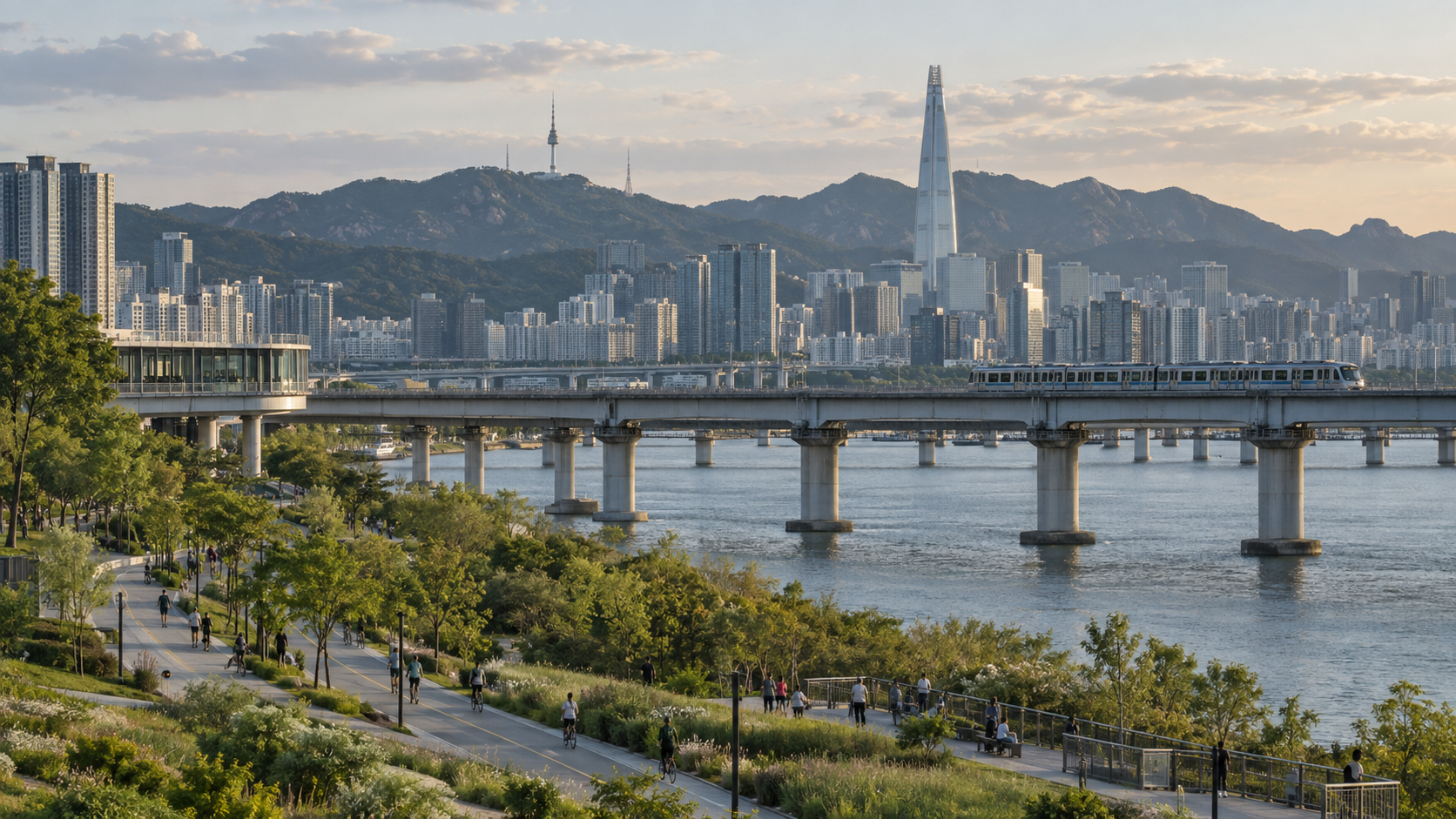
Seoul combines nature and high-tech urban life by concentrating dense housing, transit and digital services around a landscape shaped by mountains, the Han River and restored streams. Nature did not simply survive outside the city: geography constrained Seoul’s growth, while public projects connected parks, trails, waterways and transit to everyday life.
How does geography shape Seoul?
Wooded mountains rise inside and around the city, channeling development into valleys and along the river. Dense neighborhoods can therefore sit unusually close to trail networks and viewpoints. The Han River divides the metropolis while bridges and transit lines bind its districts together.
Why does Seoul feel both dense and green?
High-density development leaves sharp boundaries between built-up districts and steep terrain. Apartment towers, offices and stations may stand within minutes of riverside parks or mountain entrances. This is not untouched wilderness; it is a managed urban landscape supported by reforestation, trail maintenance and park investment.
How did public projects reconnect nature and city life?
Projects such as the restoration of Cheonggyecheon replaced road infrastructure with a public stream corridor. Riverside parks, neighborhood greenways and mountain trails now form a network of recreational spaces connected by public transportation.
What makes Seoul a high-tech city?
Digital payment, real-time transit information, fast communications and extensive public data make city systems easier to navigate. Seoul also uses spatial data and smart-city tools for planning and services. The important point is not technology for its own sake, but how it lowers the friction of moving through a very large city.
Is the balance perfect?
No. Heat, flooding, air pollution, habitat pressure and unequal access remain serious concerns. Popular trails and river parks require constant maintenance, while redevelopment can reduce local green space even as the city promotes larger flagship projects.
FAQ
Are mountains really inside Seoul?
Yes. Several prominent mountains and extensive trails lie within the city boundary and are reachable by public transportation.
Is Seoul a green city?
Seoul has abundant mountains, river parks and restored waterways, but environmental quality varies by district and season.
Why is Seoul so technologically convenient?
Dense demand, long-term infrastructure investment and coordinated digital services make real-time information and cashless systems widely useful.
The mountain and the megacity
Seoul’s distinctive character comes from overlap rather than separation. Nature constrains the city, the city manages nature and technology helps residents move between both.