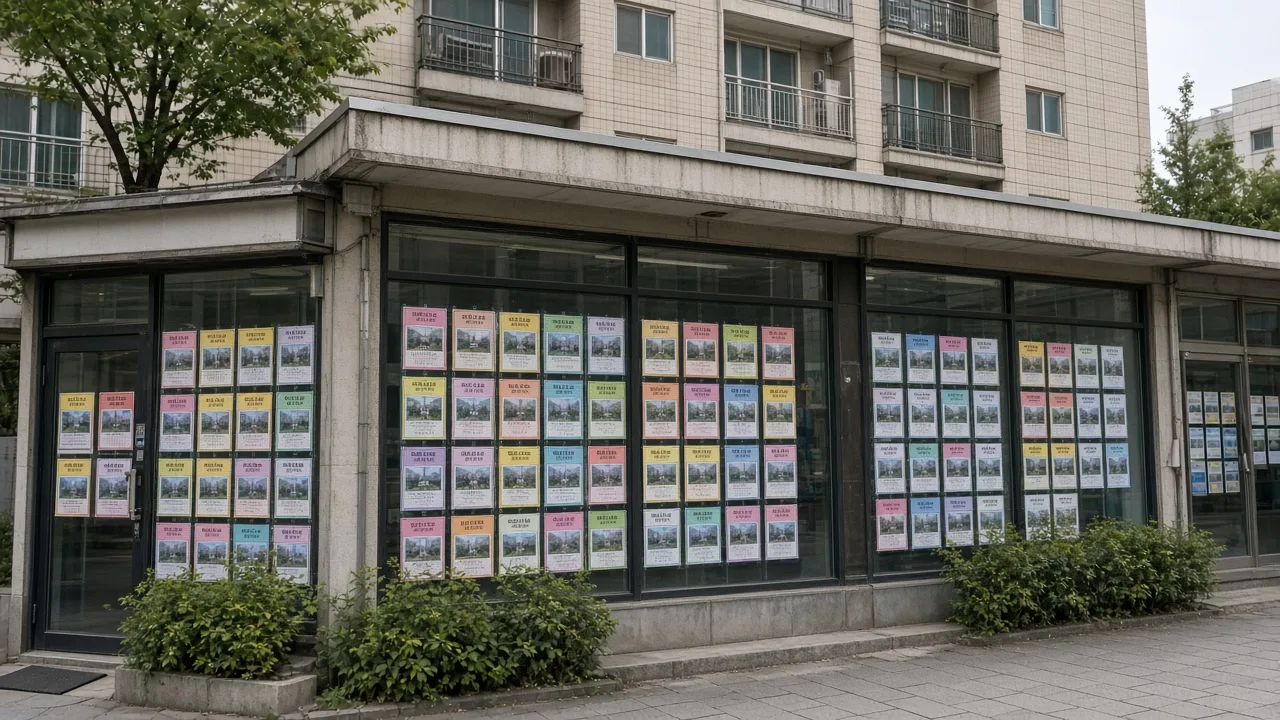
There are so many real estate offices in Korea because home sales and rentals are commonly arranged through a licensed agent with legal duties to check the property, because the agent’s fee is capped by law, and because more than half a million people have earned the national license. Korea Association of Realtors figures show about 109,320 licensed agents running offices at the end of 2025, and 551,879 people holding the license. The number has now started to fall. This guide explains why Korea ended up with a “budongsan” (부동산, real estate office) on almost every corner, what an agent legally has to do for you, what the fee caps are, and why the glut is shrinking.
How big is the real estate agent industry?
The Korea Association of Realtors reported in January 2026 that 9,150 agents opened a new office in 2025. That is the smallest number since 1998, the year of the IMF financial crisis, when 7,567 opened. In the same year 11,297 closed and 1,198 suspended business, and the number operating fell from 111,794 in January to 109,320 in December, the first time in about five years that it dropped below 110,000, according to Yonhap and Newsis.
The same figures show the scale of the pool. Maeil Business Newspaper noted that, with 551,879 people holding the license at the end of 2025, only about one in five was running an office.
The decline began earlier. Yonhap reported in April 2025 that the number of agents in business had fallen every month since February 2023, when it peaked at 117,923. Newsis added that closures and suspensions have outnumbered new openings every month since February 2023.
These are people, not buildings: the association counts licensed agents who are operating (개업 공인중개사). A single office can have more than one agent, so the figures are not a count of storefronts.
Why Korea needs so many agents
Three features of the housing market explain the demand.
1. The law gives agents a formal role. A Korean home is commonly viewed, priced and contracted with a local agent, and the law gives the agent a formal role: under the Licensed Real Estate Agents Act, before a deal is completed the agent must check the condition, location and rights over the property and any legal restrictions on trading or use. The agent must explain them to the client and show supporting documents such as the land register, the real estate registry certificate, the trust record and the building register. The agent then writes up the explanation in a document, signs and seals it and gives it to the parties.
2. The deals are large. The deposit systems described in our guides on jeonse and large rental deposits mean a renter hands over a deposit worth a large share of a home’s value. With that much cash at stake, it is natural for tenants to want a licensed professional to check the paperwork.
3. Courts have made the duty strict. According to a court precedent summarized on the Korean legal-information site govbrief, an agent who mediated leases in a multi-household house wrote down the total of earlier tenants’ deposits as the landlord gave it, even though the landlord had refused to provide documents and the amount was far below the real figure. Tenants later lost part of their deposits in an auction. The court held that the agent should not have passed on information that may be wrong as if it were true, and that an agent mediating such a lease must ask the landlord for the other tenants’ deposit and lease dates and explain them to the client, not stop at the registry. A rule like this makes a professional’s checking a normal part of the process.
Local knowledge keeps offices small and everywhere
The practical reason offices are everywhere is that real estate is local. Agents commonly specialize in one apartment complex or a few blocks, because that is where they know the prices, owners and tenants. That is why a Korean apartment complex often has a row of offices at its gate or in its shopping arcade, each advertising the same flats. This is an observation about the market, not an official statistic.
What the agent’s fee is, and who sets it
The fee is capped by regulation. Under the rules in force since 19 October 2021, as published by the Seoul Metropolitan Government, the maximum fee for housing is a percentage of the transaction price. Within that ceiling, the client and the agent negotiate. VAT is not included.
| Deal | Transaction price | Maximum rate |
|---|---|---|
| Sale | ₩200M to under ₩900M | 0.4% |
| Sale | ₩900M to ₩1.2B | 0.5% |
| Sale | ₩1.2B to ₩1.5B | 0.6% |
| Sale | ₩1.5B and over | 0.7% |
| Lease (jeonse or monthly rent) | ₩100M to under ₩600M | 0.3% |
| Lease | ₩600M to ₩1.2B | 0.4% |
| Lease | ₩1.2B to ₩1.5B | 0.5% |
| Lease | ₩1.5B and over | 0.6% |
For smaller deals, Seoul lists higher rates with fixed caps (for example 0.6% up to ₩250,000 for sales under ₩50M). For a monthly-rent lease the “transaction price” is the deposit plus 100 times the monthly rent (or 70 times if the total is under ₩50M). Officetels and shops follow different rules; officetels of 85㎡ or less with a kitchen and bathroom are capped at 0.5% for sales and 0.4% for leases, and other non-housing property at up to 0.9%. If you are comparing, see what an officetel is.
A capped percentage limits what an agent can charge, so income depends on how many deals close. When sales fall, income falls with them.
Why the number is shrinking
The association says the drop is due mainly to fewer new openings, not more closures, and that the reason is weak profits. In its account, regulation reduced the number of homes listed and the volume of deals. Maeil Business Newspaper reported that the housing slump began in the second half of 2022 and that the association chief pointed to the loan cap of 600 million won in the capital region (the June 27 measures) and the October 15 measures, which designated all 25 Seoul districts and 12 areas of Gyeonggi as regulated zones and land transaction permit zones. That is the association’s view: its chief argued that the government is concentrating on stopping price rises while agents and end users are neglected.
Yonhap also reported that the number of new openings in January and February 2025 was 1,796, the fewest since 2000, which the association read as a sign that the market is saturated. It added that some owners cannot recover their premium (the “key money” described in our guide to gwolligeum) and so keep their offices open reluctantly, and that more than 2,500 offices are listed for sale on the association’s website. The number of people taking the licensing exam in 2024, 154,669, was the lowest in eight years.
What to do if you rent or buy through a Korean agent
- Ask for the explanation document. The agent must give you a written confirmation and explanation of the property’s condition and rights, signed and sealed.
- Check the registry and the building register yourself too. The agent must show them, and for a multi-household house you should ask about the other tenants’ deposits.
- Confirm the fee in writing. The maximum rate is a ceiling, and the amount is negotiated within it. VAT is extra.
- Use the Seoul guide if you are a foreigner. The Seoul Metropolitan Government publishes an English guide to brokerage fees.
FAQ
Why are there so many real estate agents in Korea?
Homes are commonly traded through licensed agents who must verify and explain a property’s rights, the fee is capped by law, and 551,879 people hold the national license. The result was more than 110,000 agents in business until late 2025.
How many real estate agents are there in Korea?
About 109,320 licensed agents were operating at the end of 2025, according to the Korea Association of Realtors, out of 551,879 license holders. The number has fallen each month since February 2023.
How much do Korean real estate agents charge?
The fee is a percentage of the price with a legal maximum. For a home sale from ₩200M to ₩900M the cap is 0.4%, and for a lease from ₩100M to ₩600M it is 0.3%. The parties negotiate within the cap, and VAT is extra.
Do I need an agent to rent a home in Korea?
An agent is the common route. The agent must check the registry and building records and give you a written explanation of the property.
Are Korean real estate offices closing?
More offices closed or suspended than opened every month from February 2023 through December 2025, and 2025 had the fewest new openings since 1998.
Sources and further reading
- Yonhap News, “New licensed agent openings last year the fewest since 1998” (22 January 2026, Korean): yna.co.kr
- Newsis, “‘We cannot even pay the rent’: new agent openings at the lowest since the IMF crisis” (22 January 2026, Korean): newsis.com
- Maeil Business Newspaper, “‘I do not know what is different from the IMF era'” (22 January 2026, Korean): mk.co.kr
- Yonhap News, “New licensed agent openings lowest in 25 years” (13 April 2025, Korean): yna.co.kr
- Seoul Metropolitan Government, “Seoul Guide to Real Estate Brokerage Fees” (English): english.seoul.go.kr
- Licensed Real Estate Agents Act, Article 25, with related court cases (Korean): govbrief.kr