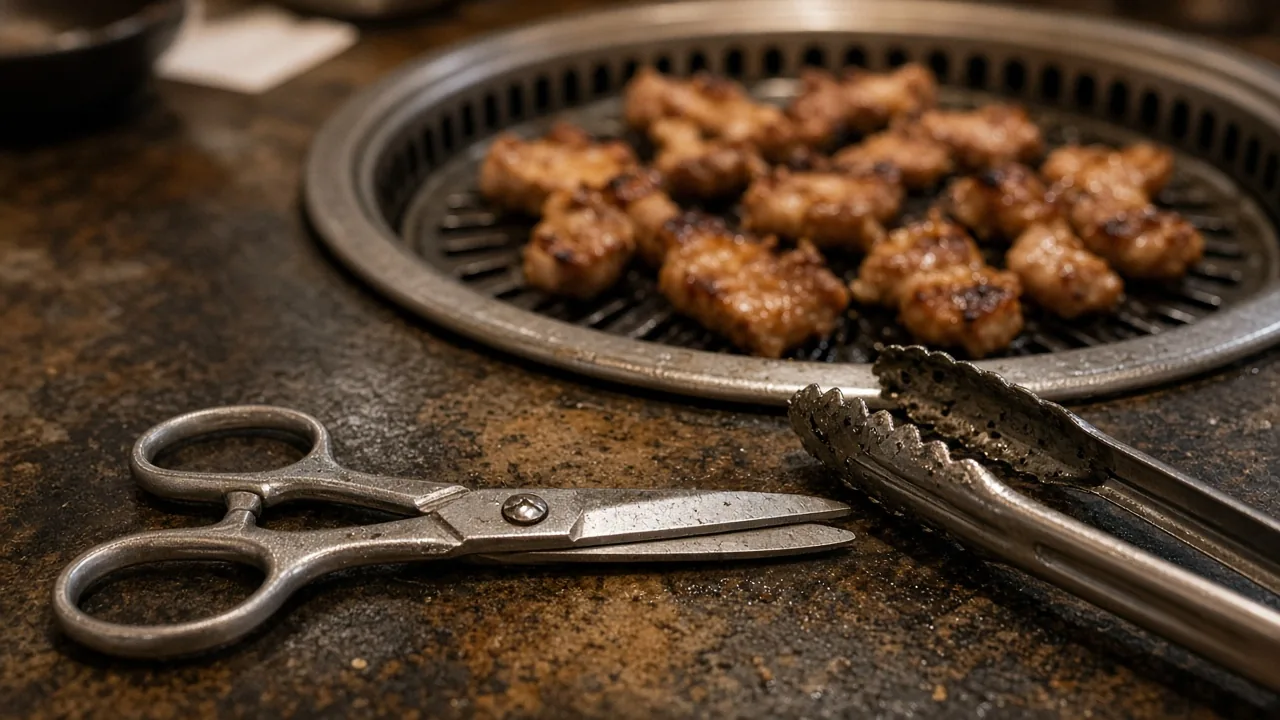
Korean food scissors are an ordinary dining tool in Korean restaurants and homes. At a barbecue restaurant, someone cuts grilled meat into bite-sized pieces over the grill with scissors. At a noodle restaurant, a server may offer scissors to shorten cold noodles. The habit is not ancient: sources place its spread in the late 1970s and 1980s, though they disagree on where it began.
Last updated: October 31, 2026
Key takeaways
- Koreans use scissors for grilled meat, noodles, kimchi and other foods because they are fast and need no cutting board.
- The practice dates from roughly the 1970s to 1980s, not from older tradition. Sources disagree about whether naengmyeon or galbi restaurants came first.
- Food scissors are a distinct tool: rounded tips, bigger grips and stainless steel, according to Stripes Korea.
- Some foreigners find it startling, and one Korean columnist has also criticised it.
Korean food scissors at a glance: Korean food scissors are a common table tool for cutting grilled meat, cold noodles and kimchi into bite-sized pieces. The habit spread in the 1970s and 1980s, and sources disagree on whether noodle or galbi restaurants came first. Korean food scissors are a distinct tool, with rounded tips, large grips and stainless steel blades, and they are kept for food only.
What do Koreans cut with Korean food scissors?
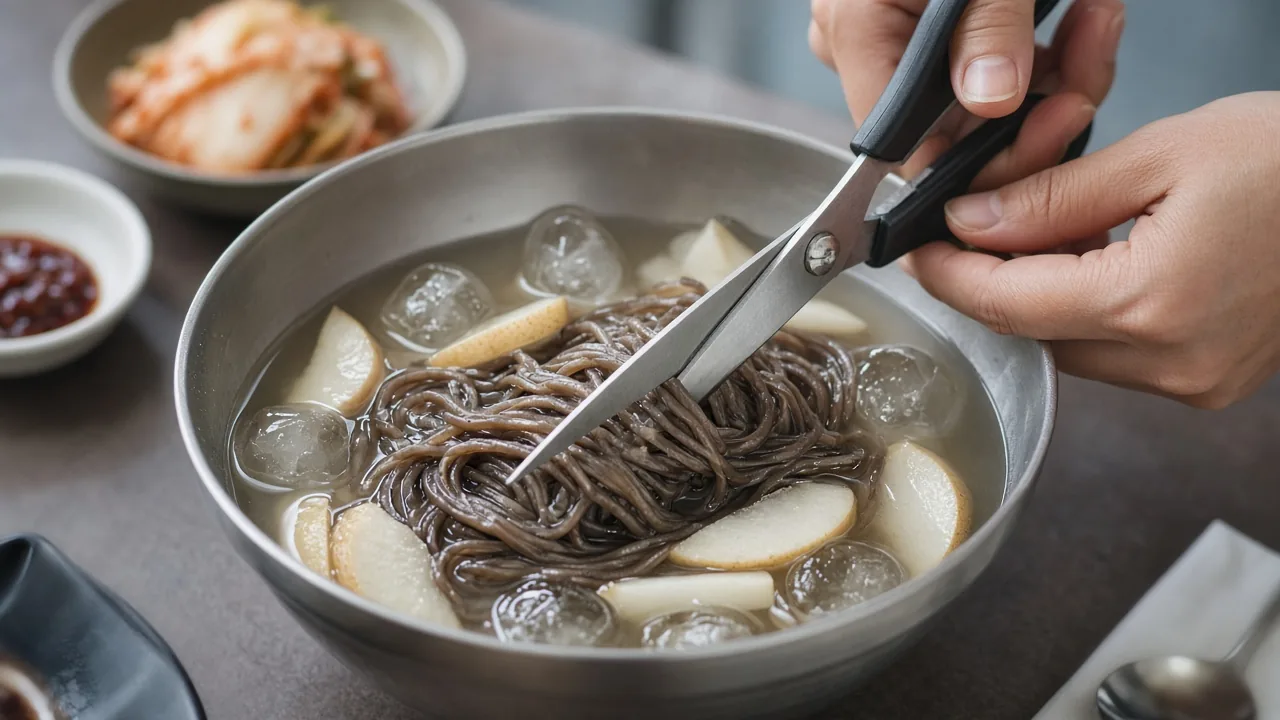
According to Stripes Korea, scissors are common for “grilled meat at Korean BBQ joints, and restaurants that serve ox bone soup and kal-guksu noodle soup.” They are also used for kimchi and other vegetables, and food-stall staff use them to cut fried vegetables or squid before serving. In Kakao Pay’s explainer, cutting kimchi and food with scissors is described as an everyday habit.
Why scissors instead of knives?
The explanations in the sources are practical:
- No cutting board. Kakao Pay’s explainer says there is no need to take out a board, and Stripes Korea notes scissors save washing a board and plate.
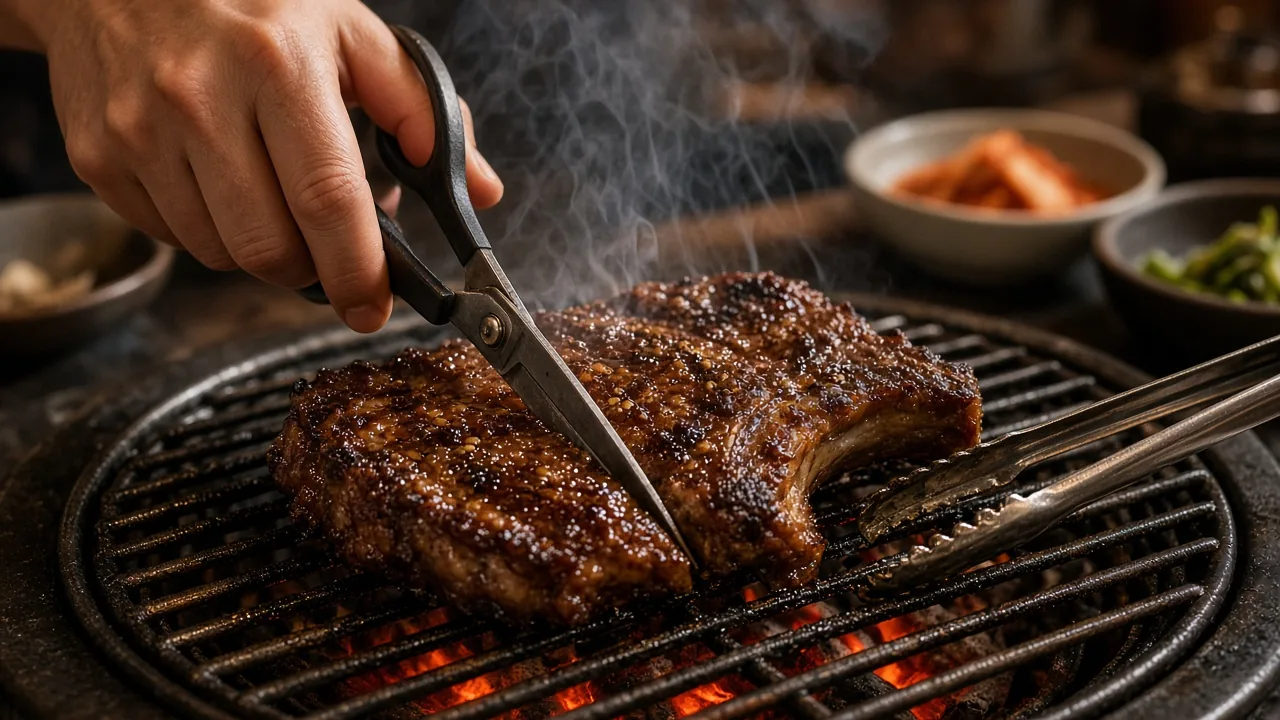
- Cutting on the grill. Meat is cut straight on the grill into shareable portions.
- Noodles. Cold noodles are long and chewy, and scissors shorten them quickly.
- Table setting. Korean place settings usually have chopsticks and a spoon but no knife, so a shared cutting tool fills the gap. This is an observation, not a claim from the sources.
Where did the habit come from?
Two accounts, and neither cites a primary source:
| Account | Source | Story |
|---|---|---|
| Noodles first | Korea Times column by Yang Dong-hee (2015); repeated by Stripes Korea (2024) | Scissors began in naengmyeon (cold buckwheat noodle) restaurants in the 1970s and then spread to meat and seafood |
| Galbi first | Kakao Pay explainer (September 2026) | From the late 1970s in upscale grilled-galbi restaurants, then in 1980s suburban “garden” restaurants as car ownership grew, then noodles; pork restaurants adopted scissors later because pork was pre-sliced thin before the 1990s |
Both accounts agree on a timeline of roughly the last 50 years, not the Joseon dynasty. Stripes Korea says it was “originally not a traditional custom in Korea.” This article does not choose between the stories.
Was there a hygiene campaign?
Kakao Pay’s explainer says that in the early 1980s restaurants often used large cast-iron shears from the clothing trade, which rusted and looked unsafe. Before the 1986 Asian Games and the 1988 Seoul Olympics, it says, the government banned cutting shears in restaurants and required sanitary scissors, and a design campaign gave rise to plastic or rubber handles and stainless blades.
No second source for the scissor-specific campaign could be found. Maeil Business Newspaper’s 1980s archive does show the government tightening restaurant hygiene before the Games, including open kitchens for new restaurants and inspections, but none of the archive items checked mentions scissors. Treat the campaign story as plausible but unverified.
Why is a kitchen scissor not an office scissor?
Stripes Korea says food scissors differ from office scissors: they have rounded tips and a larger grip to apply force on tough cuts of meat, and heat-treated stainless steel to prevent rust. Many Korean households keep a pair just for the kitchen, separate from the paper scissors.
Not everyone likes it
The 2015 Korea Times column is critical. The writer lists scissors at the table among restaurant practices he dislikes, says foreigners have told him it was a “scary and appetite-killing experience”, and suggests smaller, safer scissors. He also argues that restaurants use scissors to speed up turnover, which is his opinion rather than evidence. Kakao Pay’s explainer notes that some foreigners find cutting food with scissors unpleasant because they use dinner knives.
When scissors appear and how to handle them
Visitors: you do not need to bring any. Stripes Korea describes cutting meat directly on the grill with scissors, and VisitKorea notes that some meat restaurants have staff grill the meat for you. If you are unsure, ask. Restaurant etiquette also differs on tipping; see tipping in South Korea.
Expats and renters: keep a pair of kitchen scissors for food only, separate from paper scissors, as many Korean households do.
Workers: scissors often appear at team meals around a grill.
Common mistakes with Korean food scissors: using office scissors for food, assuming the habit is centuries old, and treating the origin story as settled.
For late-night food culture, see why South Korea has so many convenience stores and why food delivery is so convenient.
Were scissors always part of Korean life?
Scissors themselves are old. The Encyclopedia of Korean Culture (Academy of Korean Studies) says the oldest scissors found in Korea came from the Bunhwangsa pagoda, built in the Silla period: a primitive, single-piece iron form with no handle, whose two blades crossed at a narrow rounded base. Goryeo-period remains show two shapes, that early form and the X-shaped scissors we know today, with many handle designs. Most Joseon scissors were X-shaped, mostly of cast iron, and late in the Joseon period handles appeared with different left and right sides, one for the thumb and one for the other four fingers. The entry describes scissors as tools for cutting cloth, paper and hair, not for food.
Another traditional scissor was a showpiece. The National Folk Museum of Korea describes the yeot scissors of the sweet-candy seller as blunt, with a loose fastener, used more for the noise that draws attention than for cutting, and as a hammer-like tool for breaking hard candy. So the scissors in Korean history were tools for sewing and for performance. That fits the accounts above, which put the dining-table scissor in the last 50 years.
Which foods are cut with scissors? A quick guide
The sources name these uses of Korean food scissors:
| Food or setting | What is cut | Source |
|---|---|---|
| Korean BBQ | Grilled meat, directly on the grill, into shareable portions | Stripes Korea |
| Cold noodles (naengmyeon) | Long noodles, shortened | Stripes Korea; Kakao Pay |
| Noodle soup and ox bone soup restaurants | Noodles and meat | Stripes Korea |
| Kimchi and vegetables | Whole kimchi and other vegetables | Stripes Korea; Kakao Pay |
| Food stalls | Fried vegetables and squid before serving | Stripes Korea |
Pork is a special case. According to Kakao Pay, pork restaurants adopted scissors later, since before the 1990s pork was often served pre-sliced thin.
How do you use Korean food scissors at a restaurant? A step list
- Sit down and order. VisitKorea says that Korean restaurants do not expect tipping, and that every table has a call bell for the staff.
- If you order grilled meat, the grill is on the table, and VisitKorea notes that some places grill it for you.
- When the meat is ready, use the table scissors to cut it into bite-sized pieces on the grill. Stripes Korea says this saves time and makes shareable portions.
- For noodles, cut once or twice to shorten the strands if you find them too long.
- For a ssam wrap, VisitKorea says to put the meat on lettuce or perilla leaf with ssamjang and eat it in one bite.
- If you are unsure what to do, ask the staff. VisitKorea says they are always ready to help.
Korean food scissors are the newcomer here. The VisitKorea page also notes that the spoon plays a central role at Korean tables, used for rice and soup and even for cutting or moving food. Scissors are a modern addition to a table that already uses a spoon for many jobs.
How to read the sources on this topic
The evidence is thin, so it is worth knowing what each source is:
- Kakao Pay Pay Attention (2026): a corporate explainer. It gives a clear story with dates, but cites no documents.
- Korea Times column (2015): an opinion column by a guest writer. Stripes Korea repeats the 1970s naengmyeon claim from it.
- Stripes Korea (2024): a feature by a staff writer, partly personal. Its design details (rounded tips, bigger grip, heat-treated stainless steel) are stated without citation.
- Encyclopedia of Korean Culture and the National Folk Museum: reference sources on scissors in general, not on dining.
A firm answer would need dated restaurant records or industry sources, such as when scissor makers began selling kitchen models. None was found. Until then, the honest summary is “about the 1970s to 1980s, origin disputed”.
What should you look for in Korean food scissors?
Stripes Korea’s design points are a useful checklist: rounded tips, a larger grip for force on tough cuts, and heat-treated stainless steel against rust. Many Korean households keep a pair that is only for food. If you buy one, keep it separate from your paper scissors for the same reason.
Quick answers
Why do Koreans cut food with scissors?
Because it is fast, needs no cutting board and works on grilled meat, noodles and kimchi, according to Stripes Korea and Kakao Pay’s explainer.
When did Koreans start using scissors in restaurants?
Roughly from the late 1970s and 1980s. Sources disagree whether naengmyeon or galbi restaurants came first.
Are Korean food scissors different from regular scissors?
Yes, according to Stripes Korea: rounded tips, larger grips and stainless steel.
Do Koreans cut noodles with scissors?
Often, especially cold noodles, which are long and chewy.
Is it impolite to use scissors at the table in Korea?
It is normal in Korean restaurants. Sources describe foreigners being surprised, but no etiquette rule against it is documented.
Were there scissors in Korea before the 20th century?
Yes. The Encyclopedia of Korean Culture dates the oldest scissors found in Korea to the Silla-era Bunhwangsa pagoda, but describes them as tools for cloth, paper and hair, not for dining.
Do Korean restaurants expect a tip?
No. VisitKorea says there is no need to tip at Korean restaurants.
Sources and background
Checked October 31, 2026.
- Kakao Pay Pay Attention: Why do Koreans cut food with scissors? (Korean, September 25, 2026)
- Stripes Korea: Scissors make the cut in Korean kitchens, November 2024
- Korea Times: opinion column by Yang Dong-hee on restaurant scissors, 2015 (secondary source, opinion)
- Maeil Business Newspaper: 1980s restaurant hygiene reports (Korean, archive)
- Encyclopedia of Korean Culture (Academy of Korean Studies): Scissors (Korean, last revised June 16, 2026)
- National Folk Museum of Korea webzine: What are yeot scissors for? (Korean, 2018)
- VisitKorea: About Korean Food (English, July 2025)