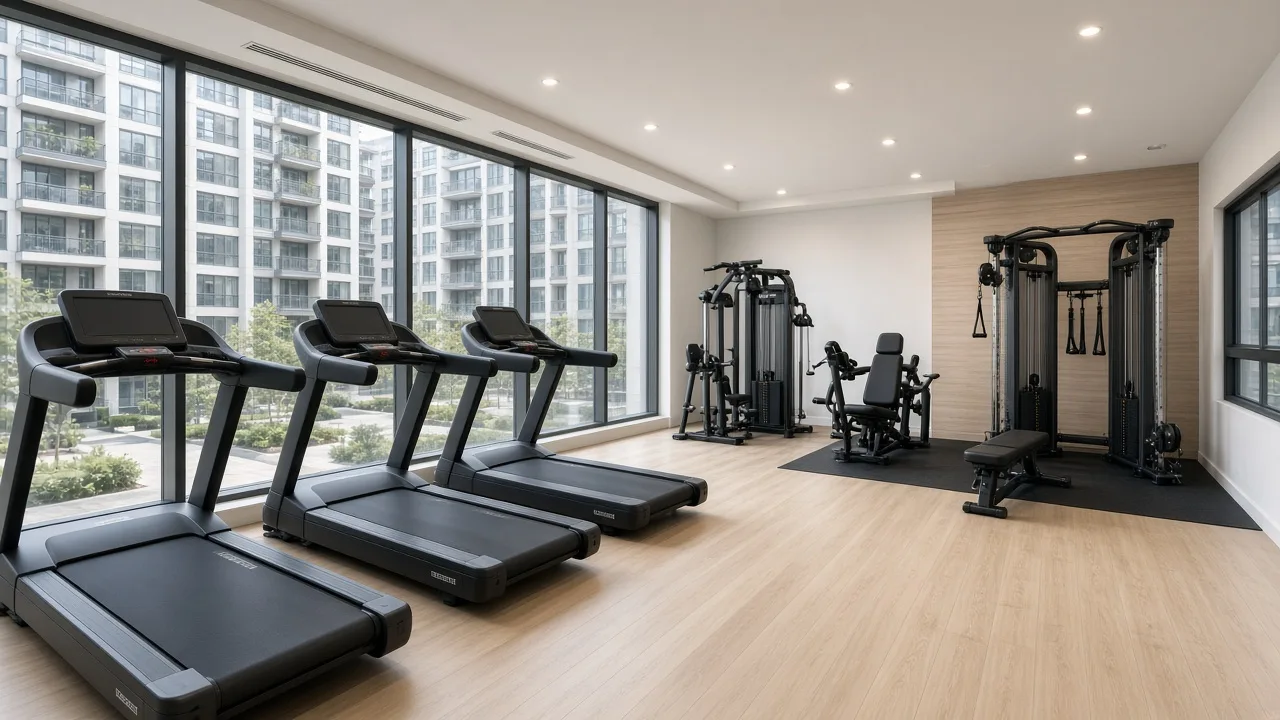
Korean apartment complexes have so many facilities because the law requires large complexes to include shared spaces such as a senior center, a children’s playground and a daycare, and because developers now compete on gyms, pools, lounges and libraries to sell new homes. The rules set a minimum. Marketing sets the ceiling. In late October 2026 the Ministry of Land, Infrastructure and Transport began a study on whether the standards need to change, because the more lavish the amenities, the more they can add to sale prices and monthly costs. This guide explains what is required, what is optional, and why a swimming pool can turn into a burden.
What Korean apartment complexes must include by law
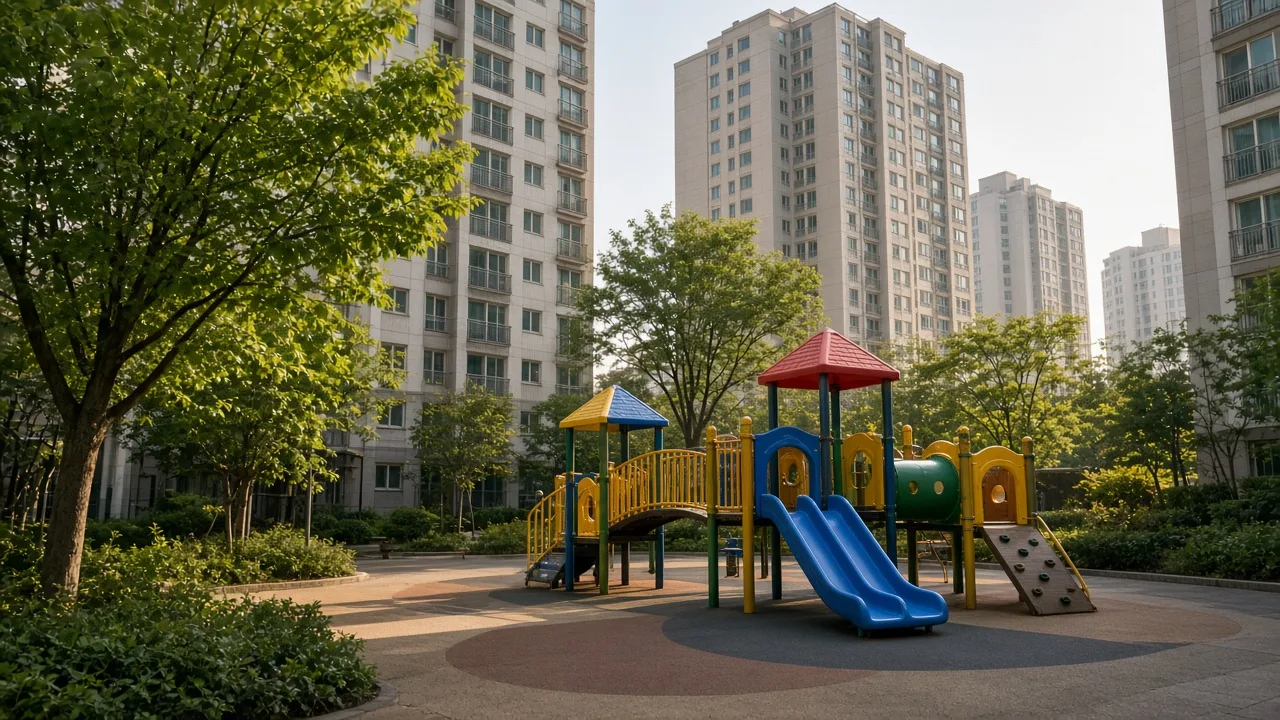
The baseline is in the Housing Construction Standards Regulation, Article 55-2 on “resident common facilities” (주민공동시설), in the version that took effect on 8 September 2026. Its main rules are:
- Any complex of 100 households or more must have resident facilities of a minimum floor area. For 100 to 999 households, the area is 2.5㎡ per household. For 1,000 households or more it is 500㎡ plus 2㎡ per household. A city or county can tighten or relax this by up to a quarter through a local ordinance.
- Which facilities must be included depends on size:
| Complex size | Required facilities |
|---|---|
| 150 households or more | Senior center, children’s playground |
| 300 households or more | Senior center, playground, daycare center |
| 500 households or more | Senior center, playground, daycare center, resident exercise facility, small library, after-school care center |
- Some can be skipped. The permit authority can waive a facility it judges unnecessary given the complex and local supply. A small library is not required if a public library is within 300 meters or planned in the complex. An after-school care center is not required if a majority of prospective residents oppose it in writing.
- There are design rules. An outdoor playground must be at least 3 meters from neighboring lots, internal roads and parking. A senior center needs good sunlight, a multipurpose room, separate space for men and women, and water, cooking and toilet facilities. A daycare must be installed by the time the building passes its use inspection. A small library must meet the Library Act standard, which sets a minimum floor area of 33㎡.
The wording of the regulation was amended on 30 June 2026, so older guides may list different thresholds. Check the current version if it matters for a specific project.
The broader legal category these belong to is set by the Housing Act, which defines welfare facilities for residents to include a children’s playground, neighborhood facilities, a kindergarten, a resident exercise facility and a senior center.
These requirements explain the baseline you see in almost any large complex: a playground between the buildings, a senior center, a daycare and often a small library. For why apartments dominate Korean housing in the first place, see why apartments are so popular in South Korea.
How facilities became a selling point
Meeting the minimum is no longer what sells a flat. Maeil Business Newspaper’s English edition reported on 27 October 2026 that facilities have become a key axis of competition in high-end and differentiated housing. The paper said the range has widened from senior centers and playgrounds to fitness centers, swimming pools, saunas, golf practice ranges and sky lounges.
It gave examples from redevelopment projects in Seoul:
- A pilot-apartment reconstruction in Yeouido won by Samsung C&T is to include about 9,591 pyeong of community facilities, among them a sky lounge with a view of the Han River.
- Hyundai Engineering & Construction’s plan for Banpo Jugong Complexes 1, 2 and 4 in Seocho-gu included an indoor ice rink, a water park, an opera house and a rock-climbing facility.
- Gaepo Xi Residence in Gangnam-gu, which rebuilt Gaepo Jugong Complex 4, installed an infinity pool.
The paper added that the facilities, concentrated in luxury complexes, increasingly influence the symbolism and the value of a complex. (The pyeong is a traditional area unit of about 3.3 square meters.)
This marketing happens alongside the sale system. Apartments are often sold before they are built, and buyers choose from drawings, models and brochures; for how that works, see our guide to the Korean housing subscription account. In a brochure, a pool and a sky lounge are easy to picture.
The cost problem: what the ministry is worried about
The same report explains why the government is now involved. Spending on facilities raises construction costs, which can push up the sale price, and facilities may be neglected after completion because of the burden of running them. The Ministry of Land, Infrastructure and Transport said it was concerned that specialized community facilities could add to long-term housing costs, such as management costs and long-term repair provisions after moving in, as well as construction costs and sale prices. It put out a tender for a study titled “Study on the Installation and Operation of Multi-Family Housing Welfare Facilities”, and said it would survey the facilities of complexes of 150 households or more that were approved and completed in the past five years. It will look at possible duplication with neighborhood and community facilities, and at the role of local governments in supervision. The result could be changes in regulations or law.
The monthly costs of an apartment are explained in our guide to Korean apartment maintenance fees.
What happens after move-in
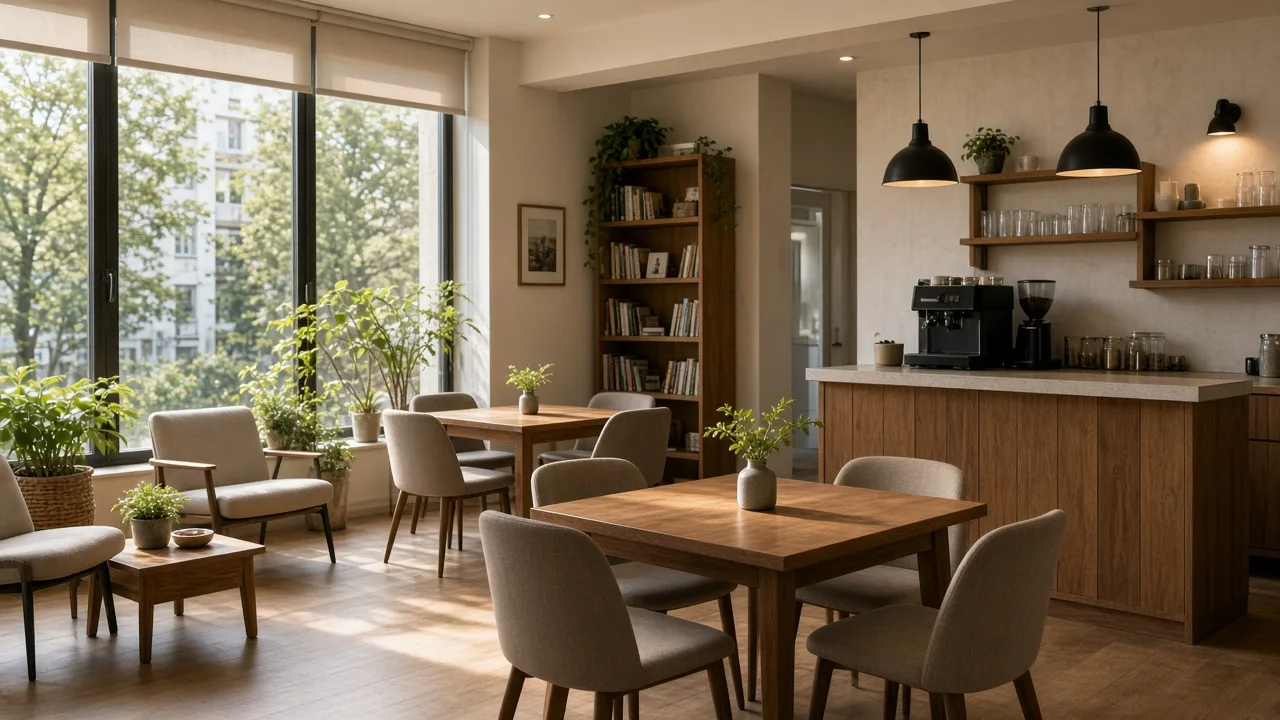
Korea Apartment News (한국아파트신문) reported in March 2026 that glamorous facilities such as pools, cinemas and high-end saunas have long counted as a measure of a complex’s value in the sales market, but after residents move in they can become a nuisance. Low usage and swelling deficits can turn them into a main culprit of heavy management fees and a source of disputes among residents. The paper described how some complexes responded:
- Raemian Anyang Megatria (4,250 households, Anyang). After contracting out operation led to chronic deficits, the management office and the residents’ council switched to self-operation from May 2024. They added classes by age group, redesigned the cafeteria menu, turned a neglected storeroom into an unmanned cafe and introduced online booking through the apartment app. Community income doubled afterwards, and the surplus now goes to improving the facilities.
- A 6,000-household complex in Gangnam. It has a sauna, bowling alley, pool, a pet shower room and a shared office, and all are used actively thanks to about 80 community staff. Staff say a deficit is unavoidable if residents are to have cheap, good facilities, so the aim is to narrow it, in part by repairing equipment themselves. The complex also lets residents bring guests who pay an extra fee.
- I’Park City Complex 1 (1,254 households, Daejeon). It turned a space for a sculpture into a community lounge using a district grant, and linked its cafe with a local bakery, reporting monthly sales in the 20 million won range and a surplus.
- The Sharp First World (1,596 households, Songdo). It turned a banquet hall used once or twice a year into a book-cafe sky lounge and moved a reading room to make room for a gym. The paper said the community repair reserve reached nearly 200 million won in a year.
The people interviewed also warned about design choices. A management director said climbing walls became a fashion for builders but need permanent safety staff and have few users. A community manager at a large Seoul complex said that almost no complex makes a profit on its facilities, and that repair costs rise sharply after the free warranty ends about two years later. Their advice was to build flexible multipurpose rooms instead of rigidly assigned uses, which are hard to change later, and to price the long-term repair and replacement costs of equipment before buying it.
What this means if you live in or rent a Korean complex
- Ask what the facility actually costs. A pool or sauna may be free to residents, but the operating deficit is carried by the complex, which usually means the residents as a group. The ministry’s concern is about exactly those long-term costs.
- Check whether tenants can use the facilities. Rules on access, booking and fees are set by each complex, so ask the management office.
- Look at the shared spaces before you buy. A well-used cafe or library can matter more than a dramatic amenity that nobody visits.
- Remember the name and brand. Complexes often use the facilities as part of their identity; see why complexes change their names.
Frequently asked questions
What facilities must a Korean apartment complex have?
Complexes of 150 households or more must have a senior center and a children’s playground. From 300 households a daycare center is added, and from 500 households a resident exercise facility, a small library and an after-school care center, with some exceptions.
Do all Korean apartments have a gym or swimming pool?
No. The law requires a resident exercise facility only from 500 households. Pools, saunas and golf ranges are extras that developers add to compete.
Who pays for apartment community facilities in Korea?
The cost is built into the sale price at first, and later the running costs and repair reserves are paid by the residents of the complex. Korean press reports describe some complexes where deficits push management costs up.
Why is the Korean government studying apartment facilities?
The Ministry of Land, Infrastructure and Transport started a study in October 2026 because lavish facilities may raise sale prices and long-term management costs, and may be neglected after completion.
Can non-residents use apartment facilities in Korea?
It depends on the complex. Some allow residents to bring guests for an extra fee, according to Korea Apartment News, but each complex sets its own rules.
Sources
- Housing Construction Standards Regulation (주택건설기준 등에 관한 규정), Article 55-2, resident common facilities (주민공동시설), National Law Information Center, Ministry of Government Legislation (Korean): law.go.kr
- Housing Act (주택법), Article 2, definition of welfare facilities (복리시설), National Law Information Center, Ministry of Government Legislation (Korean): law.go.kr
- Maeil Business Newspaper (English), “As apartment community facilities have emerged as a key element in the competition for high-end…” (27 October 2026): mk.co.kr
- Korea Apartment News, “Complex community facilities reborn as landmarks through demand analysis and operating innovation” (15 March 2026, Korean): hapt.co.kr