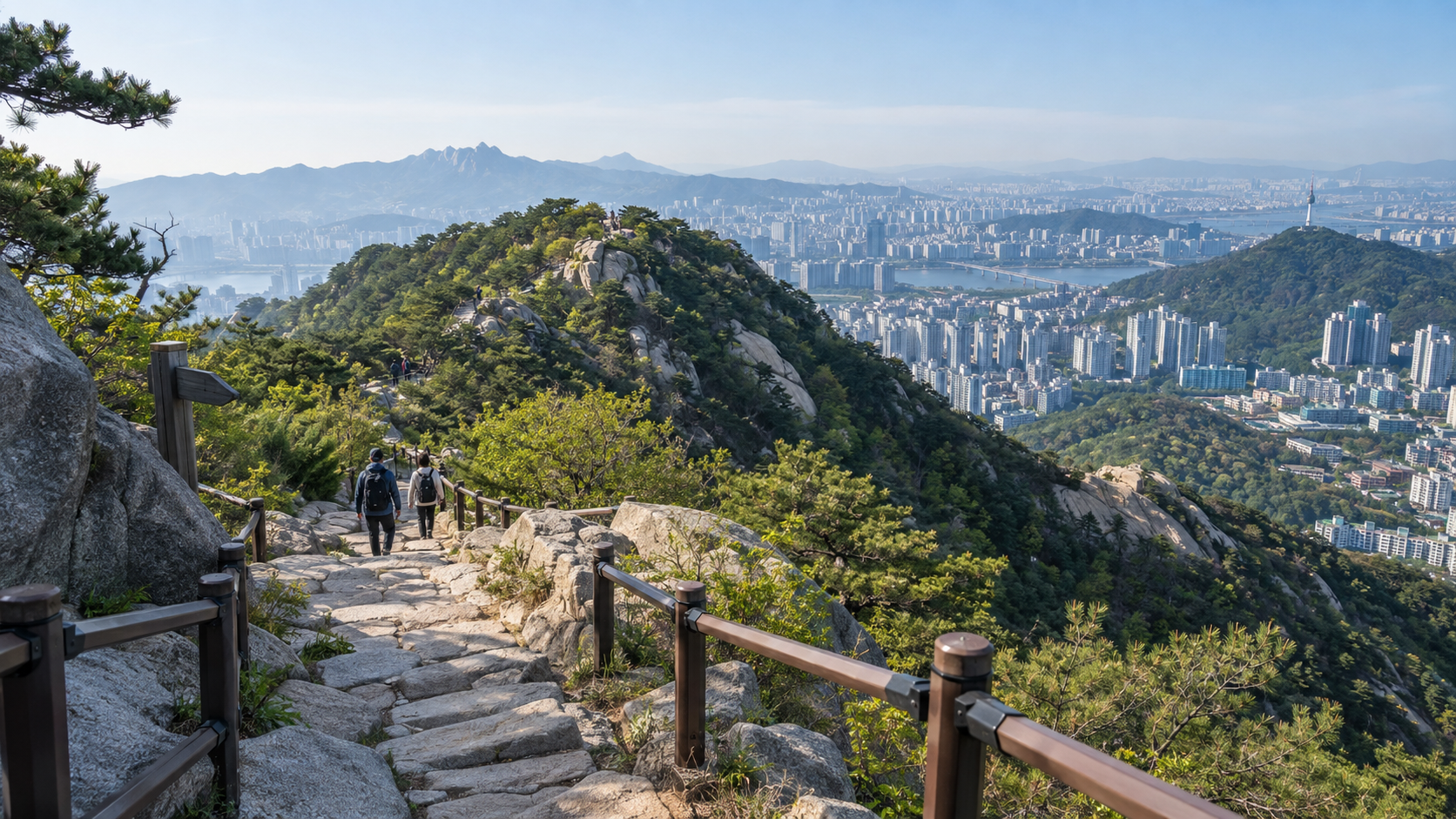
Mountains in South Korea are unusually accessible because mountainous terrain lies close to dense cities, public transportation reaches many trailheads, and public agencies maintain popular routes with signs, stairs, location markers and rescue systems. Their wooded appearance is also the result of major postwar reforestation, not simply untouched nature.
| Factor | How it improves access |
|---|---|
| Geography | Mountains rise beside many cities and towns |
| Transit | Buses and subways reach numerous trailheads |
| Trail infrastructure | Signs, stairs and route markers reduce uncertainty |
| Reforestation | Restored forests made mountains safer and more attractive |
| Rescue systems | Location markers help hikers report emergencies |
Why are mountains so close to Korean cities?
Much of the peninsula is mountainous, so urban development often fills valleys and flatter corridors rather than spreading evenly. This produces a striking pattern: dense apartment districts can end close to wooded slopes. In Seoul, several well-known mountains are reachable by subway and local bus.
How did reforestation change the landscape?
War, fuel gathering and erosion left many hillsides degraded in the mid-twentieth century. South Korea then carried out large-scale planting, forest management and erosion control. Today’s green mountains are therefore partly a public-policy achievement.
Why are Korean trails easy to use?
Popular routes often have directional signs, distance information, steps, railings, rest areas and numbered emergency markers. Public transit reduces the need to own a car or return to the same parking lot, making point-to-point hikes easier.
Is hiking in Korea always safe?
No mountain is risk-free. Weather changes quickly, rocks become slippery and crowded routes can create accidents. Infrastructure improves access but cannot replace appropriate shoes, water, weather checks and honest assessment of fitness.
Why is hiking culturally prominent?
Accessibility makes hiking an ordinary weekend activity rather than a specialist expedition. Clubs, families and coworkers can meet near a station, hike for several hours and return to restaurants and transit without extensive planning.
Are all Korean mountains equally accessible?
No. Urban mountains and famous parks usually have stronger transport and maintenance. Remote routes may require a car, careful navigation or greater experience. Trail conditions and closures should always be checked locally.
FAQ
Can you hike from the Seoul subway?
Yes. Many trailheads are reachable by subway plus a short walk or local bus, though the exact route should be checked before departure.
Why do Korean mountains have so many stairs?
Stairs control erosion and help people climb steep, heavily used sections, although some hikers find them tiring.
Did Korea’s forests recover naturally?
Natural regrowth helped, but national reforestation, fuel-policy changes and long-term forest management were central.
A public landscape close to everyday life
Korea’s mountain access is the product of geography, density and institutions working together. The mountain at the end of a subway line feels natural, but the ease of reaching and using it was built over decades.