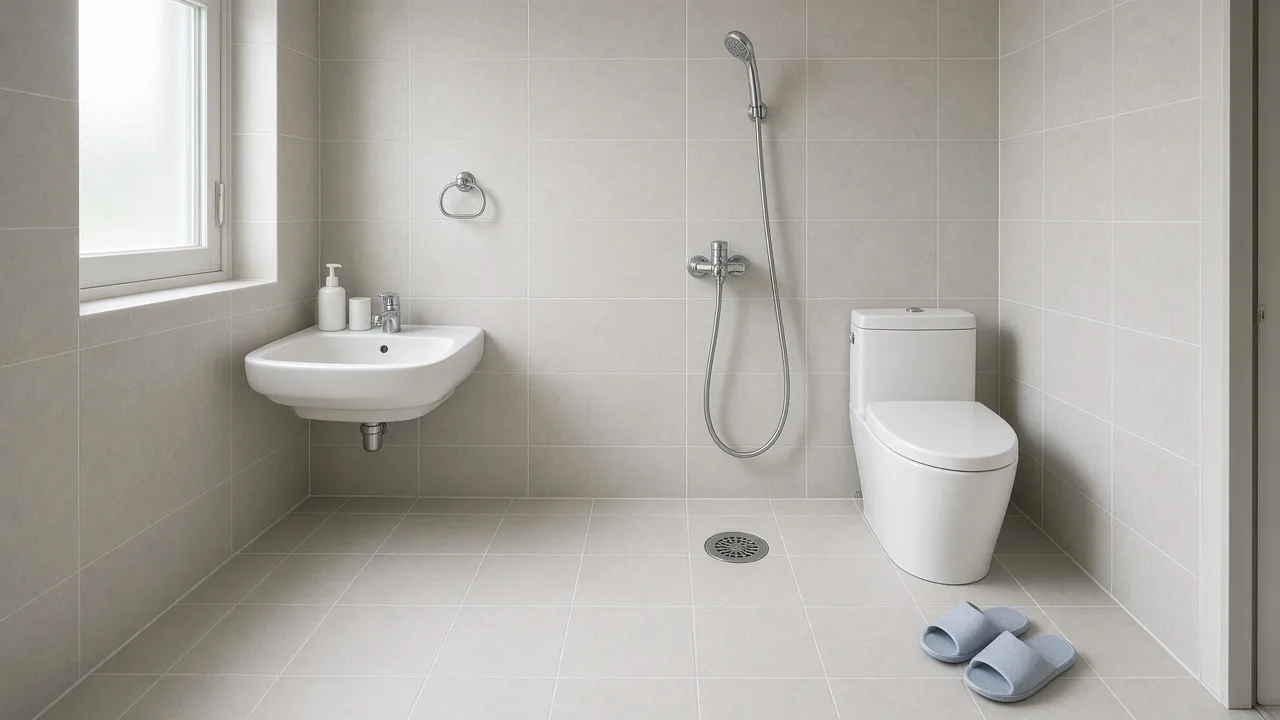
Korean bathrooms have a floor drain because the whole room is built as a wet room: the floor is tiled, fitted with a drain and meant to take a spray of water, so the shower, sink and toilet area can all get wet and be rinsed clean. That is why many Korean bathrooms have no shower curtain, a step down at the door and a pair of plastic slippers waiting beside it. The design looks odd to visitors from countries with dry bathrooms, but it follows from how Korean homes developed in the twentieth century. This guide explains the floor drain, the history behind the slippers, the newer dry-type alternative and what to do when the drain smells in summer.
What a Korean wet bathroom looks like
According to the English-language housing guide of the Institute for Basic Science (IBS), a research institute in Daejeon, you step down a small step into a Korean bathroom. The height difference keeps shower water or an overflowing toilet inside the room, where it runs into a large drain in the floor. The IBS guide notes that a floor drain makes cleaning easy, because water can be sprayed almost anywhere and gravity then pulls it out of the room.
The same guide describes the practical consequences:
- The whole bathroom is the shower. Shower curtains are uncommon even where there is a bathtub or a separate shower corner. IBS adds that when the curtain arrived in Korea it came as a loanword, written 샤워커튼, which shows how unusual it was.
- The shower head is on a hose. In homes without a bathtub, IBS says, the nozzle is connected to the sink tap rather than to a separate shower valve. IBS advises turning the nozzle away from you after a shower, because the next person who turns on the sink can get sprayed.
- Bathtubs are not universal. IBS says tubs are found in some family-size homes and are very rare in homes designed for one person.
- Sockets are covered. IBS tells tenants to check that the bathroom socket has a water cover, and to ask the real estate agent to fit one before signing a lease.
The result is a room that is inside the home but is treated more like an outdoor space that can be hosed down.
Why Korea built wet bathrooms
Edaily, a Korean business daily, explained the contrast in 2019. In Western countries, where people wear shoes indoors, bathrooms mostly have no floor drain and water leaves only through the sink and the bathtub, so the floor stays dry. In Korea, the paper said, the culture of sitting on the floor, large seasonal changes in humidity and a liking for cleaning with water helped a wet-bathroom culture develop. In a wet bathroom every drop of water used in the room leaves through the floor drain.
That explanation fits the Korean home, where people sit and sleep on the floor of the main rooms. Keeping that floor clean and dry is easier if there is one room where water is allowed to go everywhere. If you want to see how the rest of the home is organized, read why apartments are so popular in South Korea and how they differ from European apartments.
From outhouse to apartment bathroom
The better history comes from Seo Hyun, an architect and professor of architecture at Seoul National University, in a column for JoongAng Ilbo titled “A genetic test for the bathroom slipper”. He argues that the Korean bathroom still carries the cultural genes of the old outhouse.
His account runs like this:
- The outhouse (byeonso, dwitgan). In the farming era the toilet was a separate, remote structure that also produced manure for the fields. As cities grew in the twentieth century, the toilet moved closer to the house, but it still had to face the road so the waste could be collected. Many had a separate entrance, so you still went there in outdoor shoes.
- The American import. After liberation the model for advanced housing came from the United States, and it arrived in the form of the apartment. The three-fixture bathroom of toilet, tub and sink entered the apartment, and as apartments gained ground in the 1970s that layout became dominant, and eventually the universal bathroom type.
- More bathrooms. From the 1990s, Seo writes, every new apartment above the 30-pyeong class had two bathrooms, one with a shower instead of a tub. (The size is a supply-area label, not the floor space inside the front door.)
- Infrastructure. The change required a city-wide overhaul: running water instead of water carriers, boilers instead of fire pits for the tub, mechanical ventilation once the bathroom sat in the middle of the floor plan, and sewers and septic systems for waste.
Even so, Seo says, the bathroom was never fully accepted as an interior room. The light switch is outside, unlike in other rooms. Hot-water pipes ran under every other floor but not the bathroom’s, and floor heating reached bathroom floors only in the twenty-first century. The rest of the home is swept and wiped, while the bathroom is a place where water is poured on roughly. That is why the floor is tile rather than wood. And to resolve the contradiction of a room that is indoors in fact but outdoors in perception, Seo says, the slipper became necessary.
Why there are slippers
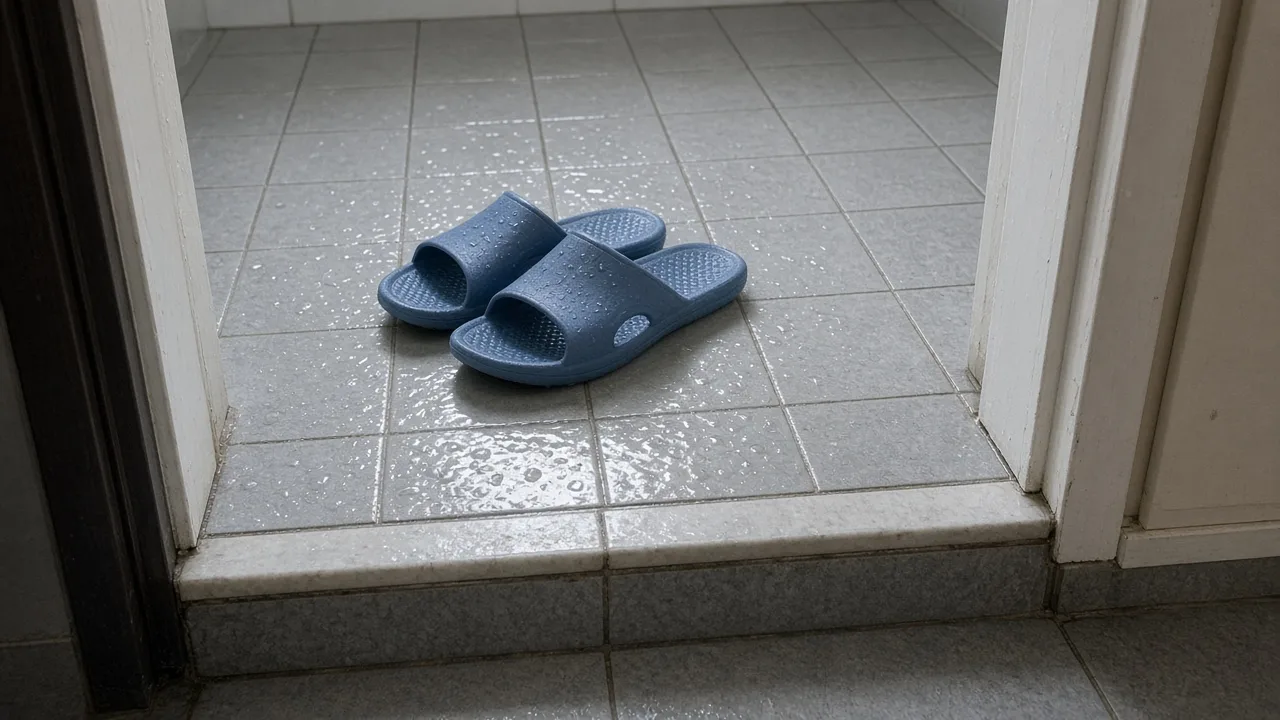
The slippers have a plain job. IBS says most households keep a shared set of rubber or plastic slippers to avoid slipping on the wet floor. If someone wears them in the shower they stay wet for hours, because the bathroom door is usually shut. It also warns that feet longer than 280 mm are rare in Korea, so large feet may not fit the standard slippers.
For a visitor the rule is simple: leave your indoor socks outside the bathroom or check that they are dry, put on the slippers, and take them off when you leave. The slippers mark the boundary between the dry home and the wet room, so water and bathroom dirt do not travel into the living area.
The drain and the summer smell

A floor drain solves one problem and creates another: smell. The cause is a general plumbing principle. Under the drain cover is a trap that holds a small amount of water. The Tokyo Metropolitan Sewerage Bureau’s household guide (available in a Korean edition) describes this “seal water” as the standing water that stops odors, gas and pests from coming up the pipe. The guide lists the common causes of trap failure: hair and dirt that are not cleaned out, improper handling such as removing the bell part of a bell trap, seal water that evaporates after a long period of no use, aging fittings and poor pipe connections.
A local Korean household-repair column describes the same fix for a floor drain. Lift the perforated cover, pull out the plastic cap, remove the hair and debris, check that water stays in the trap, and put it back together. Cleaning the drain often is the best prevention.
In practice, if the room smells in summer:
- Clean the drain. Remove hair and soap residue from the cover and trap.
- Refill the trap. If you have been away, run water down the drain so the seal water is restored.
- Check the fittings. Cracked or badly seated parts let odors through even when the water is present.
- Report persistent problems. If the smell remains after cleaning, the cause may be elsewhere in the building’s pipes, which is a matter for the management office. (How building costs are shared is covered in our guide to Korean apartment maintenance fees.)
Mold, towels and the squeegee
A bathroom that is wet and mostly closed is a good place for mold. IBS recommends checking for it if the door is usually shut, and says that cleaners to kill mold are sold in larger grocery stores. A simple habit is a squeegee: IBS says it is called 물기 제거 (mulgi jegeo, “water removal”) and is sold in cleaning sections and sometimes in car sections of shops. Seo Hyun notes that mechanical ventilation became necessary once bathrooms moved into the middle of apartment floor plans, and a working fan or window is what lets the room dry between showers.
Seo Hyun adds a more critical view. The tile joints are hard to clean and the humidity makes the room a good breeding place for bacteria, he writes, and washing and drying all the towels that wipe up shower water uses more resources than it should. He predicts that the slipper will disappear as bathrooms gain active drying equipment and smart toilets. That is his forecast, not a trend measured by data.
The dry bathroom alternative
Not every new bathroom is a full wet room. According to the Edaily report, bathroom makers also sell a dry-type design in Korea, which separates the area with the tub and shower, where the floor often gets wet, from the area with the toilet and sink, where the floor can stay dry. One manufacturer told the paper that a dry or semi-dry bathroom can be created by putting the drain on one side or installing a shower booth or partition, not by buying a special product. The industry view in the report was that people should choose the layout that fits their own home rather than argue about wet versus dry.
So the floor drain is not a fixed rule of Korean housing, but it is still the default you will meet in most rentals and older apartments.
What to check when you rent
- Look for a water cover on the bathroom socket, and ask for one if it is missing.
- Find out whether the room has a window or ventilation fan.
- Check the step at the door and watch where water goes when you rinse the floor, so it reaches the drain and not the hallway.
- Run water down the drain to see how fast it clears, and sniff for odor.
- Plan to buy slippers and a squeegee.
FAQ
Why do Korean bathrooms not have a shower curtain?
Because the entire bathroom is designed to get wet. The floor is sloped to a drain, so water from the shower does not need to be kept inside a tub or a curtain.
Why is there a step down into a Korean bathroom?
The step keeps shower water or an overflow inside the room, so it runs into the floor drain and not into the rest of the home.
Why do Koreans wear slippers in the bathroom?
Because the floor is wet and slippery, and because the slippers keep feet off the wet tile and stop water being carried into the dry living area. They are usually shared and left in the room.
Why does my Korean bathroom drain smell?
A floor drain contains a trap that holds a little water to block odors. The smell usually means the trap is dirty, has dried out after a long time unused, or has a bad connection. Clean the drain and refill the trap with water. If the smell stays, tell the building management.
Are all Korean bathrooms wet rooms?
No. Many are, but dry-type bathrooms that separate the shower area from the toilet and sink are also sold in Korea.
Sources and further reading
- Institute for Basic Science, “Bathroom” in the Living in Korea housing guide (English): centers.ibs.re.kr
- Seo Hyun, “A genetic test for the bathroom slipper”, JoongAng Ilbo (Korean): joongang.co.kr
- Edaily, “Bathrooms are now rest spaces: choose between wet and dry” (12 September 2019, Korean): edaily.co.kr
- Tokyo Metropolitan Sewerage Bureau, sewer and daily life guide, odor and trap page (Korean edition): gesui.metro.tokyo.lg.jp
- Yangpyeong Citizen’s Voice, “DIY at home: drain odor” (2018, Korean): ypsori.com