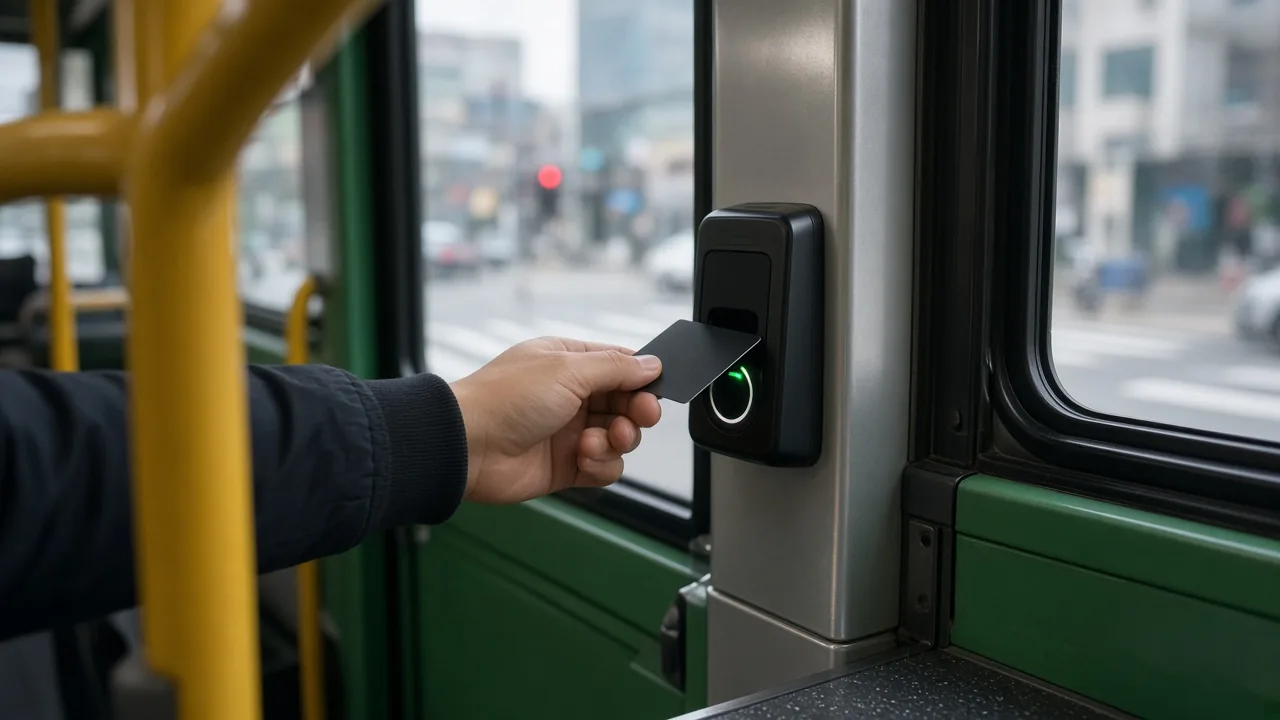
Why do you have to tap off a Seoul bus, tapping your card as you leave? Because in the Seoul metropolitan area, the fare you pay depends on distance, and the exit tap tells the system where your trip ended. If you don’t tap off, your transfer discount is broken and the system charges you for the untapped trip the next time you board. A Seoul city bus on its own has a flat fare, but the tap-off matters as soon as you transfer.
Last updated: October 31, 2026
Key takeaways
- Tap your transport card when you board and when you get off, every time, if you may transfer.
- Transfers are discounted if you board the next vehicle within 30 minutes of getting off (60 minutes between 9 p.m. and 7 a.m.), up to four transfers.
- If you forget to tap off, the transfer breaks and the base fare that was not collected is charged when you next board.
- A Seoul city bus ridden alone costs the flat base fare (1,500 won on the city’s fare page, unchanged since August 2023 and still listed in October 2026), with no distance charge.
Why do you have to tap off a Seoul bus?
The Seoul Metropolitan Government describes the integrated transfer system as combining fares across the capital region so that you pay in proportion to the distance travelled, whichever mode you use. The system covers Seoul, Incheon and Gyeonggi buses, metropolitan subway lines, GTX-A and Han River buses.
For a transfer trip, you pay the base fare for the first 10 km (30 km for wide-area buses), plus 100 won for each additional 5 km (80 won for youths, 50 won for children). To calculate the distance, the card must be tapped on each boarding and each exit. That is why the exit reader exists.
What are the transfer rules?
| Rule | Detail (Seoul Metropolitan Government) |
|---|---|
| Transfer window | Board within 30 minutes of getting off (60 minutes from 9 p.m. to 7 a.m.) |
| Maximum | Up to four transfers (five boardings) in a row |
| Same card | One card per person |
| Same route | No discount for transfers between the same route or the same vehicle |
| Distance charge | 100 won per 5 km beyond the first 10 km (30 km for wide-area buses) |
| Time limit | Base fare is charged again if a ride exceeds 5 hours (subway, city bus) or 1 hour (village bus) |
| Early-morning discount | 20% off the base fare for the first boarding before 6:30 a.m. with a transport card |
Early-morning example from the city’s page: a first boarding on a village bus before 6:30 a.m. costs 960 won (a 20% discount on 1,200 won). If you then transfer to a city bus, you pay the 300 won difference in base fares (1,500 minus 1,200 won) at the normal rate, not at the discounted rate.
What happens if you forget to tap off a Seoul bus?
According to the Seoul page, the system breaks the transfer at the vehicle where you did not tap off. When you board the next vehicle, the untapped trip is treated as a single, separate trip and the base fare that was not collected is charged. In other words, you lose the transfer discount and pay extra at your next tap-on. It is a small sum, but it adds up if you do it often. If you think you were overcharged, call the Seoul call centre on 02-120.
What do locals do?
- Tap off every time you leave. The reader only helps if you use it at every exit.
- Use a single card per person. Transfers only work with one card per person. If you travel as a group, the driver can change the passenger count, and for group transfers you must tell the driver at each boarding.
- Know that subways are separate. For subway-only trips the fare is distance-based at the gate. On buses, you tap at the reader.
Tapping off to keep your transfer discount
Visitors: buy or load a transport card, and tap it at every boarding and exit. Check that your card is accepted before you travel.
Expats: if you commute with transfers, tapping off every time keeps your transfer discount intact. See why Seoul public transport is so good.
Workers: an early-morning first boarding before 6:30 a.m. gets 20% off the base fare with a transport card.
Common mistakes: not tapping at the exit reader, transferring to the same route and expecting a discount, and waiting more than 30 minutes (60 at night) between rides.
For the Seoul context, see why South Korea is concentrated in Seoul. To find your stop and the next bus, see why Google Maps is limited in South Korea.
How much does a transfer trip cost? Worked examples
All the examples below apply the published rules to the fares on the Seoul pages (1,500 won for a city bus, 1,200 won for a village bus). They are arithmetic illustrations, not fare receipts, and the fares may change. At about 1,400 won per US dollar, 1,500 won is roughly US$1.07.
Example 1: village bus then city bus, with an early start. You tap on a village bus before 6:30 a.m. with a transport card. The 20% discount takes the base fare from 1,200 won to 960 won. You get off, tap off, and board a city bus within 30 minutes. As described above, you then pay the 300 won difference between the two base fares. Total: 1,260 won (about US$0.90) for two vehicles, instead of paying 960 won and then a full 1,500 won for the second bus.
Example 2: a longer transfer trip. The rule adds 100 won for each 5 km beyond the first 10 km. A transfer journey that runs 10 km beyond that first 10 km adds two steps, or 200 won. If the base fare is 1,500 won, the journey costs 1,700 won (about US$1.21). For a youth the added step is 80 won, and for a child 50 won. This is why the exit reader matters: without the exit tap the system cannot measure where the trip ended.
Example 3: what a forgotten tap could cost over a month. The Seoul page says a missed exit tap breaks the transfer, and the base fare that was not collected is charged at the next boarding. Suppose that amounts to one 1,500 won base fare each time (an assumption, since the page does not give a figure). If you forgot once a week, that is about 6,000 won a month (roughly US$4.30). The sum is small, but it is money for nothing.
How do I tap off a Seoul bus step by step?
- Use one transport card for the whole trip. Transfers work only with one card per person.
- Tap on the reader when you board.
- When you reach your stop, tap the exit reader before or as you step off. This is how to tap off a Seoul bus so the system records where you left.
- If you are transferring, board the next vehicle within 30 minutes (60 minutes between 9 p.m. and 7 a.m.).
- Tap again when you board and when you leave, up to four transfers in a row.
- If a charge looks wrong, call the Seoul call centre on 02-120 and ask about the trip.
How does Seoul compare with London?
London’s bus system makes a useful contrast. According to Transport for London, with pay as you go at the adult rate its Hopper fare gives unlimited bus and tram journeys within one hour of touching in for £1.75, and you get it automatically if you touch in with the same card or device each time. TfL’s page also lists £1.85 for the same fare from 1 November 2026. The TfL description speaks of touching in only, with no exit tap needed.
Seoul does something different because its fare is built on distance across modes. Its transfer window is 30 minutes (60 at night), the exit tap is part of the calculation, and the extra distance charge applies beyond the base distance. Neither system is simply better. London’s rule is simpler for a rider making many short hops, while Seoul’s rule charges more in proportion to the distance you actually travel.
Practical scenarios
A visitor changing buses near the city centre. Keep the same card, tap at every exit, and change within 30 minutes. If you rest for coffee for an hour in the daytime, the transfer discount will not apply to the next ride.
An expat commuter with a village bus first leg. The early-morning discount applies only to the first boarding before 6:30 a.m. with a transport card, so the first leg is the one that can be discounted.
A family travelling together. The Seoul page says the driver can change the passenger count and that group transfers must be announced to the driver at each boarding. The page does not say what happens if you forget, so tell the driver each time.
A long ride out of the city. A ride longer than the maximum ride time (5 hours on a subway or city bus, 1 hour on a village bus) is charged the base fare again, so a very long trip does not stay on one fare.
More common mistakes
- Using a different card on each leg of a transfer, which loses the discount because transfers are one card per person.
- Boarding the next bus on the same route and expecting a transfer discount.
- Stopping for more than 30 minutes (60 at night) before the next ride.
- Assuming the exit tap matters on a lone city bus ride. It does not change a flat fare, but it keeps any later transfer intact.
- Relying on an old fare. The Seoul fare page was last edited in July 2025, and January 2026 reports mentioned a possible increase, so check the fares before you travel.
Questions readers ask
Do you have to tap your card when you get off a Seoul bus?
Yes, if you may transfer. The exit tap calculates distance and keeps your transfer discount. A single city bus trip has a flat fare.
What happens if I forget to tap off in Seoul?
The transfer is broken, and the base fare not collected is charged when you board the next vehicle, according to the Seoul Metropolitan Government.
How long do I have to transfer in Seoul?
30 minutes after getting off, or 60 minutes between 9 p.m. and 7 a.m., for up to four transfers.
How much is a Seoul city bus fare?
The city’s fare page (edited July 2025) lists 1,500 won for city buses and 1,200 won for village buses. Check the current page before travelling.
Can I transfer between buses on the same route?
No. Transfers between the same route or the same vehicle get no discount.
How much extra do I pay for a longer transfer trip?
The Seoul rule adds 100 won for each 5 km beyond the first 10 km (30 km for wide-area buses), or 80 won for youths and 50 won for children. A trip 10 km beyond the first 10 km adds 200 won.
Do I need to tap off in London like I do in Seoul?
Transport for London describes its Hopper fare as unlimited bus and tram journeys within one hour of touching in. It does not describe an exit tap for buses.
Where the facts come from
Checked October 31, 2026.