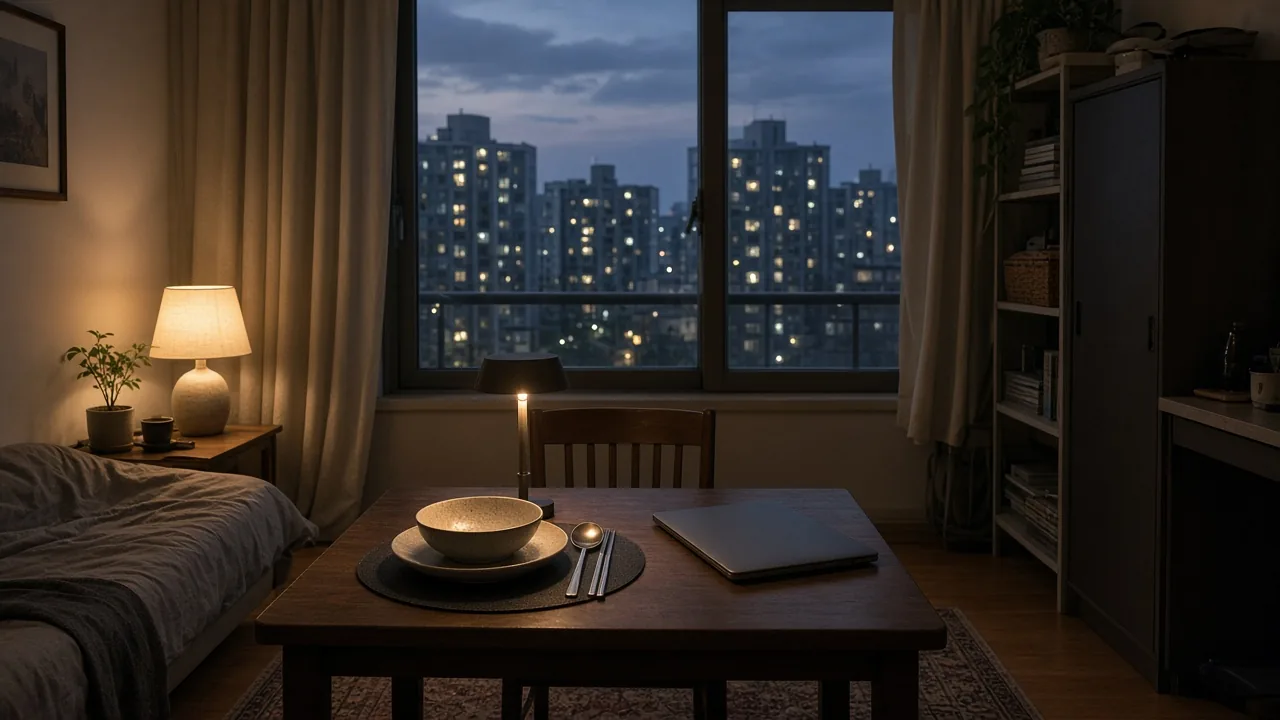
Single-person households in Korea are now the most common household type. The 2025 register-based census counted 8.24 million one-person households on November 1, 2025, equal to 36.6% of general households, up from 36.1% (8.045 million) a year earlier, according to the Ministry of Data and Statistics. That is more than two-person, three-person or four-person households, and the average Korean household now has 2.16 people.
Last updated: October 31, 2026
Key takeaways
- 36.6% of Korean households have one person (8.24 million, November 2025).
- Living alone is not just a young-adult story: people aged 70 and over (19.8%) and 29 and under (17.8%) were the largest groups in 2024.
- People who live alone had lower incomes (34.23 million won a year, 46.1% of the all-household average) and reported more loneliness (48.9% versus 38.2%).
- Growth is slowing: +2.8% in 2024 and +2.5% in 2025.
How common are single-person households in Korea?
The census counts households each year from administrative registers. Key 2025 results (briefing of July 28, 2026):
| Measure | 2025 result |
|---|---|
| One-person households | 8.24 million (36.6% of general households) |
| Annual growth | +2.5% (2.8% the year before) |
| Average household size | 2.16 people |
| Highest share by region | Seoul, 40.5% |
| Lowest share by region | Gyeonggi, 32.2% |
| Older people living alone | 10.9% of all general households |
One-person households have been the most common household type since 2015. The “typical” family of two parents and two children, which still shapes many apartment designs, is now a minority.
A caution: a share of households is not a share of people. A four-person household counts as one household and four people, so the share of the population that lives alone is smaller than 36.6%.
Who lives alone in Korea?
Statistics for 2024 (Ministry of Data and Statistics, December 2025) show a spread across ages:
| Age group of person living alone | Share of one-person households (2024) |
|---|---|
| 29 and under | 17.8% |
| 30s | 17.4% |
| 60s | 17.6% |
| 70 and over | 19.8% |
In the 2025 census, the biggest groups differ by sex: among men, people in their 30s are the largest group (21.8%); among women, people in their 60s (18.6%). That fits a picture of younger men who are unmarried and older women who are widowed or divorced, though the figures themselves do not give causes.
Other facts from the 2024 data:
- Work. 5.10 million one-person households were employed in October 2024, up 426,000 on the year, about 63% of the total.
- Place. 42.7% lived in Seoul and Gyeonggi Province.
- Housing. 39.0% lived in detached houses and 35.9% in apartments. Only 32.0% owned a home, against 56.9% of all households.
- Money. Average annual income was 34.23 million won (about US$24,400), up 6.2%, or 46.1% of the 74.27 million won for all households. That gap partly reflects having one earner and including retirees, not just low pay.
- Spending. Average monthly spending was 1.689 million won (about US$1,200), 58.4% of the all-household figure of 2.89 million won.
Why are single-person households in Korea rising?
Statistics do not assign causes, but the standard explanations are well documented:
- Later and less marriage. Many young adults postpone or skip marriage (see why young South Koreans delay marriage). In 2025, 54.7% of people in their 30s were unmarried, according to the census briefing.
- Fewer children. Smaller families mean fewer relatives to live with (see why South Korea’s birth rate is so low).
- Longer lives. After a partner dies, the survivor is more likely to live alone. Older people living alone are 10.9% of all general households.
- Divorce and separation.
- Work and study. Young people moving to the capital area for jobs or universities often live alone, which fits the 40.5% share in Seoul.
Housing and services have adapted. Small units such as officetels suit one person (see what an officetel is), and convenience stores and delivery apps sell single portions at late hours (see why South Korea has so many convenience stores).
Do people who live alone in Korea feel lonely?
In the 2025 survey results published by the ministry:
- 48.9% of one-person households said they often or sometimes feel lonely, against 38.2% overall (10.7 points higher).
- 51.1% were satisfied with their relationships, against 55.5% for the whole population.
- 68.9% said they have someone to help them when ill, 45.6% someone to lend money, 73.5% someone when depressed, each lower than average.
These do not show that living alone causes loneliness. About half did not report feeling lonely, and living alone includes professionals who chose a small flat near work, students, and retirees with strong networks.
What do single-person households in Korea mean for you?
Visitors: you will see solo diners everywhere, counter seats and single-serve meals. Some barbecue places still need two portions.
Expats and renters: the 2024 data put 39.0% of one-person households in detached houses and 35.9% in apartments, and only 32.0% owned their home, so renting is the common route. Ask about the management fee.
Workers and residents: with 48.9% of one-person households reporting loneliness often or sometimes, against 38.2% overall, it is worth knowing that being alone is common but not always comfortable.
Common mistakes: reading “36%” as a share of people, assuming loneliness follows automatically from living alone, and assuming all solo households are young.
How do single-person households in Korea compare with Japan, the US and the UK?
Official statistics bureaus publish the share of households with one person, but their definitions and years differ, so read the table as a rough comparison.
| Country | Share of households with one person | Source and year |
|---|---|---|
| South Korea | 36.6% (8.24 million) | Ministry of Data and Statistics, register census, November 2025 |
| Japan | 38.1% (21.15 million) of private households | Statistics Bureau of Japan, 2020 census |
| United States | 29% (39.7 million) of households | Census Bureau, Current Population Survey, 2025 |
| United Kingdom | 29.5% of 28.6 million households | Office for National Statistics, 2024 |
Three points stand out. First, Korea is close to Japan and well above the United States and the United Kingdom, but the Japanese figure is five years older. Second, the UK also publishes the share of people who live alone, 12.5% of people in households in 2024 (8.4 million), which shows how much smaller a share of people is than a share of households. Third, the age structure differs: the UK’s Office for National Statistics says 51.1% of people living alone in 2024 were aged 65 or over, while Korea’s 2024 data show the largest group at 70 and over (19.8%) with people aged 29 and under at 17.8%.
For older people living alone, Japan’s 2020 census counted 6.72 million one-person elderly households among 55.7 million private households, about 12.1% (6.717 divided by 55.705). Korea’s 2025 figure for older people living alone is 10.9% of general households. The years and definitions differ, so the two numbers show a similar scale rather than an exact gap.
A worked example: what the average figures mean in won and dollars
The 2024 statistics give average annual income and monthly spending for one-person households and for all households.
| Measure | One-person household | All households |
|---|---|---|
| Annual income | 34.23 million won (about US$24,450) | 74.27 million won (about US$53,050) |
| Monthly spending | 1.689 million won (about US$1,210) | 2.89 million won (about US$2,060) |
A few calculations show how to read this:
- Income per month for a one-person household averages about 2.85 million won (34.23 divided by 12), or about US$2,040.
- Spending of 1.689 million won is about 59% of that monthly income (1.689 divided by 2.85), a rough ratio because the two figures come from different measures.
- Run the same calculation for all households (2.89 million won a month times 12, divided by 74.27 million won) and spending is about 47% of income. So the average one-person household spends a larger share of its income (about 59%) than the average household (about 47%), although the income and spending figures come from different measures and the gap partly reflects having only one earner.
These are averages that include retirees and workers, so they say little about any single person’s budget.
What does the loneliness data say, and what does it not?
The 2025 survey gives 48.9% for loneliness among one-person households against 38.2% overall. It also gives 51.1% satisfied with relationships against 55.5% for all, and lower shares who have someone to help when ill (68.9%), to lend money (45.6%) or to talk to when depressed (73.5%). These are gaps of a few points to about ten points. They do not show that living alone causes loneliness, because the survey does not control for age, income or health, and over half of one-person households reported relationship satisfaction.
Practical scenarios
A young professional moving to Seoul alone. Seoul has the highest share of one-person households among regions (40.5% in 2025), so you will not be unusual. The 2024 housing data (detached houses 39.0%, apartments 35.9%) show a mix of housing types.
An older person living alone. The data show that the group is large: people aged 70 and over are the biggest age group among one-person households (19.8% in 2024), and older people living alone are 10.9% of all general households.
A newcomer comparing with home. Compare households with households and people with people. A “36%” in Korea and a “12.5%” in the UK describe different things.
A business or local planner. Growth is slowing (+2.8% in 2024, +2.5% in 2025), so the number of one-person households is still rising but more slowly.
FAQ
What percent of Korean households are one person?
36.6% in the 2025 census (8.24 million), up from 36.1% (8.045 million) in 2024. It is the largest household type.
Who lives alone in Korea?
In 2024 the biggest age groups were 70 and over (19.8%) and 29 and under (17.8%). In the 2025 census, men in their 30s and women in their 60s were the largest groups.
Why are more Koreans living alone?
Later and less marriage, fewer children, longer lives, divorce, and moves for work and study. The statistics do not rank causes.
Is living alone common among older Koreans?
Yes. People 70 and over were 19.8% of one-person households in 2024, and older people living alone were 10.9% of general households in 2025.
Do people who live alone in Korea feel lonely?
48.9% said they often or sometimes feel lonely, against 38.2% overall in 2025, though about half did not.
Is living alone more common in Korea than in the United States?
By the share of households, yes: 36.6% in Korea (2025 register census) against 29% in the United States (Census Bureau, 2025). The definitions differ.
How does Korea compare with Japan?
Japan’s 2020 census counted 38.1% of private households as one-person, slightly above Korea’s 36.6% in 2025, but the data are five years apart.
Sources and further reading
Checked October 31, 2026.
- Ministry of Data and Statistics: 2025 Statistics of One-person Households (press release, Korean)
- Korea Policy Briefing: 2025 Population and Housing Census, register-based results, July 28, 2026 (Korean)
- Census Korea: 2025 register census results (Korean)
- Yonhap: 2025 Social Survey, loneliness, November 2025 (Korean)
- U.S. Census Bureau: Census Bureau Releases New Estimates on America’s Families and Living Arrangements (December 2, 2025)
- Statistics Bureau of Japan: Statistical Handbook of Japan 2026, households (2020 census)
- Office for National Statistics: Families and households in the UK, 2024 (released July 23, 2025)