
What is a pyeong? A pyeong (평) is the traditional Korean unit of floor area, equal to about 3.3 square meters, and it is still how most Koreans picture the size of a home even though the law moved to square meters in 2007. That is why an apartment listed as 84㎡ is called a “34-pyeong” home in conversation, even though 84㎡ is only about 25.4 pyeong. The two numbers describe different areas of the same flat. This guide explains the units, the three area labels on a Korean apartment listing, why the gap exists, and how to compare homes without being misled.
What is a pyeong, and how do you convert it?
According to Korea’s Ministry of Land, Infrastructure and Transport (MOLIT), one square meter is 0.3025 pyeong, and one pyeong is 3.3057㎡. KB Real Estate’s explainer rounds this to 3.3㎡. The unit is older than the apartment boom, and Koreans still use it for homes, offices, land and even air conditioners.
MOLIT also offers a mental shortcut. Drop the last digit of the square-meter figure and multiply what is left by three. For 84㎡ you drop the 4, multiply 8 by 3 and get 24, close to the true 25.4. For 59㎡, round to 60, drop the zero and multiply 6 by 3 to get 18, close to the true 17.8.
The shortcut gives the real pyeong, meaning the actual area. The confusing part starts when Koreans say a number that is not the real conversion.
Why 84㎡ is called 34 pyeong
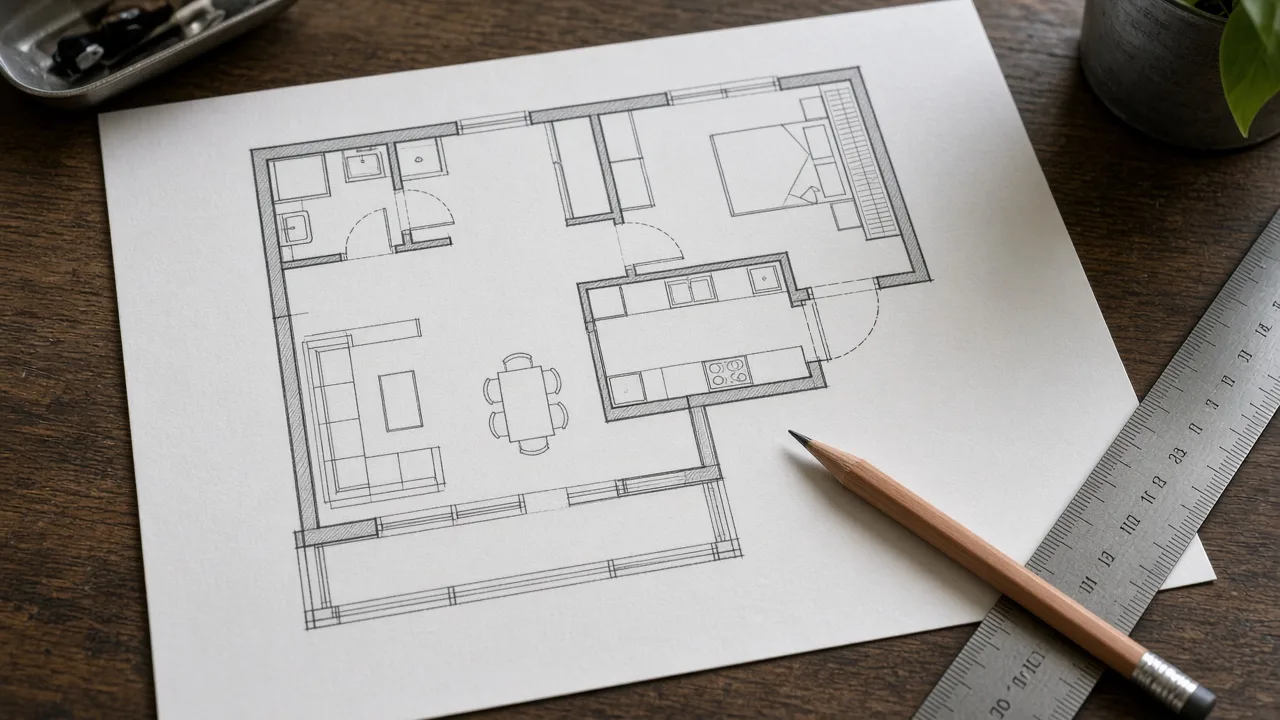
The short answer is that people use two different areas. MOLIT explains that when homes were advertised in pyeong, the figure was normally the supply area (공급면적), which is the private interior plus the shared parts of the building. Today a new-apartment ad in square meters gives the exclusive area (전용면적) instead. The unit and the thing being measured both changed, but everyday speech kept the old pyeong labels.
So the same flat has several numbers:
| Term | What it covers | Typical 84㎡ example |
|---|---|---|
| Exclusive area (전용면적) | Living room, kitchen, bedrooms, bathrooms and entrance inside your door. Balconies are not included. | 84㎡, about 25.4 pyeong |
| Housing common area (주거공용면적) | Shared parts of your building: stairs, corridors, elevators, main entrance | Added to exclusive area |
| Supply area (공급면적) | Exclusive area plus housing common area. The “pyeong” people say. | About 114㎡, called 34 pyeong |
| Other common area (기타공용면적) | Parking, guard post, management office, community facilities | Added to supply area |
| Contract area (계약면적) | Supply area plus other common area | Larger still |
Those definitions come from MOLIT and KB Real Estate. KB gives a rule of thumb for common sizes: an exclusive 59㎡ is sold as a “25-pyeong” home, 74㎡ as 30, 84㎡ as 34 and 114㎡ as 43. These labels are approximate, because the exact supply area depends on how much shared space each complex has.
What the balcony does to the numbers

The balcony is the reason two homes with the same 84㎡ can feel different. A balcony is not part of the exclusive area. MOLIT calls the balcony the “service area” (서비스면적) when it is converted into indoor living space, and says that the exclusive area plus the service area is sometimes called the real area.
Converting a balcony into a room was not always legal. A December 2005 amendment to the Building Act Enforcement Decree defined the balcony as a buffer space between the inside and outside of a building and allowed housing balconies that meet national standards to be used as living rooms, bedrooms or storage. In apartments on the fourth floor or above that lack two direct staircases, the same decree requires a refuge space of at least 3㎡ if shared with a neighbor or 2㎡ per household, or a lightweight dividing wall that can be broken in an emergency. The decree also changed the floor-area calculation, so that a strip along the longest wall with a depth of 1.5 meters does not count against the building’s floor area.
Maeil Business Newspaper’s English edition explains the effect. According to the construction industry, a 59㎡ unit typically has a balcony of about 17 to 18㎡. If it is expanded, the usable area rises to around 76 to 77㎡, which the paper says is almost the same as the 84㎡ of homes before the expansion was legalized. That is why developers now design floor plans on the assumption that the balcony will be expanded, and why a modern 59㎡ flat can hold three rooms and two bathrooms.
KB Real Estate adds that designers began raising the number of “bays”, the sections between columns along the front of the building, to enlarge balcony frontage. Two-bay flats gave way to three-bay and four-bay layouts, and wider, shallower rooms. The headline area did not change, but the experience did.
Why Korea moved to square meters in 2007
Korea’s law on measurement requires legal units, and from July 2007 it was to become an offense to use non-legal units such as the pyeong in contracts and advertising. A Kyongnam Shinmun report ahead of the change said that businesses using pyeong in a sales contract or advertisement faced a fine of up to 500,000 won, and that even showing pyeong beside square meters was to be treated as illegal. Appliance makers responded by marking air conditioners in square meters, and builders looked for loopholes. The report said some developers planned to print something like “85㎡ (32형)”, where the “형” (type) suffix avoids the word pyeong while giving the same information.
The habit survived because the number is intuitive. An apartment listing on an internet portal is also often expressed in supply area, MOLIT notes, so a buyer who calls a real estate office may hear about a “33-pyeong apartment on a good floor” even when the sales brochure says 84㎡. Even official price statistics follow this convention. Maeil Business Newspaper reported that the Housing and Urban Guarantee Corporation (HUG) measured the Seoul apartment sale price at 38.63 million won per 3.3㎡ in May 2024, a pyeong in everything but name.
Why 85㎡ is the line that matters
If you read Korean housing news you will notice that 85㎡ keeps appearing as a threshold. KB Real Estate traces it to a 1973 housing supply plan aimed at easing the shortage in the capital region. Planners assumed that about 5 pyeong per person was a suitable living area and set the “national housing size” at 25 pyeong. That implies a household of five, our own reading of the arithmetic, and 25 pyeong converts to about 82.6㎡. The standard was then set as an exclusive area of 85㎡ or less.
That line still matters. KB says that an exclusive area of 85㎡ or less qualifies for an exemption from the 0.2% rural special tax that is added to the acquisition tax, and that the share of new apartments allocated by the points system also differs at 85㎡. MOLIT classes apartments at or below 85㎡ as small, up to 135㎡ as medium and above 135㎡ as large. For how subscription works in practice, see our guide to the Korean housing subscription account.
This is also why 84㎡ became known as the “national size” (국민평형): it sits just under the 85㎡ line, and for decades it has been the typical family-size apartment.
Apartments and officetels are measured differently
MOLIT points out that apartments and officetels are not comparable by their headline “sale area”. Apartments follow the Housing Act and are marketed by supply area, while officetels follow the Building Act and are marketed by contract area, which includes extra common space. MOLIT puts the exclusive ratio of a typical apartment at 70 to 80% and that of an officetel at 30 to 40%. The same sale area therefore gives far less usable space in an officetel, and an apartment also gains a balcony. If you are considering one, read what an officetel actually is before comparing prices.
Is 84㎡ still the standard?
Less than before. Maeil Business Newspaper reported in July 2024 that the 59㎡ unit, the “25-pyeong” home, had become a serious rival to the 84㎡ “34-pyeong” home. Citing R114, it said that in the first half of 2024 the subscription competition ratio for homes of 60㎡ or less was 29.4 to 1, against 6.59 to 1 for the 60 to 85㎡ band that includes 84㎡. In existing-home sales, the share of homes under 60㎡ rose from 32.9% in 2018 to 38.5% in 2023, while the 60 to 85㎡ share fell from 54.5% to 51.3%.
The paper tied this to demography. Single-person households passed 10 million in March 2024, or 41.8% of all households, and with two-person households they made up about two thirds of the total. It also noted a critical view that the popularity of small homes is partly supply-driven, since redevelopment projects split units to maximize profit and buyers settled for what was available. The point is that “34 pyeong” is a label for a family of four that is no longer the typical household. To see why such apartments dominate in the first place, read why apartments are so popular in South Korea.
How to read a Korean listing without being misled
A few habits help when you compare homes:
- Compare by exclusive area. It is the number written in sales brochures and the one that is consistent across complexes. Treat “pyeong” as a rough label.
- Ask which area a price per pyeong uses. A price of so many won per pyeong can be based on supply or exclusive area, and the difference is large.
- Check whether the balcony is expanded. An expanded unit has more usable space than the same exclusive area unexpanded. Ask whether the work was done to the legal requirements.
- Check the exclusive ratio. An apartment at 70 to 80% and an officetel at 30 to 40% are very different homes at the same headline area.
- Do not trust the shortcut for money. Use it for a feel for size, and use the exact figure of 3.3057㎡ per pyeong for contracts.
FAQ
What is a pyeong in Korea?
In everyday use it is a traditional Korean unit of area equal to about 3.3057 square meters. People still use it for homes and offices, although since 2007 contracts and advertisements are supposed to use square meters.
How big is a 34-pyeong apartment?
It usually has an exclusive area of 84㎡, about 25.4 pyeong. The “34 pyeong” is the supply area, which adds shared parts such as corridors, stairs and elevators and is about 114㎡ according to KB Real Estate. The exact figure varies by complex.
What is the difference between exclusive area and supply area?
Exclusive area is the space inside your own front door, excluding balconies. Supply area is the exclusive area plus the shared parts of your building. Contract area adds parking, management offices and community facilities.
Why do Koreans still use pyeong if it is not legal in advertisements?
Because it is an intuitive label for supply area, and because everyday speech and real estate offices kept it. Since July 2007 the law has required square meters in contracts and ads, and developers have used workarounds such as a “type” suffix.
Is the balcony included in the apartment size?
No. The balcony is excluded from both exclusive and supply area. If it is legally converted into a room it is counted as service area, which gives more usable space than the listed area suggests.
Sources and further reading
- Ministry of Land, Infrastructure and Transport, “Exclusive area, supply area and contract area explained” (2021, Korean, via Daum): v.daum.net
- KB Real Estate, “Why is the ‘national size’ 84㎡ called 34 pyeong, not 25?” (April 2023, Korean): kbthink.com
- Kyongnam Shinmun, “Non-legal units banned from July” (2007, Korean): knnews.co.kr
- Korea Policy Briefing, text of the Building Act Enforcement Decree amendment on balconies (Presidential Decree No. 19163, 2005 and 2006, Korean): korea.kr
- Maeil Business Newspaper (English), “Where should I buy among 34 pyeong and 25 pyeong apartments” (13 July 2024): mk.co.kr