
동지 (Dongji) is the winter solstice, the shortest day and longest night of the year, and Koreans traditionally mark it by eating 팥죽 (patjuk), a porridge of red beans served with small glutinous rice balls, because the red colour of the beans was believed to drive away evil spirits and bad luck at the darkest turning point of the year. Dongji was also called the “small New Year,” and in 2026 it falls on 22 December in Korea (05:52 Asia/Seoul). It is observed as a seasonal custom, not a public holiday.
| Term | What it means |
|---|---|
| 동지 Dongji | The winter solstice, the 22nd of the 24 solar terms |
| 팥죽 patjuk | Red-bean porridge, the Dongji food |
| 팥 pat | Red (adzuki) beans |
| 새알심 saealsim | Small glutinous rice balls served in patjuk, literally bird-egg-like balls |
| 아세 ase / 작은설 jageun-seol | “Small New Year,” traditional nicknames for Dongji |
| 애동지 ae-dongji | An early Dongji (before the 10th day of the 11th lunar month), when patjuk was sometimes replaced for children |
Why did the longest night need a special food?

Because in an agricultural calendar, Dongji was not a curiosity. It was the hinge of the year.
Dongji is the 22nd of the 24 solar terms by which the traditional calendar organised farming and ritual life, and after it, daylight begins to lengthen again. The National Folk Museum and the Cultural Heritage Administration both record Dongji’s status as a reference point for reckoning time: it was regarded as the starting point of a new annual cycle and nicknamed ase, the small New Year, a status preserved in sayings such as “past Dongji, you grow one year older” and “eat patjuk on Dongji and you’ll grow one year older.” Courts marked it formally: new calendars were made, stamped and distributed to officials at Dongji, a custom behind the later habit of exchanging calendars around the year’s end.
A hinge that important acquired a protective rite, and in Korea that rite was red.
Why red beans, of all things?
Because red was the colour of positive, yang energy, and therefore the colour believed effective against the dark forces that the longest night let loose.
The heritage record is explicit that this evil-banishing purpose is what distinguishes Korean Dongji custom. Koreans made patjuk, ate it, and also placed or sprinkled it around the house (by the front gate, on walls, near the ancestral shrine) as a rite to chase away evil spirits for the coming year, and shared it among family and neighbours. The porridge was therefore doing two jobs at once: a hot, filling winter meal, and a household protective ritual that happened to be edible.
The 새알심 rice balls sharpened the New Year meaning. Tradition recorded by the Cultural Heritage Administration describes eating a number of rice balls equal to one’s age, tying the dish directly to the passage of a year of life, one reason Dongji could be spoken of as a small Seollal, the main Lunar New Year, where eating 떡국 (tteokguk, rice-cake soup) is likewise said to add a year.
Is patjuk always the Dongji food?
Almost always, with one traditional exception that still gets reported most years.
When Dongji falls early in the lunar month it is called 애동지 (ae-dongji), and in that case patjuk was traditionally considered bad for children, so some households ate 팥떡 (pat-tteok, red-bean rice cakes) instead. In 2025, for example, Dongji was an ae-dongji, and Seoul’s traditional-culture events served red-bean rice cakes and red-bean tea alongside, or instead of, porridge. The constant is not the porridge. It is the red bean.
That distinction helps explain the custom’s durability. Rituals attached to one recipe break when tastes change; rituals attached to an ingredient can move between porridge, rice cake and tea.
What happens on Dongji in Korea now?
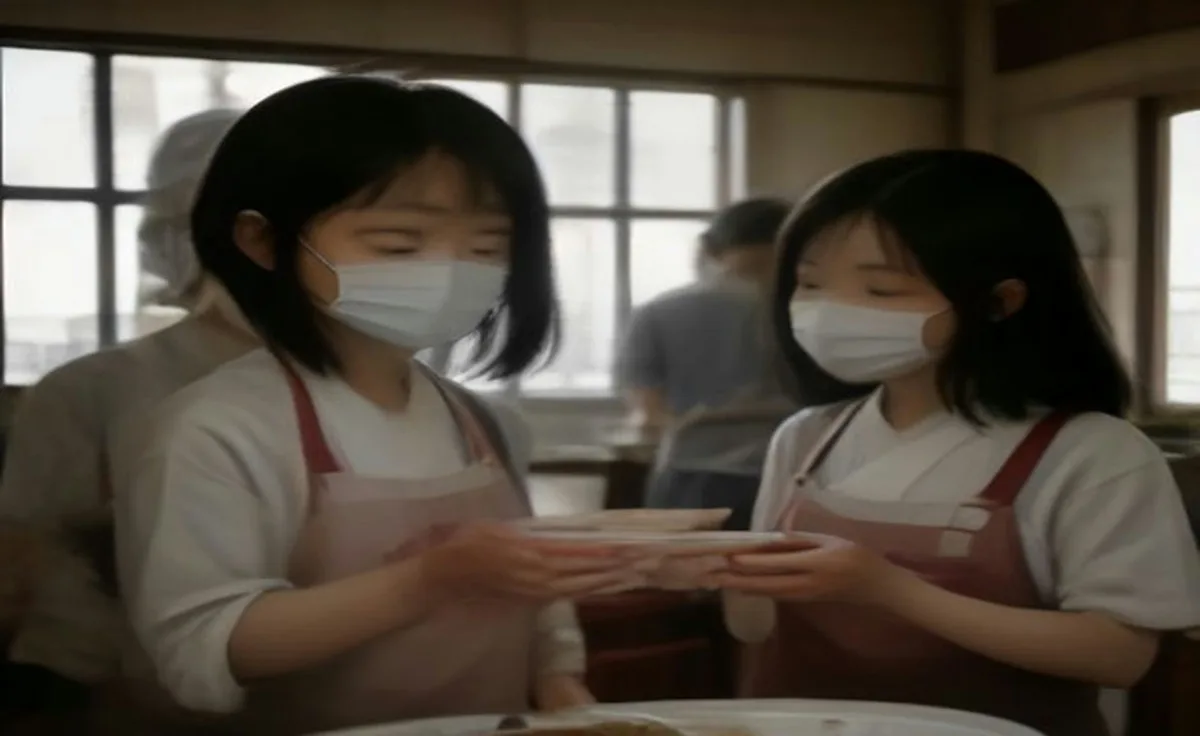
A quieter, institutional version of the same rite.
Dongji is not a public holiday, and for most working Koreans 22 December is an ordinary day. What remains visible is organised tradition: the National Folk Museum holds an annual Dongji event, welfare centres and community kitchens cook patjuk for elderly residents (Yonhap photographed volunteers preparing it at a senior welfare centre in Daegu eleven days before Dongji in 2025) and restaurants, bakeries and convenience retailers sell patjuk as a seasonal item. Households that keep the custom often buy rather than make it, as with much Korean seasonal food.
Notice what has dropped away and what has not. The sprinkling of porridge at gates and walls has largely gone from apartment life, where there is no gate and the walls are shared. The eating has remained. That is the usual Korean pattern for seasonal customs in cities: the household rite shrinks to the bowl.
What the Dongji custom gives and why it fades
What the custom gives. A marker in the darkest week that is neither commercial nor religious in the modern sense: a shared, inexpensive food, a reason to feed elderly neighbours, and a reminder that the days are about to lengthen. Patjuk is also genuinely suited to its date, hot, soft, and sustaining in the coldest part of the year.
What it costs. Very little, which is part of why it survives, but also why it fades. With no holiday, no travel and no large family obligation, Dongji depends on memory and institutions. A generation that does not encounter it at home may meet it only as a convenience-store seasonal product, with the age-counting rice balls and the small-New-Year meaning stripped out.
The honest middle. Dongji today is best described as a living custom of reduced scope. It has not become a festival, and it has not vanished; it persists where someone (a museum, a welfare kitchen, a family) deliberately cooks red beans in December.
What is changing now?
Two things. First, the keepers of the custom are increasingly public: museums, municipalities and welfare institutions stage Dongji for citizens rather than each household staging it for itself, complete with calendar-giving revivals and performances. Second, the food is being reformatted (red-bean teas, rice cakes in ae-dongji years, packaged patjuk) which keeps the ingredient and the date in circulation even when nobody makes porridge from scratch.
In 2026, Dongji falls on Tuesday, 22 December in Korea. Expect patjuk on seasonal menus that week, a museum event or two in Seoul, and, in households that keep it, a bowl eaten without much ceremony, which is, historically, rather the point.
Quick answers
When is Dongji in 2026?
Dongji, the winter solstice, falls on 22 December 2026 in Korea (05:52 Asia/Seoul). It is a seasonal custom, not a public holiday.
Why do Koreans eat red-bean porridge on Dongji?
Red was believed to carry positive yang energy and drive away evil spirits and bad luck. Patjuk was eaten and traditionally also placed around the house on the longest night.
What are the rice balls in patjuk?
They are 새알심 (saealsim), small glutinous rice balls. Tradition describes eating a number equal to your age, linking Dongji to growing a year older.
What is ae-dongji?
An early Dongji, falling before the 10th day of the 11th lunar month. In ae-dongji years, patjuk was traditionally avoided for children and red-bean rice cakes were eaten instead.
Is Dongji like Seollal?
Dongji was called the “small New Year” and once marked the start of a new calendrical cycle, but Seollal (Lunar New Year) is the large family holiday with travel and ancestral rites. Dongji has no comparable obligation today.
Why did patjuk survive when the ritual faded?
Koreans eat patjuk on Dongji because the longest night was once a point of real calendrical and spiritual exposure: the year turned in the dark, and a red, hot, shared food was the household’s way of meeting it. Apartment living removed the gate to sprinkle and the shrine to serve, the working calendar never gave Dongji a day off, and what survived was the part that needed nothing but a bowl. That a welfare centre’s volunteers, rather than each family, now cook much of Seoul’s patjuk tells you where the custom lives today, no longer in every kitchen, but not yet only in a museum.
Related reading: Why Are Some Young South Koreans Delaying or Opting Out of Marriage? Why Are Apartments So Popular in South Korea? Why Is South Korea So Concentrated in Seoul?
Sources and background
- Cultural Heritage Administration: The Traditional Holiday of Dongji: small New Year, calendars, patjuk and age-counted rice balls
- National Folk Museum of Korea: Dongji seasonal customs: ae-dongji, jung-dongji and no-dongji, calendar-giving and red-bean porridge
- Korea.net (Ministry of Culture, Sports and Tourism): Koreans celebrate Winter Solstice with patjuk
- Seoul Metropolitan Government (Media Hub): 2025 Dongji in Seoul: 22 December, ae-dongji red-bean rice cakes and tea (in Korean)
- Yonhap News: volunteers preparing patjuk before Dongji, Daegu, 11 December 2025