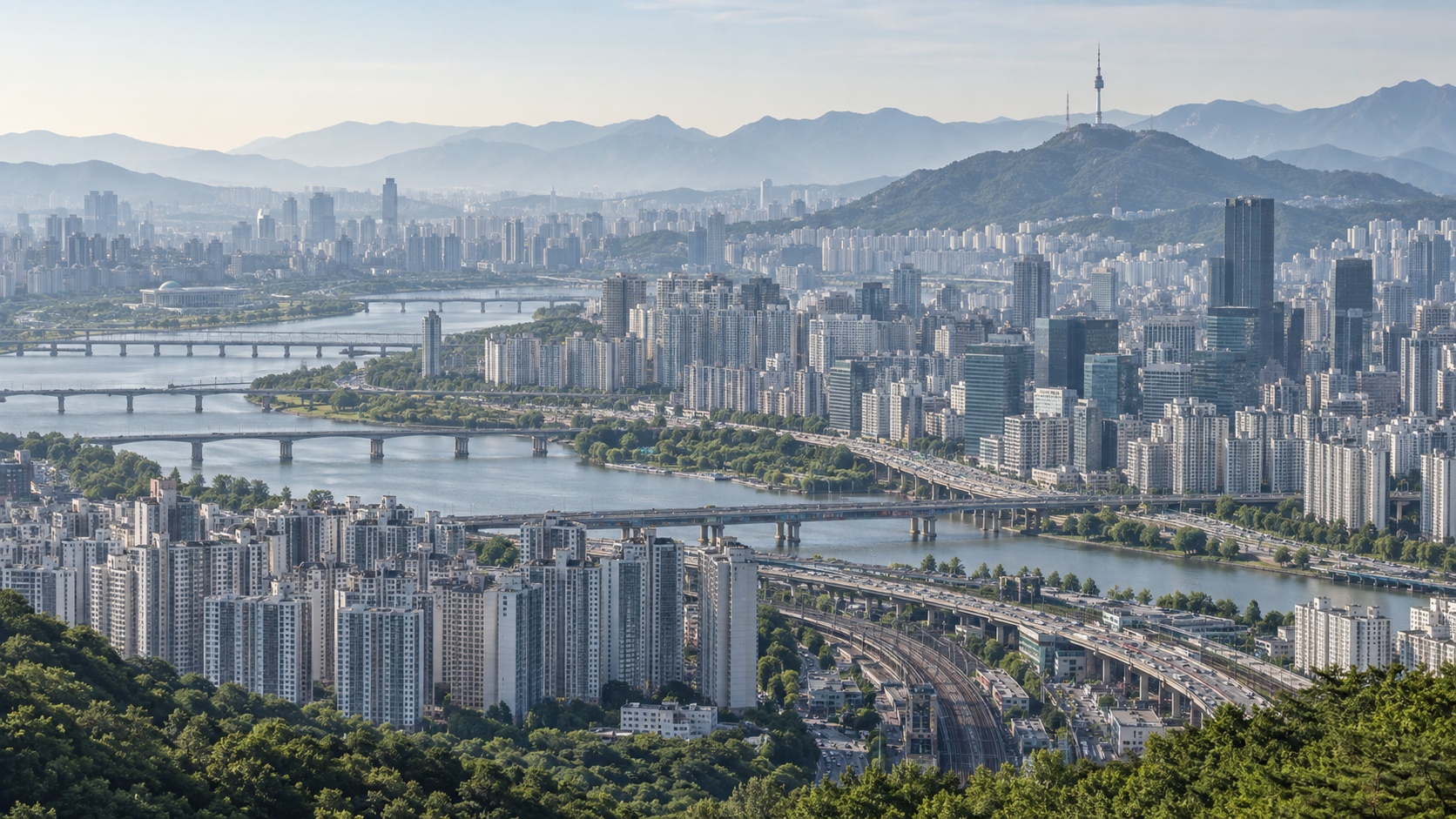
South Korea is concentrated in Seoul because political centralization, rapid industrialization and decades of investment placed high-value jobs, universities, transportation, healthcare and culture in the capital region. Those advantages now reinforce one another: people move toward opportunity, and organizations follow the people already there.
Here, Seoul concentration usually refers not only to Seoul city but to the wider Seoul Capital Area of Seoul, Incheon and Gyeonggi Province.
| Driver | Why it reinforces concentration |
|---|---|
| Jobs and headquarters | Workers gain access to more employers in the same field |
| Universities | Students arrive young and often begin careers nearby |
| Specialized services | Major hospitals, media and cultural institutions attract national demand |
| Transport networks | Lines converge on the capital and expand its commuting zone |
| Professional networks | Dense information and personal connections generate new opportunities |
How did Seoul become South Korea’s dominant center?
Seoul’s role as a political capital predates modern industrialization. After the Korean War, reconstruction and export-led growth accelerated urban migration. Government, finance and corporate decision-making clustered in the capital while factories and new residential districts expanded through the surrounding province.
This history matters because institutions leave a long shadow. Once leading universities, national media, ministries and headquarters are concentrated in one region, later industries can recruit workers and reach clients more easily by locating nearby.
Why do young Koreans continue to move toward Seoul?
The capital region offers a thicker labor market. A software engineer, designer or financial worker can change employers without necessarily changing region. Specialized workers also benefit from dense communities of clients, suppliers and peers.
Universities create an early pipeline. Students who move to the capital for education build friendships, internships and job-search networks there. The decision to stay after graduation is therefore not simply a preference for entertainment or convenience.
Statistics Korea’s Korean Social Trends 2024 found that since 2000, interregional migration has contributed more to population imbalance than differences in natural population change. This supports a crucial distinction: regional decline is not caused only by low birth rates. The movement of working-age people also changes where future births, jobs and services will occur.
Does better transportation reduce concentration?
Not automatically. Faster rail and roads can support regional firms and commuters, but they can also extend Seoul’s reach. A resident may live farther away while continuing to study, work, shop or seek medical care in the capital.
This is sometimes described as a two-way effect of connectivity. Transport can spread access, yet it can also allow the strongest center to capture more demand. The result depends on whether regional cities possess jobs and institutions that generate journeys of their own.
What are the benefits and costs of concentration?
Concentration can raise productivity by placing workers, firms and services close together. It also supports frequent transit, specialized hospitals, diverse cultural markets and rapid information exchange.
The costs are equally structural:
- Housing demand raises prices and pushes households into longer commutes.
- Regional universities and employers lose young people.
- Local services weaken as population and tax bases shrink.
- Families may delay housing, marriage or children while competing for metropolitan opportunity.
- National infrastructure must serve both an overcrowded center and depopulating regions.
These costs do not make every move to Seoul irrational. They emerge precisely because individual moves can be rational while the collective result is unbalanced.
Have Sejong and the innovation cities worked?
South Korea moved ministries to Sejong and relocated public institutions to designated innovation cities. These policies created jobs, housing and new administrative centers outside Seoul. They demonstrate that government can move organizations and generate local demand.
Their limitation is that relocating an institution does not instantly reproduce an ecosystem. A spouse’s career, a child’s education, suppliers and professional networks may remain in the capital. Evaluation should therefore distinguish success in moving public employment from the harder goal of building self-sustaining regional labor markets.
Can South Korea become less Seoul-centered?
Complete decentralization is unlikely, and weakening Seoul would not automatically strengthen other cities. A more realistic goal is to make regional centers independently viable.
That requires more than distributing buildings. Regional cities need combinations of universities, employers, healthcare, culture and transport that allow residents to make several life choices without returning to Seoul. The policy question is not where one office is located, but how many meaningful alternatives a person has within a region.
FAQ
Is half of South Korea’s population in Seoul?
The common claim refers to the wider capital area, not Seoul city alone. Any statistic should specify whether it covers Seoul, Incheon and Gyeonggi Province and state its reference year.
Why do Korean companies prefer Seoul?
Headquarters benefit from access to skilled workers, clients, finance, government and other firms. Once these networks are concentrated, proximity becomes self-reinforcing.
Did moving government offices to Sejong solve the problem?
It reduced the physical concentration of some government functions and created a new administrative city, but it did not by itself redistribute the broader private labor market and social networks.
Is Seoul concentration caused by low birth rates?
Low birth rates worsen regional decline, but migration is also central. Young adults moving away changes both the present workforce and where future households form.
A country needs more than one place to imagine a future
Seoul’s dominance is not maintained by a single policy. It is produced by overlapping systems that make the capital the safest place to search for the next opportunity. Sustainable decentralization therefore means building regional ecosystems, not merely asking individuals to make a sacrifice for balance.