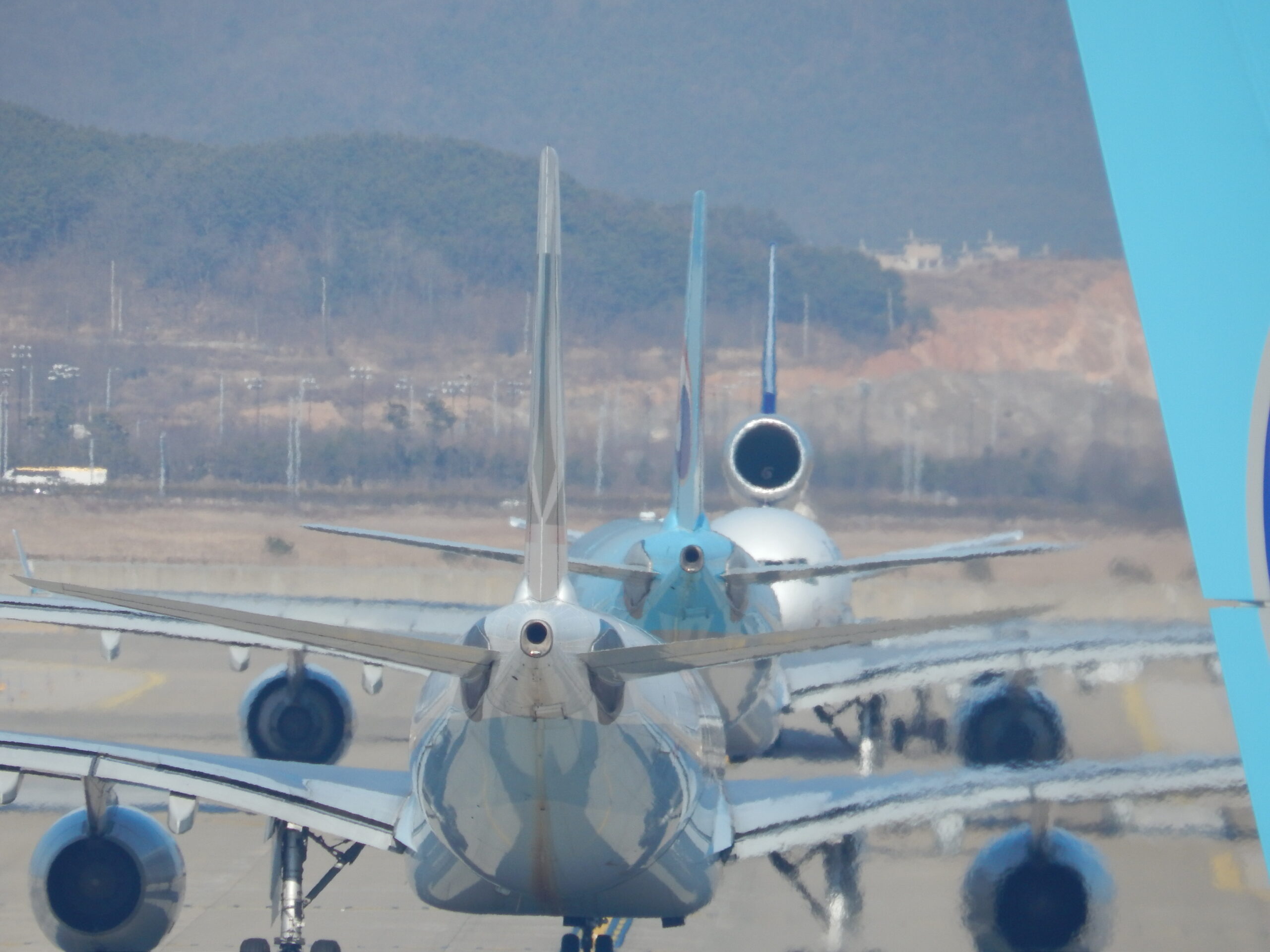
South Korea restricts flights so that aircraft noise cannot affect scores on the English listening section of its national university entrance exam. The Ministry of Land, Infrastructure and Transport issues the restriction in coordination with the Ministry of Education, and it covers a short window around the listening broadcast, not the whole day. For the most recent sitting, on 13 November 2025, all takeoffs and landings were suspended nationwide from 13:05 to 13:40, a total of 35 minutes. The next exam falls on 19 November 2026, and the ministry normally publishes that year’s notice only days in advance, so the figures below describe 2025 unless stated otherwise.
What exactly is restricted, and for how long?
The 35-minute window, 13:05 to 13:40, brackets the listening broadcast with roughly five minutes of margin on each side. Aircraft already in the air were not forced down. They had to hold at or above three kilometres of altitude, high enough that engine noise does not carry meaningfully to the ground. Helicopters, light aircraft and drones were included, emergency flights were exempt, and around 140 flights had schedules adjusted, 65 international and 75 domestic. The scope matters, because the story is often retold as Korea closing its airspace for a day. It does not.
What is the CSAT, and who runs it?
The exam is the 대학수학능력시험, shortened to 수능 and rendered in English as the College Scholastic Ability Test, or CSAT. It is one nationwide multiple-choice and short-answer examination, sat on a single day in November, covering Korean, mathematics, English, Korean history and electives in social studies, science or vocational tracks.
It is written, printed and scored by the 한국교육과정평가원, the Korea Institute for Curriculum and Evaluation, a government-funded institute that also produces the June and September national mock exams. Because the state owns the questions, the papers, the rooms and the scoring, it also owns the testing conditions. Equalising those conditions is not a favour to students. It is part of running the instrument.
The institute’s schedule sets the exam for Thursday, 19 November 2026, with results on 11 December 2026, a date the Ministry of Education confirmed in advance. Korean sources call it the 2027 학년도 exam because it governs admission for the 2027 academic year, even though it is sat in 2026, a label that routinely confuses English coverage.
Why does an English listening test require a national quiet period?
The English section is the third period of the day, running 13:10 to 14:20. Within it, 17 listening questions are broadcast over each school’s public address system during the first 25 minutes, so the audio ends at roughly 13:35.
Listening questions are played once. A student cannot re-read a sentence or return to it later. If a low-flying aircraft passes over one school during a question and nothing passes over another, the score difference reflects the flight path, not English ability. With 551,864 people registered for this year’s exam as of the institute’s 8 September 2026 results, uncontrolled noise would introduce variation that scoring cannot correct afterwards.
Test sites are ordinary schools, not purpose-built examination centres, and many sit under approach paths or near major roads. Controlling the outside is cheaper than soundproofing thirteen hundred buildings.
What else shuts down or shifts on CSAT day?
The aviation measure is one line in a cross-government package. The Ministry of Education reported its 2025 same-day plan to the cabinet on 21 October 2025, covering 554,174 candidates at 1,310 test sites across 85 districts. Reported elements included:
| Measure | Detail |
|---|---|
| Work start time | Offices and large employers asked to begin at 10:00, not 09:00 |
| Public transport | Extra Seoul-region metro services during morning entry |
| Traffic control | Vehicles barred from the final 200 metres before each site |
| Noise control | Construction, events, horns and loud vehicles restricted nearby |
| Military activity | Artillery firing and training suspended during the listening period |
| Police support | 10,475 officers and 2,238 patrol cars, including transport for delayed candidates |
| Financial markets | Korea Exchange opened at 10:00 and closed at 16:30 |
The legal force of these items differs sharply, a distinction usually lost in English reporting. The flight suspension is a binding directive to air traffic control. The 10:00 work start is a request for cooperation that many employers honour and some ignore. Treating them as one decree overstates how centrally commanded the day is.
Could a visitor’s flight to or from Korea be affected?
Yes, though the effect is usually modest: a short schedule shift rather than a cancellation, and only for flights touching a Korean airport in the early afternoon of exam day.
If you are travelling on 19 November 2026, check three things: your airline’s notification, since carriers contact affected passengers directly; the departures board of your airport operator, Incheon International Airport Corporation for ICN or Korea Airports Corporation for GMP, PUS, CJU and the regional airports; and the transport ministry’s press release for the year, which gives the exact window.
Ground travel deserves more attention than the flight. The morning entry period brings heavy congestion near schools, roads around test sites close to cars, and taxi demand spikes. Allow margin or use the metro.
Is the CSAT really the one exam that decides everything?
Less than it used to be, and this is where most English-language framing goes wrong. Korean admissions run through two tracks. 수시, or susi, is the early track, which weighs school records, essays, interviews, portfolios and recommendations. 정시, or jeongsi, is the regular track, where the CSAT score is dominant or decisive.
The Korea Council for University Education’s plan for the 2027 cycle allocates 277,583 of 345,717 total seats, or 80.3 percent, to susi, and 68,134 seats, or 19.7 percent, to jeongsi. That is the first time the susi share has passed 80 percent since the current exam format began. The split is uneven: universities outside the capital region fill 89.5 percent of seats through susi, capital-region universities 65.8 percent, and the sixteen most selective Seoul universities still fill 43.4 percent through jeongsi.
One qualification keeps this from being a clean refutation. Many susi tracks impose a 수능 최저학력기준, a minimum CSAT score an applicant must clear regardless of their school record, so the exam remains a gate even in the early track. That requirement is receding at the top: a Jongro Academy analysis of 10 May 2026 found 40.1 percent of general susi places at Seoul National, Yonsei and Korea universities carried no CSAT minimum in the 2027 cycle, rising to 57.8 percent in 2028.
Do the restrictions actually make admissions fairer?
The case in favour is strong on its own terms. A student in a rural county should not be disadvantaged relative to one in Gangnam because of where the flight paths run. Standardised measurement only works if the measurement environment is standardised, and the state issuing the score is the obvious party to guarantee it.
The case against is not that the measures are unreasonable but that they are narrow. Conditions are equalised for 35 minutes. The years before are not, and private tutoring, study space, quiet housing and parental availability vary enormously by household income. A system can deliver a perfectly fair morning on top of a deeply unequal preparation period, and the fairness of the morning can make the inequality harder to see.
There is also a reflexive cost: reorganising a national calendar around one exam signals that the exam deserves it, which strengthens the belief sustaining the arrangement. Defenders counter that the CSAT’s main virtue is its resistance to manipulation, and that where trust in subjective evaluation is low, a blunt standardised test is the most defensible gate available.
FAQ
When is the next Korean CSAT, and when is the English listening section?
The exam is on Thursday, 19 November 2026, for admission to the 2027 academic year. The English section runs from 13:10 to 14:20, with the 17 listening questions broadcast during the first 25 minutes, ending at about 13:35.
Are all flights in Korea grounded on CSAT day?
No. For the 2025 sitting the suspension lasted 35 minutes, from 13:05 to 13:40. Outside that window airports operate normally.
What happens to planes already flying?
They continue, but must remain at or above three kilometres of altitude during the window so that engine noise does not reach test sites.
How many students take the CSAT?
For the 19 November 2026 exam, 551,864 people registered: 355,391 current high school seniors, 173,706 graduates retaking the test, and 22,767 equivalency-route candidates.
A short measure attached to a large question
The direct reason Korea restricts flights during the CSAT is narrow and technical: a listening test played once cannot tolerate uncontrolled noise, and the state that issues the score owns the conditions under which it is earned. The reason it becomes international news is wider. A country willing to spend real coordination guaranteeing identical conditions for half a million people on one morning invites the question of how far that guarantee extends backward into the years before.
Related reading
- How Does the Korean Age System Work After the 2023 Reform?
- Why Are Some Young South Koreans Delaying or Opting Out of Marriage?
Sources and further reading
- Korea Institute for Curriculum and Evaluation: CSAT date and timetable
- Korea Institute for Curriculum and Evaluation: 2027 CSAT registration results, 8 September 2026
- Ministry of Education: 2027 CSAT to be held on 19 November 2026
- Ministry of Education: exam date and score release date, with exam structure
- Ministry of Land, Infrastructure and Transport flight suspension for the 13 November 2025 sitting, as reported by Kyunghyang Shinmun
- Ministry of Education: same-day support package reported to the cabinet, 21 October 2025
- Policy briefing: traffic, noise and weather measures on exam day
- Korea Exchange delayed market opening on exam day
- Police deployment and patrol-car transport for delayed candidates
- Korea Council for University Education: 2027 admissions plan, susi and jeongsi shares
- Jongro Academy analysis of CSAT minimum requirements at selective universities, 10 May 2026
Photo: ICN Departures by G B_NZ, via Wikimedia Commons, licensed under CC BY-SA 2.0. Resized automatically by WordPress; image remains licensed under CC BY-SA 2.0. Illustrative airport photo, not taken during the CSAT.
