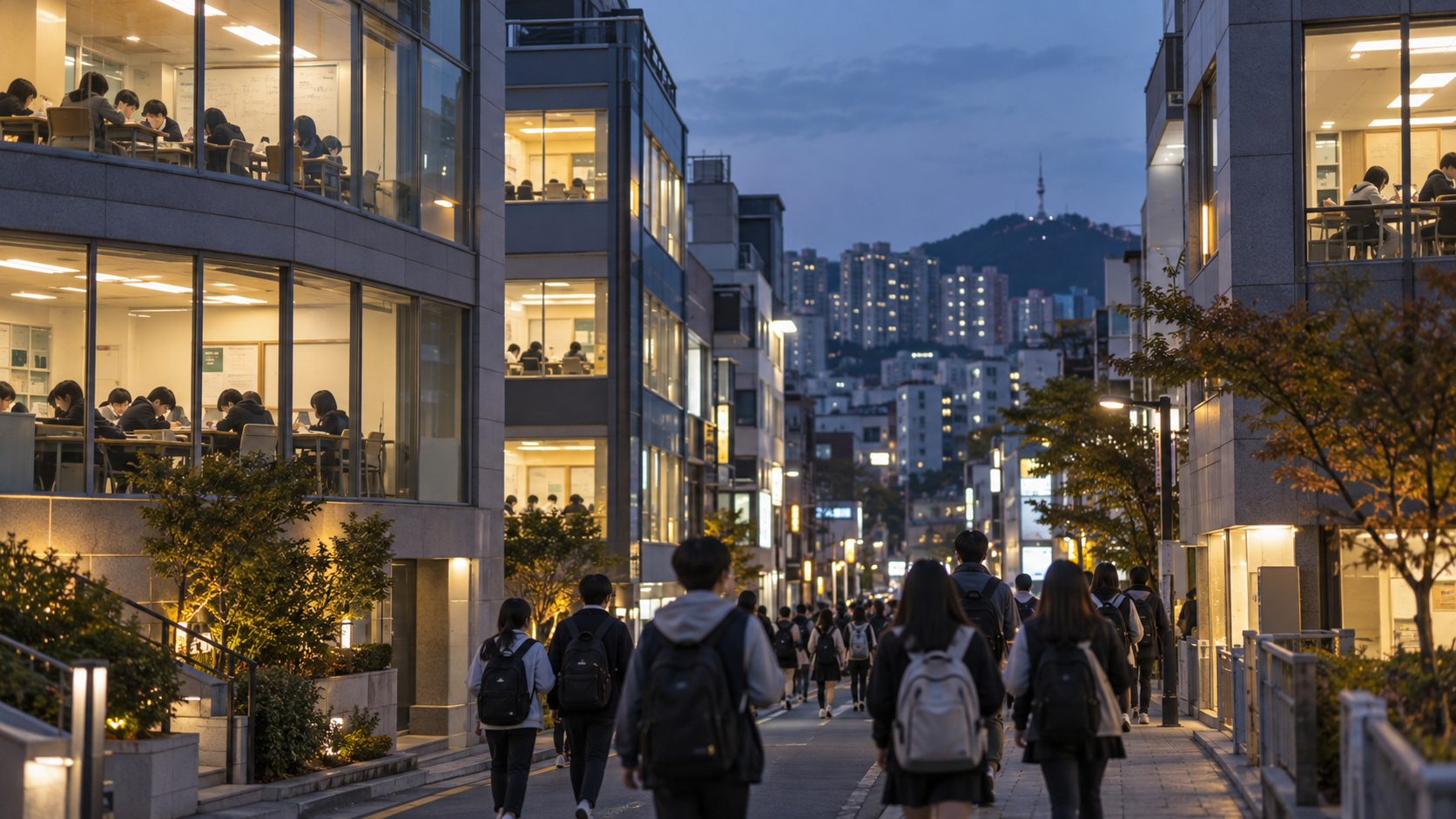
Hagwons are popular in South Korea because families believe private instruction can improve performance in a competitive education system where grades, entrance exams and university reputation may shape later opportunities. They also provide childcare, enrichment and specialized teaching, so not every hagwon serves the same purpose.
| Driver | How it creates demand |
|---|---|
| Competitive admissions | Families seek preparation beyond the school curriculum |
| Peer participation | Opting out feels risky when classmates study ahead |
| Labor-market signaling | Selective universities are perceived as pathways to stronger first jobs |
| Working parents | Academies also fill after-school time |
| Unequal resources | Affluent families can purchase more intensive preparation |
What is a hagwon?
A hagwon is a privately operated academy. The category includes exam-preparation institutes, subject tutoring, foreign-language schools and academies for music, art, sports and coding. It should not be translated simply as a cram school because many serve younger children or teach non-exam subjects.
Hagwons operate alongside public schools rather than replacing them. For many students, the school day is followed by a second sequence of classes in the afternoon or evening.
How widespread is private education in Korea?
The 2024 Private Education Expenditures Survey, produced by Statistics Korea and the Ministry of Education, estimated total private-education spending for elementary, middle and high school students at 29.2 trillion won. The participation rate was 80.0 percent, and participating students spent an average of 592,000 won per month.
The survey also reported that the student population fell from 5.21 million in 2023 to 5.13 million in 2024 while total spending increased 7.7 percent. These figures cover surveyed private education for school-age students, not every adult academy or informal lesson in Korea.
Why is public school not considered enough?
Public schools must teach a broad range of students and cannot organize every lesson around one family’s preferred university strategy. Hagwons can group students by level, move ahead of the official curriculum and specialize in particular exams.
This creates a coordination problem. Even parents satisfied with public school may worry when other children receive additional preparation. Participation becomes defensive: families pay not only to move ahead but to avoid being left behind.
How do university admissions sustain hagwon demand?
Korean university admissions combine standardized testing, school records and other pathways. The exact rules change, but uncertainty itself can support a consulting and preparation market. Families seek help interpreting requirements as well as teaching content.
Selective university names are widely believed to influence access to prestigious first jobs and social networks. The effect varies by occupation and individual, so it should not be treated as destiny. Yet the perceived stakes are high enough to shape family behavior years before an application is filed.
Why has spending risen despite low birth rates?
Fewer students do not necessarily mean less spending. Families may concentrate more money and attention on each child. Competition for selective places also remains even when the overall number of children falls.
Statistics Korea’s Korean Social Trends 2025 notes that total private-education spending rose from 17.8 trillion won in 2015 to 29.2 trillion won in 2024. The trend reflects prices, participation and spending intensity, not simply the number of students.
Does every Korean student attend a hagwon for the same reason?
No. Families use hagwons for exam preparation, basic support, childcare, social activity and arts or sports. Motivation also differs by age, region and income.
The national participation rate should not erase inequality. A wealthy household can purchase elite instructors and multiple subjects. Another family may use one local academy because parents work late. A third may opt out entirely.
Have attempts to regulate private education worked?
Korean governments have repeatedly regulated tuition, operating hours and advance learning. Regulation can limit particular practices, but it does not remove the underlying demand created by competition and unequal access to desirable schools and jobs.
When formal hagwons are restricted, demand may move to private tutoring, online courses or less visible services. Durable reform therefore requires attention to the incentives surrounding admissions and employment, not only the academies themselves.
Will online learning and AI replace hagwons?
Digital tools can make instruction cheaper and more personalized. They may weaken some large lecture businesses, while strengthening platforms that provide testing, feedback and planning.
Technology changes delivery more easily than motivation. If families still believe small performance differences have large consequences, they will use new tools to compete rather than stop competing.
FAQ
What does hagwon mean in English?
It means a private academy. Depending on the program, it may resemble a tutoring center, language school, arts academy or exam-preparation institute.
How much do Korean families spend on private education?
The 2024 national survey estimated 29.2 trillion won in total spending for elementary, middle and high school students. Average monthly spending among participating students was 592,000 won.
Do Korean students attend hagwon every night?
Schedules vary widely. The national survey reported an average of 7.6 weekly participation hours across students in 2024, but individual students may attend much more or not at all.
Are hagwons only for the CSAT?
No. The CSAT university entrance exam is important, but hagwons also teach school subjects, languages, arts, sports, coding and other activities.
Hagwon is a system, not a personality trait
Private education in Korea is often explained through cultural enthusiasm for learning. That matters, but it is incomplete. Hagwons persist because families respond to a competitive selection system with the resources available to them. The second school system will remain powerful while opting out feels like a private risk.